Saturday, November 23, 2013
Saturday Salon: The bright, tantalizingly weird and stylized world of Robert LaDuke
I love Robert LaDuke's paintings even if sometimes I'm thinking 'what on earth does this man mean by this?' That's half the fun.
I suppose this is an art deco type style, if it must be categorized. I'm taken by the flatness, the odd perspectives, the bright colors, behind the stylized stillness, the almost constant sense of desperate motion, the occasionally bizarre situations and even the portents of disaster. There's something excruciatingly silent about Robert Laduke's world - I simply can't imagine what music might accompany it. Or for that matter, what actual noises. Everything that is happening I'm imagining happening in total silence. Even those plane and cars falling out of the sky. But I don't seem to mind it. That's the odd effect the work has on me.
I couldn't find much biography of the artist, except that he was born in 1961 in Massachusetts and attended the Art Institute of Chicago. I wish there were more. If you find any, please let me know so I can update.
Link to see more of Robert LaDuke's work here and here.
Fortunately many of the paintings are available as posters online.
I've culled the paintings in my post from various sources online in the interest of education, enlightenment and just the sheer joy of sharing art that I love. All the paintings are copyrighted by Robert LaDuke and no infringement is intended.
Friday, November 22, 2013
J.F.K. - 50th Anniversary
John Fitzgerald Kennedy (1917 - 1963), 35th President of the United States
Portrait by Aaron Shikler
Today, November 22nd, is the 50th Anniversary of that dreadful day in Dallas, Texas, when a gunman destroyed not only a President and his presidency but any remaining traces of innocence my generation might have harbored. The death of a young President, happening so horribly, was the very last thing any of us would have ever envisioned. It was not only the shock, you see, it was the idea; if a President could be gotten at, than who on earth was safe? The world was suddenly turned topsy-turvy in a most terrible, unexpected way.
Gone in the shock of a few moments was the 'Camelot' of our dreams, the soft-spoken elegant wife - no longer the First Lady, those adorable children we'd become so fond of, the dogs, the ponies, the vigorous Kennedy clan coming and going at the White House, the very idea of an exuberant America on the brink of something grand.
How could this happen? No wonder an anguished Walter Cronkite (the most respected television newsman in America) cried on the air. This was an event that defied the imagination.
Fifty years later, it was just yesterday. A few days ago.
I still occasionally ask: how could this happen?
I was startled recently when standing on line at the supermarket, I happened to glance at the front page of a tabloid flashing autopsy photos of President Kennedy. My initial reaction was outrage. It still is. What has happened to us? How can it be that so many think nothing of such a deviant invasion of privacy? The plundering of a murdered man's dignity.
Along with assorted groceries, breath mints, potato chips and pictures of dim-witted celebrities, you're welcome to look at photos of a President's corpse.
Fifty years later.
How could this happen?
Watching the funeral in a shop window.
Chicago, November 1963
Tuesday, November 19, 2013
Tuesday's Forgotten (or Overlooked) Film: DADDY LONG-LEGS (1955) starring Fred Astaire and Leslie Caron.
Let me say going in that I've never found Leslie Caron a scintillating screen presence except for maybe, in GIGI. So there's that to consider. But I can see Fred falling for her French bubbly effervescence - why not. He's an old guy, she's young and vibrant. There's that accent AND she really, really knows how to dance. Plus she's awfully cute. What more could any man want?
And I know that there are MANY people who think Fred was just too old for this role - I've even heard that some people find the whole thing creepy. I don't, but then far as I'm concerned Fred was ageless. But let's not dwell on the reality, ladies and gents. This is a movie. A musical. In Technicolor. It's Fred Astaire. Honestly, who cares how old he really was? It's make-believe!
I'll tell you a secret, I found Gene Kelly much more objectionable (age-wise) opposite Caron in AN AMERICAN IN PARIS. But that's just me.
DADDY LONG-LEGS (1955) is a film directed by Jean Negulesco with a screenplay by Phoebe Ephron and Henry Ephron based on the wonderful (maybe even legendary) epistolary novel of the same name by Jean Webster. Read more about that version on my earlier blog post here.
As with most adaptations of novels, the movie takes liberties, but that's to be expected. For instance, in the book, the young American waif is named Jerusha 'Judy' Abbott. But since Caron is so obviously French, her name was changed to Julie Andre and she becomes a waif in an orphanage in the French countryside.
Traveling in France, Jervis Pendleton III (Fred Astaire) a fabulously wealthy businessman, stops off at an orphanage which he sponsors. He spots a charming young girl, Julie Anders (Leslie Caron) and decides to underwrite her education in the states. To that end, Julie shortly gets shipped off to a college in New England where her roommate and friend will be (coincidentally) Jervis's niece, Linda (Terry Moore). (Not that Julie knows about the family connection. She has no idea that Jervis is 'her' Daddy Long-Legs.)
You know how girls's colleges were depicted in movies once upon a time: fun, fun, and more fun. Sweater-sets, plaid skirts, saddle shoes, singing, dancing, the students all perky and bright-eyed and looking to connect with husband material. (There's a male college conveniently near by.)
At the orphanage, Julie's only glimpse of Jervis had been of his shadow - just enough to capture her imagination. He is tall and thin with long legs, hence the moniker 'Daddy Long-Legs'. But she is told by the orphanage administrator that she and her benefactor will never meet, that is one of the scholarship's provisos.
Jervis worries that if anyone found out he was sponsoring a lovely young girl, gossip might be hurtful not only to her but to his corporate dealings - Jervis is a hard headed business man first and foremost. He has no interest in friendship with his new ward. In fact, before too long he forgets about her.
Julie, however, has been told she must write to her mysterious sponsor and let him know of her life at school but she must not expect any replies to her letters. Huh?
I don't know about you, but that seems just the teensiest bit off-putting to me. But hey, she's getting a scholarship and a chance to have a better life, so why not. Besides she doesn't really believe he actually means not to respond to her letters.
But as the years pass and she writes her 'Dear Daddy Long-Legs' letters to Jervis - letters which he doesn't even bother to open - she finally realizes that her guardian did, indeed, mean what he said. Though that doesn't stop her continuing to write and unburdening herself to him. She is, after all, very grateful for this chance at a new life, not to mention his continued generosity.
When over time Jervis's gruff secretary, Alicia Pritchard (the wonderful Thelma Ritter) reads some of Julie's letters, she is so touched, she begins to chide her boss for not responding. Even Jervis's equally gruff associate Griggs (the equally wonderful Fred Clark), eventually gets in on the notion. Life is more than just about business, Miss Pritchard insists, to Jervis's surprise. Really? At the very least, he decides to read a letter or two.
Despite his inclination to keep ignoring the young girl he's uprooted and installed in a state-side school, Jervis decides - finally - to check up on her. Yes, he is touched by her letters too. He will drop in at the school to visit his niece Linda never admitting to Julie - whom he meets and is again enchanted by (in the way that only a younger woman seems able to enchant an older man) - who he really is.
Once they dance together (Sluefoot!), of course, it's all over but the wedding invitations. But that's a little later in the story. First Julie and Linda (who can easily see that her uncle dotes on Julie) travel to NYC on school break while Jervis tries to figure out how to tell Julie who is and Julie, smart girl that she is, begins to suspect.
It's all happily ever after of course, and even if we all know (including Jervis) that he's too old for Julie, it doesn't seem to matter much - love will find a way. It's only thirty or so years difference after all.
Several terrific songs and dances later, all's well that ends well. You know how that goes.
Don't forget to check in at Todd Mason's site, Sweet Freedom, to see what other films and/or audio visuals other bloggers are talking about today.
Sunday, November 17, 2013
Sunday Salon: New York Cityscapes
American Impressionist Colin Campbell Cooper (1856 - 1937) 'Hudson River'
Contemporary American painter Anne Bascove (b. 1946 - )
Canadian-American Impressionist/Realist Ernest Lawson (1873 - 1939)
Spanish painter Joaquin Sorolla y Bastida (1863 - 1923) 'New York City Marathon'
American Illustrator Leonard Weisgard (1916 - 2000)
American Realist and 'Ashcan School' Painter John French Sloane (1871 - 1951) 'Woman's Work'
American Contemporary painter Francis Livingston
American landscape painter Guy Wiggins (1883 - 1962)
American Impressionist Colin Campbell Cooper (1856 - 1937) 'Chatham Square'
American Social Realist painter Reginald Marsh (1898 - 1954)
American Contemporary painter Eric Drooker
American Impressionist Childe Hassam (1859 - 1935) 'Lower Manhattan'
American Modernist painter Georgia O'Keefe (1887 - 1986) 'New York at Night'
American illustrator Mary Petty (1899 - 1976) (illust. for a New Yorker cover)
American Realist painter Edward Hopper (1882 - 1967) 'Riding in the Park'
American Realist and 'Ashcan School' painter John French Sloan (1871 - 1951
American Contemporary painter Stephen Magsis '108 Franklin Street'
American Realist and 'Ashcan School' painter George Luks (1867 - 1933) 'Bleeker and Carmine Streets'
American illustrator Arthur Getz (1913 - 1996)
American Realist and 'Ashcan School' painter George Bellows (1882 - 1925) 'Cliff Dwellers'
American Contemporary painter Christine LaFuente
French illustrator Jean Jacques Sempe (b. 1932 - )
American Realist and 'Ashcan School' painter John French Sloan (1871 - 1951) 'Cornelia Street'
American Contemporary painter and illustrator Owen Smith (New Yorker cover 2006)
New York is central to my happiness even if I haven't been there in a while - I grew up in Manhattan, the city has a habit of latching onto your heart forever. Though I rarely get a chance to visit much anymore, in my own mind, I'm still a New Yorker and always will be.
At this holiday time of year, especially, the city glows in a special way.
So it's not at all remarkable to me how many artists have tried to capture the city in their work. The place is, after all, a magical sort of kingdom.
American Impressionist Colin Campbell Cooper (1856 - 1937) 'South Ferry'
Researching more of Cooper, I found this wonderful painting showcasing South Ferry, an area on the tip of Manhattan, very familiar to me growing up. I lived just about four or five blocks away and here's where we used to walk to take the ferry to Staten Island in the summer to go swimming or later, to ride horseback.
Contemporary American painter Anne Bascove (b. 1946 - )
Canadian-American Impressionist/Realist Ernest Lawson (1873 - 1939)
American Illustrator Leonard Weisgard (1916 - 2000)
American Realist and 'Ashcan School' Painter John French Sloane (1871 - 1951) 'Woman's Work'
American Contemporary painter Francis Livingston
American landscape painter Guy Wiggins (1883 - 1962)
American Impressionist Colin Campbell Cooper (1856 - 1937) 'Chatham Square'
American Social Realist painter Reginald Marsh (1898 - 1954)
American Contemporary painter Eric Drooker
American Modernist painter Georgia O'Keefe (1887 - 1986) 'New York at Night'
American illustrator Mary Petty (1899 - 1976) (illust. for a New Yorker cover)
American Realist painter Edward Hopper (1882 - 1967) 'Riding in the Park'
American Realist and 'Ashcan School' painter John French Sloan (1871 - 1951
American Contemporary painter Stephen Magsis '108 Franklin Street'
American Realist and 'Ashcan School' painter George Luks (1867 - 1933) 'Bleeker and Carmine Streets'
American illustrator Arthur Getz (1913 - 1996)
American Realist and 'Ashcan School' painter George Bellows (1882 - 1925) 'Cliff Dwellers'
American Contemporary painter Christine LaFuente
French illustrator Jean Jacques Sempe (b. 1932 - )
New York is central to my happiness even if I haven't been there in a while - I grew up in Manhattan, the city has a habit of latching onto your heart forever. Though I rarely get a chance to visit much anymore, in my own mind, I'm still a New Yorker and always will be.
At this holiday time of year, especially, the city glows in a special way.
So it's not at all remarkable to me how many artists have tried to capture the city in their work. The place is, after all, a magical sort of kingdom.
American Impressionist Colin Campbell Cooper (1856 - 1937) 'South Ferry'
Researching more of Cooper, I found this wonderful painting showcasing South Ferry, an area on the tip of Manhattan, very familiar to me growing up. I lived just about four or five blocks away and here's where we used to walk to take the ferry to Staten Island in the summer to go swimming or later, to ride horseback.
Friday, November 15, 2013
Friday's Forgotten (or Overlooked) Books: FOR OLD CRIME'S SAKE (1959) by Delano Ames
Yes, yes, I know I've been lauding Delano Ames lately as the next best thing to chocolate, but bear with me. I'm smitten. I must laud while the lauding is good.
FOR OLD CRIME'S SAKE published in 1959 is yet another delightful vacation book - another wild and wacky holiday with those insouciant amateur detectives Dagobert and Jane Brown. This time we're off to Tabarca (?!) a small island in the Mediterranean where a grumbling Jane has won (with Dagobert's help) an all expenses (more or less) paid trip.
Jane's grumbling is the result of her reluctance to go anywhere near Tabarca. To her, the whole escorted trip in the company of six other contest winners and an officiously jovial host (sort of like a sheep-herder, but with people) who refers to himself in the third person, sounds like a nightmare.
Turns out Jane was right.
But let's back up a bit. We open in London where Dagobert and Jane are, as usual, discussing economics.
'Dagobert was deeply moved when my premium bond drew a fifty-pound bonus. Money so simply come by opened up new vistas. Far too many people, he decided, underrate money; and to acquire more of it momentarily displaced his current passion for Mudejar architecture.
Knowing my husband's aptitude for getting what he wants, I stirred expectantly. He grew pensive, giving the problem fuller consideration. In an effort to be helpful I said that some people made money by going to work. Dagobert who is always open to fresh ideas at once went out and bought the morning papers.
I plied him with coffee as he ran a hopeful eye down the Situations Vacant column.
"There are all sorts of things," he said in surprise. "The Government of Nigeria, for instance, is looking for a driller. Or, nearer home in Slough, Tracers and Estimators are urgently required. Bee-keepers...no, it's book-keepers. Coffin maker...
"No," he said, "You'd hate that."
"What?"
"Previous training unnecessary, good pay while you learn, rapid advancement - for intelligent young woman."
He turned the page before I could see it. 'We mustn't rush these things," he said, feeling that enough had been done for one morning. "It may take a day or two."
As these sorts of things will, the aforementioned fifty pounds detours into a 'let's take a trip' mode. But fifty pounds isn't much when gamboling abroad. Dagobert's new idea is that he and Jane should enter numerous competitions (contests) and win themselves a trip or two or at the very least 'double their income' (as a contest in The Daily Sketch promises). Soon Dagobert is furiously 'at work' signing up for as many competitions as he can find while Jane goes out to buy new shoes.
When I returned late that afternoon, he was still hard at it. The place was strewn with magazines and papers. He had forgotten lunch and smoked two packets of cigarettes. He had worked out that by winning, say, only a quarter of the competitions he had already entered our earnings would be in the region of a hundred thousand pounds.
I know what you're thinking, but all is not lost. They do, improbably, win the Grand Prize offering of a trip to the island of Tabarca, Europe's tiniest Principality. (Or at least Jane wins the contest. Dagobert forged her name on the entry since obviously, he couldn't enter everything under his own name.)
According to the newspapers, Tabarca has recently been bought (along with all feudal rights) by Henry Howard Hutton Jr. a 'pulled up by his bootstraps' millionaire; the island will be the setting for his lavish wedding to Princess Juana of royal Tabarcan lineage.
In fact, the contest has been spawned - as a way of promoting the island paradise and attracting publicity and tourist dollars - by 'Home Truth' a local gossip rag, controlling interest recently purchased by Hutton Jr.
Jane doesn't want to go. She is non-plussed at being chosen one of the 'Lucky Seven' contest winners. (An assorted motley group.) The trip doesn't sound like her sort of thing at all. Especially since it means leaving Dagobert behind (no spouses allowed) to the tender mercies of a married neighbor with an eager eye and the same egregious taste in music.
But 'but me no buts', Jane is soon off to Tabarca.
Following the storm-tossed, choppy-waved channel crossing from hell - everyone is agonizingly sea sick and relegated to their cubby-hole cabins - the Lucky Seven discover that they are one contest winner short. They are now the 'lucky' six, one of them has disappeared. But their tour guide Bobby Marcovitch, after an initial panic attack, insists that the disappearance shouldn't throw a damper on the proceedings.
The rest of the trip goes downhill from there.
But with Dagobert and Jane, there's never a dull moment as mistaken identities, red herrings, murder, blackmail. revenge, a broken engagement, not to mention the threat of capital punishment by hanging, add their own flavor to a murderously boisterous Mediterranean holiday, culminating in enough over-the-top Tabarcan island festivities to rival the royal wedding in Monaco. Phew!
Oh yes, Dagobert catches up to Jane, not to worry. My favorite moment in the book is when the group (the women wearing borrowed mink coats - a perk for the trip only - supplied by the contest host) is driven to their hotel (before embarking on a boat to the actual island) and Jane glances out the car window. She spies a motorcycle following them and without any hint of a qualm, she realizes that - somehow - it's Dagobert all the way from London. She pretends not to notice.
I hate to use the word 'romp' but this is exactly what Delano Ames delivers in FOR OLD CRIME'S SAKE.
I love this sort of thing when it's done well and Delano Ames (1906 - 1987) did it better than most.
Don't forget to check in at Patti Abbott's blog, Pattinase, to see what other Forgotten (or Overlooked) Books other bloggers are talking about today.
Tuesday, November 12, 2013
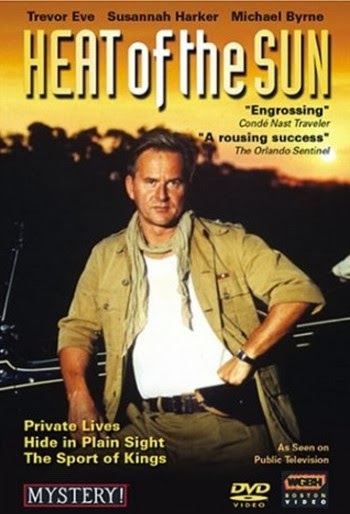
Tuesday's Overlooked (or Forgotten) Film: HEAT OF THE SUN (1998), a BBC television mystery mini-series starring Trevor Eve
I first saw this mini-series way back when and never forgot it - sort of - which is saying a lot for me as some of you may know. Oh I couldn't remember details, but I did know who starred in it. (That's something.) So I decided to take a second look and write it up for our weekly meme. Don't forget to check in at Todd's blog, Sweet Freedom, to check out what other films and/or audio/visuals other bloggers are talking about today. Glad to see Todd back at the helm.
I love it when a series is just as good the second or third time around as it was in the beginning. Such is the case with the wonderful HEAT OF THE SUN, a 1998 BBC mini-series featured on PBS 'Mystery' a few years ago. The show is set in Colonial Kenya ( filmed entirely on location in modern day Zimbabwe) during the 1930's: the era of 'white mischief', when the English sported and debauched in the jungle, making life hell for the locals, not to mention the animals shot dead for no reason other than because they're there. I'm the biggest Anglophile around, but even I have to say that these were not terribly nice people.
Ah, but into the fray comes our hero, Superintendent Albert Tyburn, played with zest and appeal by Trevor Eve. Yes, he's English too, but he's a good guy with morals and a standard of decency which seems out of sync with the rest of the dissolute English crowd - well, most of 'em anyway. He cares what happens to the natives and other locals. He has no tendency to look the other way while the 'natives' police themselves.
Trevor Eve is rugged, unflinching, pugnacious and some would say 'heavy-handed' when it comes to dealing with bad guys - but surrounded, as he is, by impervious, bigoted, upper class twits, one can hardly blame the man. He is a bull in a china shop and has a grand old time blazing a trail through the outraged sensibilities of local 'Happy Valley' British castaways.
His boss is Police Commissioner Ronald Burkitt played by the wonderful Michael Byrne, as a pompous, stiff-necked, loud mouth who shows Tyburn no respect and keeps insisting that the reluctant Superintendent wear an uniform - something that Tyburn has no intention of doing except when absolutely, positively necessary - which isn't often.
"There are no medals to be won here," Burkitt admonishes Tyburn with a sniff and a sneer upon their first meeting. It's obvious the commish has heard of Tyburn's work back in London where Tyburn's lone wolf status, while productive, didn't make him many friends.
Susannah Harker of PRIDE AND PREJUDICE fame (she was Miss Jane Bennett in the BBC production with Colin Firth) plays Emma Fitzgerald, a pragmatic young woman with a gentle demeanor; she's a pilot with her own plane and a sister who is the murder victim in the first episode. If you didn't see it coming, Emma will eventually become Tyburn's love interest.
Tyburn is a disgraced Scotland Yard man sent to Colonial Kenya to sort out crime among the local gentry, a job he takes seriously though not without a wicked gleam in his eye.
In the episode entitled, Hide In Plain Sight, Tyburn is joined by Julian Rhind-Tutt as his second-in-command, sharp shooting assistant Superintendent James Valentine (of good Devonshire stock). The young man is competent, clever and cut from the same cloth as the loose cannon (Tyburn) he comes to admire. Valentine, however, does wear his police uniform.
One of my other favorites in the cast is David Horovitch as Dr. Emil Mueller the local doctor whom Tyburn turns to when an autopsies and assorted bullet removals are required, despite the outrage of his superior who exclaims, "But he's a Jew!"
There are all sorts of delicious, colorful doings as one would expect from hedonistic ex-pats (most hiding ugly secrets) living far away from home. There are many ways to ease the boredom: alcohol, drugs, blackmail, adultery, kidnapping, murder and the usual whatnots. Lots to keep Superintendent Tyburn busy - at one point he even has a curse put on him by a witch doctor - that never happened back in London.
If you want all the details about each individual episode (there are three broken up into five segments), then please link to the PBS Mystery website where everything will be revealed.
All I'll add is this: Don't miss this terrific mini-series which is currently available (hooray!) for streaming on Netflix.
Sunday, November 10, 2013
Veterans Day Weekend
'Disabled Veteran' by Norman Rockwell
If we're free to celebrate Veteran's Day it is because of those who served and did their duty.
Friday, November 8, 2013
Friday's Forgotten (or Overlooked) Book: MURDER ON THE BLACKBOARD (1932) by Stuart Palmer
This is the first Miss Withers mystery I've read - or at least that's what memory tells me. Many thanks go out to my good blogging friend Bev at My Reader's Block for her generosity in making the book available to me.
Amateur sleuth Hildegarde Withers is a 'spinster' school teacher with a devious mind - perfect for solving crimes - and a take no prisoners attitude. The children in her charge tremble before her acerbic wit and 'rules are rules' form of teaching - nothing gets by this eagle-eyed lady of a certain age.
Miss Withers also happens to be the smartest detective in New York although she is not a member of the NYC police department. She is an amateur who likes to stick her nose into crime when she gets a chance. And since her best friend happens to be curmudgeonly Detective Inspector Oscar Piper of the NYPD, she gets more chances than most. It is an odd coincidence, but murder just seems to happen in the vicinity of Hildegarde Withers and she is only too eager to solve the mystery, with Inspector Piper along for the ride of course.
This time out, it's murder in the school room when a young teacher is killed in class after hours and Miss Withers stumbles across the body. But by the time Piper and the cops appear, the corpse has vanished. Since Withers was watching the only viable entrance, she reasons that the killer must still be hiding inside and the search begins.
Who knew that a school building after hours could be so sinister? The author has a knack for making an everyday building usually full of teachers and chattering kids, seem dark and menacing, a nice macabre touch.
Hardly has the search been concluded when in the school's basement, Inspector Piper is knocked out with a shovel and must be rushed to the hospital in critical condition. Miss Withers is left on her own (surrounded by inefficient cops) to hunt for clues and solve the mystery.
But the wily killer has apparently escaped through a fire exit (setting off the alarm) after further search in the basement turns up the charred remains of a body in the school's furnace. The janitor, found drunk in the dark recesses of that same basement, seems the most likely suspect (despite the fire alarm). But Miss Withers is doubtful.
There are many questions and no easy answers. As the back cover on my vintage paperback states:
What does the music scrawled on the blackboard mean?
Where was the murdered woman getting her scotch?
Why is her roommate hiding a pistol?
Who's collecting ladies' shoes?
I'd add:
Why was the janitor not found during the first search of the school building?
Who set off the fire alarm?
What about that surly guy running a candy store across the street?
Whose body is it in the furnace?
What about that Irish Sweepstakes ticket?
Where is the missing shoe?
Will the hapless young cop find true love with one of the suspects?
There are many red herrings to wade through in this cozy but fast-paced whodunit, since the author seems inordinately fond of leading the reader up the garden path. No real 'fair play' here, as a couple of the clues are not explained well enough so that they make real sense. But in the end, most all is revealed - in the great tradition of the Golden Age mystery - by Miss Withers, to the required roomful of suspects.
By the way, my vintage copy of the book features the same cover as depicted in this post. Fabulous artwork by John Jinks has the look of the very stylized painter Tamara de Lempicka (1898 - 1980).
MURDER ON THE BLACKBOARD was the second of three Hildegarde Withers books turned into films starring Edna May Oliver as Miss Withers and James Gleason as Oscar Piper.
Edna May Oliver as Hildegarde Withers
Don't forget to check in at Patti Abbott's blog, Pattinase, to see what other forgotten (or overlooked) books other bloggers are talking about. Today is Ross MacDonald Day over there - something I hadn't realized, so there are lots of Lew Archer books to read about. My favorite Archer: THE GALTON CASE. But I enjoyed them all. You can't go wrong with Ross MacDonald. Especially if you like hard-boiled detectives with heart.
Monday, November 4, 2013
PERSON OF INTEREST Season One
Okay, I've found another terrific television show to sink my teeth into. Not available yet on streaming from Netflix, it is available in DVDs which makes for its own agony as I have to wait two days between each disc.
Once I finished Season One of ELEMENTARY - which, by the way, brought the first season to a glorious end as the identity of Moriarity was revealed over three fabulous episodes - I thought I'd have nothing else as good to watch while I waited for Season Two to be available. (I tried watching the new season on the CBS site, but the commercials drove me batty.)
But not to worry, I found another great show almost right away.
PERSON OF INTEREST sounds like a something other than what it is and I'm glad I took a chance and jumped right in from the beginning. The pilot episode is a must.
Jim Caviezel is wonderful as John Reese 'the enigmatic enforcer' of a fabulously wealthy and reclusive inventor, Mr. Finch (played brilliantly by Michael Emerson) who has created some sort of autonomous computer which sees all and knows all. Used by the government to spy on the populace as it searches for terrorist activity, the computer has a byblow: it alerts to possible common crimes as well. Crimes the government considers irrelevant.
In all this 'seeing and knowing', the computer is able to spew out the social security numbers of people who may be in trouble - who are going to be either victims or perpetrators in the near future.
So Mr. Finch has set up his own operation, unknown to the government. He will step in and try to prevent these 'common' crimes from happening. To that end, he hauls in John Reese (an ex CIA rogue agent) as his 'partner'.
The implausibility factor is quite high, but as I tried to explain to by doubting brother, you have to have a willing suspension of disbelief going in and why not? Somehow the whole thing works. I especially like that a lot of it is shot on city streets which adds a nice verisimilitude to the idea of teeming masses.
So I'm loving this show and if you have some hours to string together, check it out and see if you don't fall in love with it as well.
Read more about the show at its IMDb link.
Friday, November 1, 2013
Book Review: MIDNIGHT AT MARBLE ARCH by Anne Perry (A Charlotte and Thomas Pitt book)
I've read Anne Perry's Charlotte and Thomas Pitt series from the beginning, many MANY books and years ago. MIDNIGHT AT MARBLE ARCH is evidence that the prolific Perry is still writing at her very best.
Victorian malice and foul murder are alive and well in Perry's latest trip to the dark and foggy London of the past. It is 1896 and the city is abuzz as the possibility of a second Boer War draws closer and events in Africa reach out to touch the financial machinations of the very rich.
But events closer to home have brought Thomas and Charlotte Pitt into a strange murder case involving one of society's own.
This is a London in which the upper crust keeps its eyes closed to sexual violence, conspiring to avert scandal even as it pertains to one of their own. When a young girl dives to her death through a window in full view of a frivolous afternoon party and no one is inclined or fast enough to think to save her, you know that these are the sorts of people one had better best avoid.
Since ex-policeman Thomas Pitt was promoted to Head of Special Branch, it is his duty to mingle with 'his betters' even if the effort often fills him with unease and distaste. Author Anne Perry is excellent at probing the fine points of upper class misbehavior and the often extreme levels to which the powerful will go to prevent any tarnish of scandal.
Pitt was not 'well born', but his wife Charlotte was - though she has never regretted marrying policeman Thomas. They've lived a frugal life until the recent promotions which have made the honest and honorable Pitt a rather powerful man, though with few friends in high places and many rancorous enemies. This we've learned over the course of many books in this long-running series.
Before the tragic events of a ghastly afternoon in which the Portuguese Ambassador's sixteen year old daughter is tragically driven to her death, there is another event just as ghastly: the brutal rape and murder of the wife of society banker Rawdon Quixwood. Almost immediately gossip begins blaming Quixwood's lady wife for the violence done her late at night in her own home, especially when it appears she opened the front door to her assailant. When later the coroner states that the lady apparently committed suicide by drinking poison - after the rape - speculation turns feverish.
In Victorian society (as in many others), rape was almost always seen as the 'fault' of the victim. The truth was rarely disclosed as everyone concerned looked the other way and refused - in most cases - to speak to the police. That didn't stop the gossips, though, from destroying the victim's reputation. In a society where women were either ladies or whores, the result wasn't very pretty and justice was often the loser.
Since matters at first appear to be out of the official reach of Special Branch, it falls to Victor Narroway (Lord Narroway) to quietly assist in the investigation of Catherine Quixwood's death - especially since the victim's husband has requested his help. Narroway is a friend of Thomas Pitt and as the retired ex-head of Special Branch, he is in a unique position to dig around informally behind the scenes. In this he is helped by the wise council of his old friend, Charlotte's elegant 'great-aunt' Lady Vespasia Cummings-Gould. The low-key affection between Narroway and Lady Vespasia is one of the pleasures of reading these books.
Eventually it becomes apparent that a serial rapist and murderer is at work in London and although we know fairly early who this might be, there are still many unanswered questions. But when in a dramatic turn of events, a suspect is arrested and put on trial for Catherine Quixwood's brutal assault, as far as society is concerned the case is closed.
The sensational trial that ensues is one of Anne Perry's finest set pieces - something she is especially gifted at creating.
But Narroway and Pitt are not satisfied that the right man is in the dock. (Pitt became involved when the case of the Portuguese Ambassador's daughter was linked to the Quixwood assault. Special Branch has a right to investigate officially when matters of state might be involved.) As the search for clues continues in a frantic race against time, the twisted truth when finally pieced together, is even uglier than first suspected.
Another extremely satisfying tale from the doyenne of Victorian mystery.
Anne Perry is the author of the equally fascinating William Monk books also set in Victorian England.
Thursday, October 31, 2013
Subscribe to:
Posts (Atom)