Friday, March 30, 2018

Friday Forgotten (or Overlooked) Book: HIDE MY EYES (1958) by Margery Allingham


Except for a rather abrupt end, this is a superb book from a writer whose work continues to surprise me. It is also the sort of book that could teach modern day writers who specialize in serial killer tomes, a thing or two or three. Can you imagine a serial killer book that doesn't relish violence? A book with no eviscerated corpses lying in their own gore, no disgusting visuals or sick humor - yet still a book which draws you in, captures you, frightens, thrills and gives you the absolute creeps? This is the brilliance of HIDE MY EYES.

 I was never a fan of Margery Allingham's work until very recently and I still cannot stomach Lugg and too much of Albert Campion is quite enough, if you know what I mean. But Allingham seems to have written several books in which Campion either doesn't appear or if he does, he's practically missing in action or lost his memory, i.e. TRAITOR'S PURSE which is my second favorite Allingham book so far. I tread timidly through the stacks of her titles and I'm happy to say, except for a dud or two, I have been rewarded for my timidity.

At this point, though, nothing I've read of hers, touches HIDE MY EYES. And yet, here is a book which almost flaunts the sorts of things I generally avoid.

1) A serial killer.

2) Multiple points of view including the killer's. (Geez, does this have to be done well to keep me reading. Because, you know, I generally DO NOT CARE what a killer's thoughts are.) The trick here is that we are privy to the killer's interactions, more than his thoughts. He is a sociopath who marches  to the tune of his own drummer, a cold-blooded creature masquerading as normal.

3) We know who the killer is almost from the very beginning. This, somehow, and unlikely as it sounds, just adds to the suspense of it all. It's a fascinating drip, drip, drip effect.

4) No hero to speak of.  Even the young romantic pair, a naive young girl and an inquisitive red haired chap of the type Golden Age writers created routinely to fill out the ranks, do nothing much to catch the killer (yeah, there's a bit of a slug fest at the end, but even that is anti-climactic). In fact, the young man never actually catches on to what's REALLY going on at all - he even hands the killer back his gun (!?).

With all this you'd think, well how good can the book be? I mean, look at that list.

Surprise. 

Why does it work so very well? Maybe it's because Allingham outdoes herself in plotting the thing - the book flows almost effortlessly from first page to last. Couple that with her natural ability to set a dark and ominous stage and you get one of the best books of this type I guarantee you will ever read.

It begins on a dark and stormy night in London, the kind of night tailor made for murderous doings.A smallish old fashioned country bus in which two elderly riders sitting side by side can be seen, slows to a stop in an alley. The bus driver steps out into the night. The couple sits, possibly asleep, while a murderer goes about his stealthy business.

"He looked thirty or a very years older and his face still possessed some of the secrecy of youth. He was good looking in a conventional way, his features regular and his round eyes set wide apart. Only the heavy muscles at the corners of his jaw, and the unusual thickness of his neck, were not in the accepted fashionable picture. The most outstanding thing about him was an impression of urgency that was apparent in every line of his body, a strain and a determination like a climber's nearing a peak."

Later we visit nearby Garden Green in daylight, it is one of those quietly run down London enclaves, in this instance, the setting for a small, private museum full of bizarre artifacts. The  museum, which is attached to a house, is kept up by a nice gray-haired old lady named Margaret (Polly) Tassie. She does this as a tribute, in memory of her beloved late husband's eccentric collecting tastes.

Into this little house comes Annabelle Tassie, a lovely, young, country-bred thing who has been sent - in lieu of a married older sister - to stay with this distant relative in London. Mrs. Tassie is trying, in her own round-about way, to mend fences after a long ago family breach.

At Annabelle's request, Richard Waterfield, a family friend of Annabelle's, will be around to keep an eye on her should the need arise. He hasn't seen Annabelle in two years, but is not surprised when she writes to him - he is, however, surprised by how lovely the girl he knew as a teenager has become. Isn't that always the way?

Mrs. Tassie and her late husband Freddy never had children, but they did befriend an engaging young man whom they doted on as the years went by. Older now, he is still in the picture and shows up now and then behaving almost as a de facto son. Mrs. Tassie regards him with an indulgent eye. She wants to believe the best of everyone.

As I mentioned, this is one of the books in which Albert Campion makes very little impact since he is hardly on the scene at all and that's just as well. Mostly it's the physically imposing C.I.D. Superintendent Charlie Luke's investigation and he sets the ball rolling by calling in Campion for a chat.

"It was one of Charlie Luke's more engaging peculiarities that he amplified all his stories with a remarkable pantomimic sideshow which he gave all the time he was talking. He drew diagrams in the air with his long hands and made portraits of his characters with his own face."

Luke has a hunch about a murder. Though Campion isn't much taken with said hunch, despite Luke's explanations and digressions, he will get drawn into the mystery once a fortuitously placed phone call arrives.

There are several murders to link and a crafty killer operating with impunity to catch, and along the way, some sympathetic characters whom the killer may or may not harm as we suffer impotently wondering if, how, why and/or when. Midway through, there is one unsettling chapter in which Richard Waterfield, on a hunch of his own, shows up in the dark of night at a large, shadow-filled junk yard (I forget what they're called in England) blindly finding his way through a large maze of intimidating mounds of debris and ominous salvage. Not knowing what might be lurking in the shadows, he comes upon a tumble down brick shack with a sinister interior.

Atmosphere. Atmosphere. This books drips with atmospherics.

The tension builds from a whole host of seemingly ill-assorted events, all moving, bit by bit, towards a final denouement. Too much tension for me. I had to stop now and then and take anxiety breaks. The clues mount up and the dots are connected, but there is still no apparent proof - the careful killer remains elusive.

In the end, it is not really police work, except in a roundabout way, that precipitates a climax, it is the killer's own personality.

The ending, as I mentioned, is somewhat abrupt, but other than that, this is the sort of book you really do not want to miss if you are at all in the mood for a suspenseful thriller written by an expert. If so, drop everything and move this one to the top of your TBR pile.

Author Patricia Abbott, our regular Friday host is taking a break, so Todd Mason will be handling hosting duties this week at his blog, Sweet Freedom. Don't forget to check in to see what other forgotten or overlooked books other bloggers are talking about today.

Friday, March 23, 2018

Friday Forgotten (or Overlooked) Book: MOTHER FINDS A BODY (1942) by Gypsy Rose Lee


Yes, THAT Gypsy Rose Lee - although some say it was actually Craig Rice who did the writing. At this point, I suppose it doesn't matter much one way or the other but for fun's sake, I'd like to believe it was Gypsy at the helm. In truth, I don't see why it couldn't have been, with maybe a little nip and tuck from her friend Georgiana Ann Randolph Craig aka Craig Rice.

* See J.F. Norris's  (PRETTY SINISTER BOOKS) comment/correction below stating that Rice herself denied she'd written the books. So that takes care of that. 

Regardless, this is a nicely done, amusingly refined mystery set in - among other nearby places of low repute -  a Texas trailer park where everyone does a whole helluva lot of drinking and smoking but very little 'carrying on.' In truth this is a pretty sanitized version of the life we like to imagine goes on in such tawdry places. (Naughty us.) Even the burlesque scenario is pretty much cleansed of any offending adjectives or adverbs.

Just a nice story of murder and mayhem among the denizens of a trailer park, a few of whom earn their living doing the hoochy-koochy in a g-string, accompanied here and there by ancient jokes and capacious quantities of liquor.


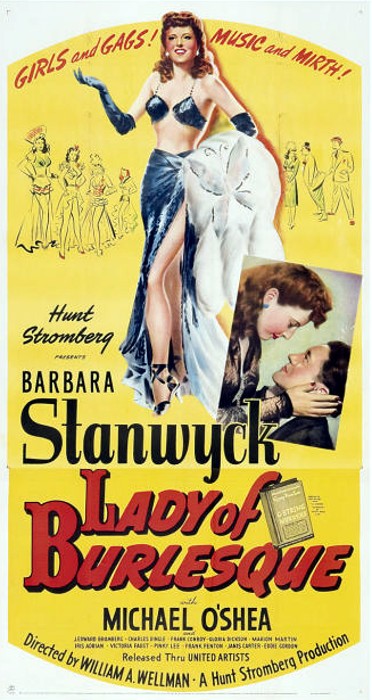
Lee wrote two books: THE G-STRING MURDERS and MOTHER FINDS A BODY. G-STRING was turned into the not entirely memorable Barbara Stanwyck film directed by William Wellman, LADY OF BURLESQUE. I mean, the film's okay, it's just not quite as much fun as it should have been - possibly because when you think of strip tease queens, you don't automatically think of Stanwyck. And Michael O'Shea is not my idea of a romantic leading man though he makes for an okay burlesque clown.


At any rate, I was lucky enough to find my particular copy of MOTHER FINDS A BODY on eBay. It came in a cache of other Rice mysteries which included HOME SWEET HOMICIDE, THE CORPSE STEPS OUT and a couple of others. Four bucks - can't beat that. I had no clue, by the way, that Rice was rumored to have written the Lee book, but was happy enough just the same, to receive my treasures.

Gypsy plays herself in the book. She's on her honeymoon after a quicky marriage aboard a romantic water taxi, to Biff Brannigan burlesque clown, currently unemployed. Also along on the honeymoon are Gypsy's Mama and a host of other hangers on tucked together inside a trailer heading east. Makes for a cozy but not very private sort of honeymoon. Especially when you add dogs, a monkey, a guinea pig and a dead body in the bathtub.

"A temperature of one hundred and ten, at night, isn't exactly the climate for asthma or murder, and Mother was suffering from a chronic case of both. She pushed the damp tight curls off her forehead and taper her foot impatiently on the trailer doorstep.

"You either bury that body in the woods tonight or you finish your honeymoon without your mother."

She meant it, too.

Mother is the sort of person who can be very tiresome on a honeymoon. When she's not behaving suspiciously, over-seeing Gypsy's life, having an asthma attack (sometimes accidentally on purpose) and/or mouthing off, she's insinuating herself into the middle of the mystery and using her charm and good looks (yeah, she's not a spring chicken, but she's still got the looks) to her advantage, regardless of the often scatter-brained circumstances. Like, for instance, when she sets the woods on fire. But I'm getting ahead of myself as usual.

The mystery's storybook setting is a lovely honeymoon encampment on the outskirts of Ysleta, Texas, a backwater town full of sleazy dives and somewhat sleazier people. Though the local sheriff isn't a bad sort - he has a friendly eye on Mother's charms. And nearby is a dark wood full of trees and hiding places - handy for disposing of an inconvenient body.

There's lots of dashing about and finger pointing and catching up on old gossip when another one or two burlesque types turn up in a dive in town.

'Biff had always been the Casanova of burlesque. I took that into consideration when I married him, and we were usually running into his ex-flames. But I never expected to find one under a piece of cheesecloth in Ysleta, Texas! 

Biff stared at the dancer with his mouth half open. Then he grinned at her, finally at me. "It's a small world, ain't it?" he asked when she tossed her brassiere on the piano. 

I waited until she threw her G-string into the tuba to answer. "Indeed it is," I replied.'

The aforementioned dive is run by a little guy who has his own bizarre rules of nicety and oh by the way, there's also a doctor behaving strangely to be taken into consideration.

Though beguiled by Mother, the sheriff still casts a suspicious eye on Gypsy and Biff and the motley assortment of show-folk descending on his town. Somebody is guilty of murder.

"...Mamie came in. She turned down the bedcovers and began tidying up the room....."I don't know how your poor mother can stand all this," she said as she rolled up a pair of nylons. "All the drinking and swearing and excitement. No wonder she has asthma."

"Well, things aren't always as upset as this," I said. "Sometimes we go for a whole week without finding one single corpse."

That's before the second corpse turns up. And someone slips Mother an illegal substance in her asthma medication.

But not before we're treated to Dimples, another trailer tag-along, doing her quiver routine at the local strip joint.

Eventually, when the surprising identity of the killer is revealed, the extent of the author's obfuscation earns our grudging admiration. Good job. Darn good mystery. Lots of fun.

And since it's Friday once again, don't forget to check in at author Patricia Abbott's blog, Pattinase, to see what other forgotten or overlooked books other bloggers will be talking about today.

Friday, March 9, 2018

Friday Forgotten (or Overlooked) Book: COLUMBELLA (1966) by Phyllis Whitney


I recently re-read Phyllis Whitney's WINDOW ON THE SQUARE (reviewed by yours truly upon my last re-read in 2011) and reminded myself yet again how much I enjoy these sorts of semi-gothic romantic suspense stories (without gore) that were prevalent in the 50's and 60's and even into the 70's. I once read them by the bucketful. Hopefully the bug hasn't bitten me again, but who knows?

I've always been a sucker for a certain sort of strong, dark, silent hero with problems, at least in books - if the guy broods, even better. It all began with JANE EYRE's Mr. Rochester - I guess I imprinted on him when I was young and impressionable.

Give me a house full of troubled inhabitants, a brooding hero (see above), a young woman fleeing her own troubled past, evil lurking in the shadows and now and then, an immoral woman bent on destruction and I'm there.

COLUMBELLA was another Whitney favorite of mine and since Kindle had it on sale one day, I succumbed.

The story is set on St. Thomas in the U.S. Virgin Islands. There are several properties involved since the hero is an architect, but in general the main action takes place in a house high on a hill overlooking the harbor. Beautiful sunsets, lush vegetation and windswept island breezes are all part of the scene. Not to mention a soaring hurricane near the end. But before we get there, there is trouble to be dealt with and secrets to be aired.

Jessica Abbott is a former schoolteacher fleeing a troubled life stateside as the 'caretaker' daughter of a beautiful, charming, feckless and flirtatious mother (lately an invalid due to an accident) whose influence didn't do Jessica any good. In fact, there is an old story of a fiancee who was more in love with Jessica's mother than with the young woman herself and well, you know how that goes. Not that Jessica blames her mother, after all, mom didn't do anything with malice aforethought.

"There was a great deal about my mother to love - her gaiety and sweetness, her interest in the problems of others that made us all open our hearts and talk to her, not realizing at first to what deadly and yet innocent use the things she learned might later be put. Even her helplessness was sometimes endearing and undisturbing as she grew older. Not that she had lost her beauty or her ability to trouble young men with longings she had no intentions of satisfying with more than kind words and a touch of the hand....Before he died, my professor father had warned me that I must look after her because she could not look after herself - she did not even know who "herself" was. I had kept my promise to him. That, at least, I had done.

But here in St. Thomas I could lie on the sand, walk the waterfront, climb the hills in a state of suspension that postponed any coming to grips with the fact that I had no life of my own.'

Upon her mother's death, Jessica 'escapes' to St. Thomas for solitude and official licking of wounds. While there she is importuned by Maud Hampden, a matriarch friend of her aunt's to come stay at Hampden House and serve as a kind of buffer between 14 year old Leila Drew and her mother, Catherine. There is very real harm being done to Leila - an impressionable young girl - by a selfish mother who is first, last and foremost only interested in her own pleasures. In fact, the woman is mentally unbalanced, but you know how these wealthy old families are about this sort of thing.

To get her out from under Catherine's unsavory influence, Leila is on the verge of being sent off to boarding school in Denver (oh my God, Denver!) by her father Kingdon Drew who grew up in Colorado. King is a brooding (uh-oh), silent man worried for his daughter and fed up with his beautiful wife's behavior - in fact, though staying at Hampden House, the two have been living separate lives for years. Why a grown man would put up with a wife's improprieties to this extent isn't really made clear, but for the sake of the story we must accept that he feels trapped because of his daughter's blind allegiance to her mother.

Naturally Jessica sees the traps inherent for her in this familiar situation. Though her own mother wasn't evil, it doesn't take long for her (or the reader) to realize that Catherine is hellbent on destroying her husband through the determined undermining of his relationship with a daughter whom she actually cares nothing about. Tearing around the islands with a younger man in tow, Catherine does everything she can to inflame and infuriate her family which includes not only her mother and estranged husband, but also a drab sister and her shell collector husband, an enigmatic man who has his own secrets to keep.

In the meantime, Jessica tries to befriend young Leila with varying results. At first convinced she can do little, she comes to the realization that Leila must somehow be saved from her cruel mother. Up until Jessica's arrival, basically just lots of hand-wringing going on.

But there is a great deal of ugliness lurking at Hampden House and when things come to a head,  there is also murder to contend with.

And last but certainly not least is a powerful hurricane which strikes the islands at just the right time. Well, you kind of knew that a story set in the Caribbean needed a hurricane to put things right.

If you like this sort of thing (as I, occasionally, do), you'll enjoy COLUMBELLA. Phyllis Whitney had the knack for telling an involved romantic tale filled with suspense and engaging people. Though in this particular tale, the characters are not all that likable, the story still works particularly because of the sense of lurking evil (with even a small touch of voodoo) and the lush setting. Whitney was always wonderfully right in her settings and also in all the ways she worked to come up with troubled heroines and strong, stalwart heroes.

And in addition, I learned quite a bit about the Virgin Islands, certainly more than I'd known though I visited St. Croix once many years ago, probably around the time this book was written.

It's Friday and yet again I'm running very late with my post. Apologies. Don't forget to check in at author Patricia Abbott's blog, Pattinase, to see what other forgotten or overlooked books other bloggers are talking about today. Patti has all the links.

Friday, March 2, 2018

Friday Forgotten (or Overlooked) Books: HOODS IN HATS (not to mention HEROES)


Yeah, I know, heroes wore the hats as well. But 'Hoods in Hats' sounds better as a title. Ha. Also I am obviously going for a specific sort of hat - variations on a fedora. Wish I could find out who the illustrators were, but to no avail.

I've read only two of the books but they were doozies:

1) FROM LONDON FAR by Michael Innes. This is an even more fantastical satire than normal (for Innes). It's all about an innocent professor who stumbles into the middle of an evil genius' preposterous plot and we get to go along for the ride. I LOVED it.

2) THE SILENT SPEAKER by Rex Stout. My second favorite Nero Wolfe book so that says it all. A room full of industry people at the Waldorf Astoria wait for a speech that will never be given. The main speaker has been murdered while preparing his notes but nobody sees or hears anything. A brilliant book in which Stout's use of characterization is vital to the outcome.

Some of us may remember the Saturday Serials of long ago when both the hero and the hoods kept their hats on NO MATTER WHAT. Even while in the midst of rock'em-sock'em fights, the hats stayed put. And EVERYONE (well, the men) wore suits - ALL the time. Even the bad guys seemed to follow certain fashion parameters which no one dared break. I often wondered too how all those dark suits never had got any lint or threads or dandruff or anything stuck to 'em. Even while fighting atop a moving train (which was a favorite) the suits stayed sartorially perfect. Or at least, that's how I remember 'em.

Ah, the good old days.

Since it's Friday, don't forget to check in at author Patricia Abbott's blog, Pattinase, to see what other forgotten or overlooked books other bloggers are talking about today.

Friday, February 23, 2018

Forgotten (or Overlooked) Book: HOME SWEET HOMICIDE (1944) by Craig Rice


My first Craig Rice book and again I ask: what took me so long? My only excuse is that though I'd heard of Rice, I'd never come across her books either in the library or in bookstores and it's only lately that I've been hearing more about her writing AND all of a sudden I was able to cash in on a cache of Rice books on ebay for four bucks. I mean, was the universe giving me a nudge or what?

(P.S. Expect to see a couple more Craig Rice reviews down the line at some point. )

Craig Rice was the pseudonym of Georgiana Anne Randolph Craig. A prolific writer, she wrote under various names and ghost-wrote several mysteries purported to have been written by celebrities such as George Sanders and even, rumor has it, Gypsy Rose Lee. Several of Rice's books were turned into popular films.

At any rate, I'm just finishing up the delightful HOME SWEET HOMICIDE and I'm running late, so my review will likely not be posted until Friday afternoon.

Yes I know you're getting tired of me saying that this or that book is a 'delight' but I can't help it. Lately I've just lucked out in the 'delight' department.

A lovely suburban murder is about to take place (well, not so lovely for the victim) in the California country-side and we are about to meet the Carstairs family who will be right in the thick of things.

Of course HOME SWEET HOMICIDE depends on your tolerance of young kids (two clever and self-sufficient sisters and an ingenious younger brother) solving a murder while their mother, a mystery writer, works in a trance-like state on her latest manuscript. Marian Carstairs is a charming widow who likes to sing railroad ditties and has time for nothing but writing, writing, writing - you know where this is headed - right? Yep, there's a handsome police detective about to enter the picture.

The kids are on the scene one afternoon when shots are fired in the Sanford house next door. Naturally, they are immediately eager to find out what's happened though it's pretty obvious from the screams (and their peeks through a window) that a body has been found - to their ghoulish delight. A young woman comes running out of the house and the kids immediately rush into action.

Almost on the spot they hatch a plot to solve the crime so that their mother gets the credit AND the resulting publicity. This, they reason, will help the sales of her books. Makes sense to me. The body next door turns out to be that of Mrs. Sanford. The screaming woman rushing from the house is a young actress suspected of hanky-panky with Mr. Sanford. The kids had conveniently seen two cars leaving the scene of the crime just moments before. They are besides themselves with curiosity. I mean, wouldn't you be?

As time is of the essence, they think nothing of concealing and desecrating evidence that should rightly be in the hands of the police. However, since the cops in this book are not especially competent, the kids get away with just about everything while their mom, oblivious (she didn't hear the shots above the clackity-clack of her typewriter), toils furiously to meet her deadline.

Teenager Dinah Carstairs and her slightly younger sister April, not to mention their brother Archie are 'innocently' underfoot as the police arrive and begin their investigation. They try to shoo the kids away but since they live next door that's kind of hard to manage - most especially on the night of their big party when the house is filled with kids running around while a 'treasure hunt' is in progress. I grew very fond of Archie's slightly disreputable group of friends, a bunch of little boys known as 'the Mob.'  They kind of reminded me of the gang of Scottish street boys so wonderfully created by John Buchan in the classic, HUNTINGTOWER.

As I mentioned, Marian Carstairs, the mother, is a distracted widow who tends to zone out when in the clutches of writing fever, but fortunately her children  have adapted to their mother's idiosyncrasies - she spends most of the day alone in a room slaving away - there but not there, if you know what I mean.  They willingly share household duties, such as making breakfast and dinner and general clean-up. Perfectly content and acclimated to their daily routine, they do occasionally wish their mother would meet someone and get married - she's been a widow for years and years.

Enter the hapless but handsome policeman, Bill Smith who happens to be fond of railroad ditties. (Coincidentally, one of Marian Carstair's fictional detectives is also named Bill Smith.) The kids think Smith would make a perfect hubby for their mom and vow to throw them together as much as possible while solving the murder. To that end, they will run rings around the two cops in charge of the case.

They also try to make sure that their mom always looks her best when there's a possibility of the handsome cop coming over to interrogate any of them. This is the 1940's when women still wore 'house coats' around the - well, the house - and Marian has an especially nice blue one. She also tucks a flower in her dark hair once in a while. Yep - Bill Smith is a goner.

Marian Carstairs...looked around the dinner table and counted her blessings. Three of them, to be exact. She sighed happily. 

There was a fresh lace cloth on the candlelit dinner table, and a bowl of yellow roses in the center. The ham was marvelously tender and delicately spiced, the sweet potatoes swam in in a thick brown syrup, the corn muffins were scorching hot and light as thistledown. A highly successful experiment had been made in combining the salad.

April, the darling, had brought a glass of sherry upstairs before dinner and said such sweet, such appreciated things! "Mother you look so much prettier in your blue house coat." "Mother, let me fix your hair tonight. " "Mother, put some war paint on. We always like to see you looking schmooz-able." And finally, "Oh, Mother, let me put one of the pink roses in your mane."

Did anyone, ever, have such wonderful children? She gazed at them rapturously. So good, so clever, and so beautiful! Marian smiled at them all, and reproached herself for having had even the faintest and most secret suspicion of them...

..."Mother," April said brightly, "if a lady was found murdered in her own living room, and if a few minutes later a socko motion-picture star drove up and said she'd been invited to tea, and somebody had heard two shots fired but the lady  had only been shot once, and if her husband was missing and didn't have any alibi, but if neither the husband or the motion-picture star had been the person who dood it," she finally ran out of breath, gasped and finished, "who would you say did?"  

"For the love of Mike!" Marian said in a startled voice. "Where have you been reading such trash?" 

Archie giggled and bounced up and down on the sofa. "It isn't trash! he said loudly. "And we didn't read it. We saw it!"

"Archie!" Dinah said sternly. She turned to Mother and said, "It happened next door. This afternoon."

Marian Carstairs' eyes widened. Then she frowned. "Nonsense. I'm not going to fall for any of your tricks, not this time."

"Honest," April said. "It did happen. It's all in tonight's paper." She turned to Archie. "Get the paper. It's in the kitchen."

"I always have to do everything," Archie complained. He left.

"Mrs. Sanford!" Marian said. "That woman! Who did it?" 

"That's just it," April said. "Nobody knows. The police have some loonie-louie theory, but they're all wrong as usual."

Along the way the kids are not averse to making up stories for the benefit of the police and even, in the course of their 'investigation' hiding the main suspect, Mrs. Sanford's nearly hysterical husband, in the playhouse. And coincidentally they are on hand when the victim's lawyer and two neighbors show up and, by various subterfuges, try to get into the victim's house. It doesn't take much putting two and two together to come to the conclusion that Mrs. Sanford was in the blackmail business.

And as the story of Mrs. Sanford's nefarious dealings becomes clearer, the plot itself becomes murkier. And of course at one point the kids get to search the dead woman's house. A very convenient fire in the neighborhood distracts the cops at just the right moment for Dinah, April and Archie to do the searching and naturally, they find what everyone is looking for. Though how the cops overlooked it isn't explained.

When the second murder occurs, the kids are on hand to hear the shots fired then as well. But the body isn't found in the Sanford house, instead it shows up elsewhere. Lots of confusion. Lots of plot twists and turns and in the middle of it all, Mother completes her latest manuscript.There's even a spy in disguise whom Dinah ferrets out and of course, Mother's Day arrives and must be celebrated with bunches of roses from next door and in the nick of time, a kidnapping and murder from the past connects everything up just as...

My favorite character is Archie, the smallest Carstairs (I believe he's about 7 or 8)), smart, wily and the family accountant. My favorite scene: on Mother's Day, Archie gives his mom two kittens named Inky and Stinky.

These kids are so well conceived and each has his or her own likable personality and what's more, despite their chicanery, they're good kids, fun to hang out with. They even, on occasion, use their own invented language (kind of like pig Latin) called King Tut's English and the author has a King Tut Alphabet chart conveniently placed at the front of the book.

A fun book. A good mystery. Terrific characters. What more could you want?

It's Friday once again and Todd Mason is doing hosting duties for author Patricia Abbott at his blog, Sweet Freedom. So don't forget to check in to see what other forgotten or overlooked books other bloggers are talking about today.


The poster from the film (based on the book) which I've never seen but I want to.

Friday, February 16, 2018

Friday Forgotten (or Overlooked) Book: THEY CAME TO BAGHDAD (1951) by Agatha Christie


Not forgotten and not too overlooked and not my first time writing about this book and probably not my last.

I've read THEY CAME TO BAGHDAD about twenty or so times over the many years since I first began reading Christie as a teenager, and am currently re-reading it for the 21st time - not that I've kept count. This book is like an old friend whose company is very comforting. And who doesn't need comforting these days.

Whose books do I turn to when things get gloomy ? Well, certainly Agatha Christie is at the top of the list. She writes about a world mostly long gone, a world in which the bad guy always got his or her just desserts and if everyone didn't live happily ever after, at least they lived comfortably.

If you would like some serious criticism or museum quality breakdowns of Christie's work, you won't find it here.There are worthy bloggers online who will spend a great deal of time dissecting Christie, comparing her to other Golden Age authors, often bemoaning her 'lack' of deep characterization (totally wrong-headed far as I'm concerned Christie does characterization very well with just a few broad strokes), while wishing she had done more of this or more of that, fitting her work into this that or the other timeline while separating her best writing years from her not so great - I don't do that. Not that there's anything wrong with it, but, just - I don't do that. I enjoy Christie for what she can do, which is genius.

THEY CAME TO BAGHDAD is one of Dame Agatha's stand-alone books, a thriller basically, with aspects of the mystery mixed in. There is no Poirot and no Jane Marple to solve the case. So perhaps I would not pick this as my first entry into Christie-land. Still, it is her best stand-alone I think, next to THE MAN IN THE BROWN SUIT with which it shares some similarities. In truth, I often get the two books confused in memory. But since they're both my favorites, I just shrug it off. Once I pick up the book and begin reading, it all sorts itself out.

The story begins leisurely enough with the reader meeting several people who will later play key roles. Lots of books begin this way but not as many do it so well as Christie. Uh-oh, would you consider that a comparison? Forgive me.

An enormously important international conference is to be held in Baghdad. Various world-wide national delegations are converging on the fabled city, including a couple of Presidents and a Prime Minister or two - naturally everyone is anxious to avoid catastrophe. What the meeting is about, Christie never makes really clear, but it hardly matters as long as we understand that it is of most importance to the future of post-war World Peace. 

Anyway, the book contains one of my favorite opening sentences:

Captain Crosbie came out of the bank with the pleased air of one who has cashed a cheque and has discovered that there is just a little more in his account than he thought there was.

I also love this description:

Captain Crosbie often looked pleased with himself. He was that kind of man. In figure he was short and stocky, with rather a red face and a bristling military moustache. He strutted a little when he walked. His clothes were, perhaps, just a trifle loud, and he was fond of a good story. He was popular among men. A cheerful man, commonplace but kindly, unmarried. Nothing remarkable about him. There are heaps of Crosbies in the East.

This is even more telling when we learn, several paragraphs later, that Crosbie's is an assumed persona since he is an undercover agent, a spy. Then we learn that Mr. Dakin, a slovenly, sloop shouldered, ineffectual man whom everyone disregards, is in, actuality, the strutting Crosbie's boss. These two characters have a very interesting opening conversation which sets the book in motion. Exposition, yes, but again, done very well.

From these two we learn that, Henry Carmichael, one of their more important operatives, a brilliant, enigmatic and canny young man of many faces and many languages, has discovered something of paramount importance to be revealed (if he makes it) at the meeting in Baghdad. Carmichael is, at the moment, in disguise as a Bedouin traveller (he speaks all the necessary languages and dialects) attempting to make his way from the mountains into Baghdad. But the enemy is onto him and already several men who had the misfortune to look like Carmichael have been indiscriminately killed in and around the city. It will be a miracle if Carmichael makes it as far as the embassy.

What this important 'thing' is is proof of a nefarious conspiracy to destabilize world peace. This 'thing' is, in truth, what Alfred Hitchcock called, "a mcguffin," a mysterious something everyone wants which sets a story in motion. In her books, Christie was occasionally fond of chatting about the 'real' source of world influence - the power behind the scenes: money. Shadowy money men who helped push the world one way or another, instigating wars and unrest if need be. She uses this idea in several of her books either as guiding light or as reason enough for murder and mayhem.

"...The upshot is that somewhere a third group of people whose aim is as yet obscure, are fomenting strife and misunderstanding and are engaging in cleverly camouflaged money and jewel transactions for their own ends. We have reason to believe that in every country there are agents of this group, some established there many years ago. Some are in very high and responsible positions, others are playing humble parts, but all are working with one unknown end in view. In substance it is exactly like the Fifth Column activities at the beginning of the last war, only this time it is on a world wide scale."

Given today's immense and secret concentrations of money stashed in various countries and the dangerous sway this money has over governments, I can't help thinking that Christie was prescient.

There are two important women characters in THEY CAME TO BAGHDAD, one is our heroine and the other is Anna Scheele, the mysterious confidential secretary to an American tycoon. Scheele's secretly scheduled appearance at the conference in Baghdad sets several governments on edge since they are not quite sure what she - or more importantly, those she represents , are up to. Upon her arrival in London, of course, she is kept under surveillance by the British. How she slips away from them is a tribute to the intelligence of the character and her wily creator.

Finally, we have the heroine of the piece, Victoria Jones. An impressionable (and very inventive) young lady freshly out of a job when she meets a young man in the park, a young man conveniently travelling to Baghdad the next day to join up with a misguided cultural group bent on bringing (among other things) Shakespeare in translation to the Middle East. The group is a kind of non-profit literary peace corps run by an absent minded professor named Rathbone. Victoria's young man - whose name is Edward - regrets he can't stay in London to spend time with her, but may he have a picture before he leaves? Handily, he has a camera.

In a very short space of time and incredible as it may seem, the penniless Victoria does manage to get to Baghdad. Believing herself in love with Edward, thinking herself a Juliet to his Romeo, she arrives lacking a job or a place to stay. But not for long. Soon she is not only reunited with her young man and looking for a job at Rathbone's spurious literary establishment, The Olive Branch, but shortly she finds herself at the scene of a midnight murder.

Of course, it's all a romp, thrilling but confusing when Victoria is kidnapped and for some reason, the kidnappers dye her hair or when we follow Carmichael the spy on his perilous trek into the city, eventually winding up at Victoria's hotel in the middle of the night.

(Earlier I love how he  resorts to Morse Code using Arabic beads to alert a friend, as he plots a quick-witted escape from the waiting room at the British Embassy.)

On the night of the murder, Mr. Dakin, the heretofore very briefly mentioned spy master reappears at a most unusual moment and naturally enough offers Victoria a job spying. Finally, Victoria has paying work.

The plot is neatly woven by Christie, jumping in intrigue from Victoria, to the spies and back again. And just when you think you almost know what's going on, there's that kidnapping with curious beauty salon consequences. Then we're off to an archaeological dig (something Christie knows heaps about) then finally, we're whisked off to the international conference where Anna Scheele comes out of hiding and there's an assassination to be averted.

Phew! This is a Christie book that moves at breakneck speed, full of clever twists and turns and enhanced by a likeable heroine you can't help rooting for.

Just a terrific, unpretentious, fun-thriller which no one - thankfully - has yet succeeded in adapting.

It's Friday and Todd Mason is again doing hosting duties in place of author Patricia Abbott who is currently duking it out with a recalcitrant computer. So don't forget to check in at Todd's blog, Sweet Freedom, to see what other Forgotten or Overlooked Books other bloggers are talking about today. 

Friday, February 9, 2018

Friday Forgotten (or Overlooked) Book: SWAN SONG (1947) by Edmund Crispin


Sorry about the plain cover and all, but great Crispin book covers are in very short supply these days. Had forgotten how much I adore Edmund Crispin so now that I've suddenly remembered and freshly found his Gervase Fen books for my Kindle, there will be no stopping me.

I guess you'd call this an academic mystery since it takes place in Oxford and the 'detective' is the eccentric Oxford don and Professor of English Literature, Gervase Fen. Though the actual setting is mostly at a local opera house (and nearby housing) currently putting on its first post WWII Wagnerian opus, Die Meistersinger - remember that Wagner was verboten in England during the war.

The cast of characters - mostly singers, and other opera personnel - is SO wonderful and SO entertaining and there are, at the end, two happy romantic outcomes on top of the crime solving - I mean, what more could anyone want? Oh and did I mention that this will be one of those impossible locked room murders? Well, not technically locked room, but the sort of thing where no one is seen going in or out through the only door and yet a man is struck dead under seemingly impossible circumstances - you know the routine. Just the kind of thing that captures our fancy.

But a mystery has to be more than just a puzzle - right? The story needs to have something else going on, something like a terrific cast and sparkling dialogue and even, more than one murder if at all possible. All these things are provided by Edmund Crispin in this, the fourth Gervase Fen book.

The main thing to love about SWAN SONG is the exuberant richness of language and the occasional composition of dense sentences on the scale of Michael Innes but with considerably more humor to soften the academic arcana (of which there is really not that much). Edmund Crispin outdoes himself here. The sniffy, sneery, smirking tone is delightful from the opening paragraphs to the introduction of the murder victim's sanity-challenged composer brother and his intimidating little domineering dragon of a paramour. EVERYTHING about this book is presented with attention to the eccentric detail - these are musicians, after all ( implies Crispin) and you know how THEY are.

Opening paragraph:

"There are few creatures more stupid than the average singer. It would appear that the fractional adjustment of larynx, glottis, and sinuses required in the production of beautiful sounds must almost invariably be accompanied - so perverse are the habits of Providence - by the witlessness of a barnyard fowl."

And on from there.

Edwin Shorthouse is a short, stout, unattractive lout with one saving grace: a beautiful bass-baritone voice. The setting for murder, as mentioned, is Oxford in the gray bleakness of January. The reason we are there is to put on a production of Wagner's opera: Die Meistersinger. The main characters in Crispin's story have an inter-connected history which is revealed at a leisurely pace as little by little other pertinent characters enter the picture though in truth, there aren't that many - just enough to confuse the issue of who the killer might be.

The loathsome Shorthouse is the obvious victim just waiting for the right moment to debut as a corpse. We don't have too long to wait.

"It argues a certain poverty of imagination,' said Gervase Fen with profound disgust, 'that in a world where atom physicists walk the streets unharmed, emitting their habitual wails about the misuse of science by politicians, a murderer can find no more deserving victim than some unfortunate opera singer..."

But everyone disliked Shorthouse intensely, in fact, even his only brother despised him. Sad. So there's no one to mourn when he's found dangling from a hook in his dressing room.

In the hothouse atmosphere of the opera house there are several suspects which immediately leap to mind: First off Adam Langley, the tenor and main protagonist. Shorthouse has never gotten over the fact that Adam is married to Elizabeth Harding, the woman Shorthouse lusted over though she could barely tolerate his presence. He has consistently been making a pest of himself even after the marriage must have made it obvious Elizabeth wasn't his for the taking. She, instead, had her eye on Adam even if marrying a singer carried some risk (see opening paragraph). She is an ambitious writer currently working on an assignment which involves interviewing famous detectives. Adam is acquainted with Gervase Fen so what would be more natural than, once in Oxford, he should introduce them.

'Professor Fen' - Elizabeth adopted her most politic charm - 'would you be prepared to let me interview you for a newspaper?'

Fen made a feeble attempt to show disinclination. 'Oh, I don't know...' he mumbled.

'Please, Professor Fen. It's in a series. I'm hoping to do H.M. [Sir Henry Merrivale], and Mrs. Bradley, and Albert Campion, and all sorts of famous people.'

There's also some name-dropping by Fen himself as when he looks out the pub window and spies fellow Oxford professor C.S. Lewis (author of the Narnia books among other classics) going about his business. There are all sorts of lovely bits like these intertwined with the mystery of the dead baritone whom everyone disliked.

More suspects: Boris Stapleton and Judith Haynes, madly in love and minor singers in the production. He is a wannabe composer hoping for his big chance to show his opera to the world famous Edwin Shorthouse for his opinion. She is a lovely girl who has been physically accosted by the same Shorthouse to the point that a friend coming along at the appropriate time has to resort to knocking the drunken singer to the ground.

Then there's Joan Davis, another singer and in his conducting debut a young man named Peacock for whom Joan has a lingering eye. Peacock and Shorthouse practically come to blows during one interminable rehearsal.

Then of course there's the aforementioned brother, famous composer Charles Shorthouse who in his own eccentric (and rather absent-minded) way is thrilled that someone has done the job of murdering his brother Edwin for him. The chapter where Charles is introduced practically steals the show.

By the way, I thought I had a handle on who the killer might be from the getgo, but turns out I was wrong.

Gervase Fen is of the Henry Merrivale/Dr. Gideon Fell school of fictional detectives though he is younger, taller and lanky and wears a strange hat which is never described - at least in this book. He also has an invisible family which apparently lives in the same lodgings as he does but are never seen. I was especially surprised to find he had a wife whose bicycle he borrows in a scene near the end.

And of course, like Merrivale and Fell, Gervase Fen is of the same run amok school of driving:

"To realize that anyone is not a very good driver takes a little time; the mind is not eager, in the face of a long journey to accept this particular verity; and it was not until Fen emerged into the High Street, with the velocity of a benighted traveller pursued by spectres, that Adam became really alarmed...

The car rushed on towards Headington. It was a small, red, battered and extremely noisy sports car, a chilled looking female nude in chromium projected from its radiator cap; across its' bonnet were scrawled in large white letters the words LILY CHRISTINE III.

'I bought her,' said Fen, removing both hands from the wheel in order to search for a cigarette, 'from an undergraduate who was sent down. But of course she was laid up during the war, and I don't think it improved her.' He shook his head, sombrely. 'Things keep falling out of the engine,' he explained."

But really none of that is as important as finding out who killed Shorthouse and how and making sure that the characters we grow to like have a happy ending. These books have one purpose and that is to entertain and oh, by the way, tell a good mystery while doing so.

Once Shorthouse is dead, there comes an attempted murder of another character and then the death of another and then a further attempt at yet another and FINALLY, we get to the end which is rather convoluted but to be expected. My kind of book.

Though I find this sort of thing completely engaging I realize that others may not be drawn into the proceedings in quite the same way and that's really too bad. For me, what is so attractive about a book like this is the comfortableness of it all. I love Oxford, so that helps as well.

"Fen, Adam and Elizabeth lunched in Fen's room at St. Christopher's. It was a large room in the second quadrangle, reached by a short flight of carpeted stairs which led up from an alley-way giving access to the gardens. It was, as the saying goes, 'lined with books'; Chinese miniatures were on the walls; and various dilapidated plaques and busts of the greater masters of English Literature decorated the mantelpiece. They ate off a noble Sheraton table, and were served by Fen's scout.

They talked about opera, and in particular about Wagner; speculations about the death of Shorthouse had inevitably reached a stasis for want of further information. Over coffee they considered plans for the afternoon."

Oh, and last but not least, did I forget to mention character names? Another Crispin delight:

There is a character named Furbelow. Yes.
A character named Mudge.
A character named Rashmole.
Not to mention the victim's not very elegant name: Edwin Shorthouse.
And the conductor is named Peacock.
(Not that Gervase Fen is a run of the mill name either.)

This is the kind of nonsense I appreciate.

In my mind, SWAN SONG is second only to Crispin's oh-so-brilliant, THE MOVING TOYSHOP. So that gives you some idea how much I loved it.

Since it's Friday once again, Todd Mason will be doing meme hosting duties later on today at his blog, Sweet Freedom. So don't forget to check in at some point to see what other forgotten or overlooked books other bloggers are talking about today. 
Monday, January 29, 2018

Monday Salon: Remember When Plane Travel Was Fun?


American Airlines ad, 1949. Good Housekeeping magazine. 


An incident in a recent book got me thinking about once upon a time plane flight.  Of course now it's often just a necessary drudgery. But remember how exciting plane travel could be? Comfortable too, with stewardesses and stewards to see to your every need. And seats like banquettes with small tables and other comfortable accoutrements. The man in the top poster looks as if he's sitting on a wicker chair (!?) Remember dressing up to fly? Remember walking onto the actual tarmac to board the plane? Outside! Those were the days.

And look at these gorgeous travel posters. Yesterday's graphics were often works of art in and of themselves, even if they were only advertising not meant to last forever.

Artwork by American illustrator Harold Anderson. (1894 - 1973)

Designer: Tom Purvis. Imperial Airways 1931.


Friday, January 26, 2018

Friday Forgotten (or Overlooked) Book: THE PONSON CASE (1921) by Freeman Wills Croft


If you don't like to read police procedural mysteries, you probably won't like the books of
Freeman Wills Croft. Happily for me, I love police procedurals and most especially love the old practitioners of the craft. I haven't read Croft in ages, but began to go through his work again last year - unfortunately, not a lot of it is easily available. But little by little, as the saying goes. And since I don't remember what I read years ago, it's like doing it again for the first time.

Warning: Croft is VERY fond of railway schedules and 'timed to the minute' alibis. And though normally my eyes glaze over when reading alibi minutiae, somehow with Croft, I take it in stride. And railway schedules - ha! I have trouble reading any kind of schedule - you should see me, a grown woman of some intelligence, lost in the utter incomprehension of a town bus schedule. Sad. But this doesn't stop me reading Croft. Go figure. It might just have something to do with the fact that he was a very clever constructor of plots, a writer of the sort of books that few can do well. He also comfortably understood his limitations and seemed happy enough within them. Once you get deep into a Croft book, it's hard to put the thing down. Listen, I'm the least detail oriented person you would ever meet, but I love his work.

And another thing: Of Croft's very early work, there's less of that turn of the century over the top exuberance that you find say, in E.C. Bentley's books, and other writers from that time. Croft avoided the curlycues. AND his women were often not of the faint of heart variety.

THE PONSON CASE (1921) is Croft's second book and does not feature Croft's most famous protagonist, Inspector French of Scotland Yard who will debut a few years later - this time out it's Inspector Tanner who has the case. It was published in 1921, so this is kind of old school before old school was old.

Yet at the same time, there's a rather strong female character  who has lots to do with pushing the case forward even where her male cohort is ready to give it up as a lost cause. The plot develops from their point of view as well as from Tanner's.

Okay so ANY reader (of a suspicious nature) who has read as many mysteries as I have (and more) will be able to figure out, more or less, not HOW the crime was committed but who was likely involved. There is a very strong clue passed off in the early part of the book in an information dump dialogue scene.Though that doesn't prevent a couple of surprises as we near the ending. An ending which dovetails nicely and explains just about everything to the reader's satisfaction.

The plot:

Sir William Ponston disappears one evening from Luce Manor, his beautifully appointed country house in the south of England. Except for the servants he had been home alone as his wife and grown daughter were away on a short trip. The beginning couple of chapters are the sort of thing that I really do enjoy reading - we get into the story immediately in a vivid setting easy to picture.

When his body is later discovered, it appears Ponson had inexplicably taken out a boat from his boat house the night before and gone out alone on the nearby Cranshaw river - something he'd never done before. Once on the river he apparently lost control of his oars and his small boat drifted too close to a waterfall and catapulted him over some rough water (well known in the neighborhood to be treacherous) to his death.

The whole thing seems incomprehensible to his family and soon enough to the authorities. Ponson didn't drown, he was already dead when he entered the water AND there's suspicious bruising on the back of his head. Uh-oh.

The meticulous Inspector Tanner of Scotland Yard is called into the case. It is known that both Ponson's son, Austin and his nephew Cosgrove are hard up at the moment and in need of funds. They will both be much better off under the terms of Sir William's will. Suspicion naturally falls on both men. Both both have seemingly unbreakable alibis for the night in question.

As is often the case in a Croft book, the investigation hinges on the strength of seemingly unshakable alibis as well as on investigatory minutiae, for instance: footprints. Inspector Tanner takes us over the evidence bit by bit as he uncovers and tries to make heads or tails of it.

Tanner's approach is to weigh each and every clue, each and every statement, and tortuously go over the tracks of the apparent killer or killers since it seems obvious in this case that there is more than one person involved. At an exciting point mid-story, Tanner hires a plane - it's 1921, so the plane is a  two man affair and there's wind and fog and lots of the sort of atmosphere I love - to fly him to Lisbon, Portugal on the trail of a suspect who has made a mad dash to the continent.

This makes for a rather thrilling action sequence in an otherwise localized tale. Tanner's energy is contagious and Croft knows how to write this sort of thing so well.

Some might find the Inspector's keenness for detail tedious, but there's a certain admirable quality to Croft's fine tuning of his plot details. You just can't help being amazed even if I did fast read some of the more esoteric timing of certain alibi aspects.

If you are of a mind to read some really well crafted, well written period detective tales of the police procedural variety then Freeman Wills Croft is the writer for you. I really do enjoy his work.

Link to Croft's Fantastic Fiction page here.

Todd Mason will be doing hosting duties some time today at his blog, Sweet Freedom, while Patricia Abbott takes a break. So don't forget to check in and see what other forgotten or overlooked authors other bloggers are talking about today.

Thursday, January 18, 2018

Friday Forgotten (or Overlooked) Book: THE MYSTERY AT THE ORCHARD HOUSE (1946) by Joan Coggin


Joan Coggin is yet another mystery writer I hadn't heard of until recently. Her Lady Lupin series would probably have remained unremembered and impossible to find except they were republished in 2003 by Rue Morgue Press.Thank goodness! At the moment those still seem to be the only copies available online.

This is a short-lived series since apparently the author stopped at four. The books are most definitely cozies and her heroine is Lady Lupin Lorimer-Hastings, a ditzy but kind-hearted society gal who uncharacteristically, falls in love with a Church of England Minister years older than herself and marries him - much to the surprise of everyone in her lively set. Her family, on the other hand, is just relieved she didn't married anyone in said lively set.

The marriage is a happy one and husband and wife are, in time, delivered of a bouncing baby boy whom they adore.

Okay, when I reviewed the first book in the series, WHO KILLED THE CURATE? (which I simply had to read because: great title) I was thoroughly taken by Joan Coggin's fun attitude towards her characters and the shenanigans they get up to. Though murder is no joke, there's still a lively enough atmosphere in cozy English village life (at least in book form) to offset the horror of untoward death. As well as, incongruously, a few laugh out loud moments as we share with Lady Lupin (or Loops as she's called by close friends) her inability to quite grasp the practicalities of day to day life as it applies to a minister's wife. She was a London city girl after all, and worried she'd find village life boring. But that is not to be. Not with everyone just waiting to pour their trials and tribulations out to her.

There is no murder in THE MYSTERY AT ORCHARD HOUSE which actually makes some sense. In a sane world how many murders could a Minister's wife be expected to run into, let alone solve? Let's get real here.

And truth to tell, murder isn't missed - there's just too much going on in yet another lively story featuring the sorts of people one might find fatiguing in real life, but in book form are no end amusing. This time out Lady Lupin is staying at her good friend Diana Turner's newly inherited house-turned-hotel out in the lovely countryside of Kent. Lady Lupin is exhausted, having just nursed her family through a severe bout of influenza then becoming ill herself. Ergo, Loops needs a recuperative break from normal daily routine. So off she goes to Orchard House for a carefree rest.

Unfortunately, 'carefree' is not in the cards.

There's just something about the lovable if screwy Lady Lupin Lorimer-Hastings that causes people to unburden their souls to her. This may come in handy for her role as a minister's attending wife, but it can get tiresome on a day in and day out basis. Maybe it's her kind heart coupled with a beguiling scatterbrain nature, but whatever it is, people respond and tell her their troubles whether Loops wants to hear them or not.

THE MYSTERY AT ORCHARD HOUSE is not a murder mystery, but a mystery of mistaken intentions and miscues with a wonderful cast of mostly ridiculous characters, some of whom are impossible to like, and a couple for whom you'll want to see a happy ending. And Lady Lupin gets the chance all over again, to get everything wrong and misdirect us all with attempts at deductions which occasionally (if accidentally) are right on the mark.

 As I mentioned, there is no actual murder, just a series of confusing thefts and possibly an attempted murder involving a vehicle. All the while, Lady Lupin must untangle some unlikely alliances, align a few misaligned hearts and help straighten out the career path of a young poet.

We also get a sharply satirical caricature of a novelist - a woman so self-involved with her own work (talk about tunnel vision) that she causes Lady Lupin to wake the entire hotel and run out into the dead of night searching for a missing child much to the chagrin of everyone when it turns out that the 'child' in question is merely a missing manuscript. Oops. 

Sort of like a female Bertie Wooster without a Jeeves to guide her through, Lady Lupin Lorimer-Hastings is a complete delight as she fumbles her way towards a very satisfactory ending in this cozy dip into a world which, if it ever existed, is now gone forever.

A frantic and very funny second book in a series I've grown fond of. Can't wait to read the two remaining.

Since it's Friday again, don't forget to check in at author Patricia Abbott's blog, Pattinase, to see what other forgotten or overlooked books other bloggers are talking about today.