Friday, October 18, 2013
Friday's Forgotten (or Overlooked) Book: THE MAN IN THE TRICORN HAT (1960) by Delano Ames
The English writer Delano Ames (1906-1987) wrote lots and lots of books, the titles of which I've just recently discovered online. Most of you know how enamored I am with Delano Ames' Dagobert and Jane Brown mystery series since I've (unashamedly) shared my enthusiasm - gone overboard, some may say. But when it comes to newly discovered authors, there's no such thing as too much shouting from the rooftops far as I'm concerned.
Isn't it thrilling to find an unknown vintage author (unknown to me anyway) and suddenly realize that there's a bunch of unread/unheard-of books out there? If you can find them, of course. The hunt is on!
To that end, I've just ordered two more Delano Ames books (all I can find that are affordable at the moment) and can't wait to see if they live up to the previous Dagobert and Jane puzzlers. Oh how I love those two amateur crime solvers.
But I'm not writing about them today, so enough of that.
Turns out that Delano Ames had another series, this one featuring the affable Juan Llorca, a member of the Spanish constabulary:
"You know those gaunt figures who appear in pairs on lonely Spanish roads, scaring the wits out of everybody with their black tricorn hats, great green cloaks and rifles? Well, one of them was my friend Paco. The other - the one with the five days' black stubble on his chin and a patch of dirty sticking-plaster on his left ear - was me.
Also my feet hurt. We'd had nearly a week of what they call 'servicio de campo', which means pushing around the countryside listening to complaints about the neighbour's goats, keeping the gypsies on the move and sleeping in our cloaks.
When we left Madrigal del Mar fives days ago there were the usual rumours that the hinterland was crawling with suspicious characters. Paco, who reads El Coyote and the comics, had great hopes about Red spies, or at least white slavers; but we hadn't seen anything out of the ordinary except old Don Fernando, who is well known to be crazy."
I love the first person point of view so I was already won over by time I finished reading these opening paragraphs of the first Juan Llorca book. I also love when an author has a droll sense of humor which (coincidentally) more or less matches mine. Delano Ames and I are on the same wavelength. Ah, bliss.
Juan Llorca is apparently the only Civil Guard member, currently assigned to duty in the small fishing village of Madrigal, who has any active sleuthing brainpower. Everyone else is out for numero uno including the alcalde (mayor), playing political one-up-man-ship, not really caring if justice is served. Sound familiar?
On the outside, the attractive if somewhat nebishy Llorca is a punctilious officer ready to do his duty even while wearing a black patent leather tricorn hat. But at heart he is a romantic with a somewhat sensitive self-image. Llorca has his eye on the beautiful but confounding English artist Julia Fairfax, newly settled in Madrigal. Is she sending Juan come hither signals or is she not? Is she married or is she not? Why is she so reluctant to discuss her background? Aside from that - is she a murderer? And oh by the way, who is Angus Smith to her?
Let's back up a bit:
When a Texas oil millionaire named Rittenbacker and his curvaceous niece and young nephew rent a Madrigal villa, they settle in to contribute to the local tourist economy and soak up the determinedly quaint Spanish atmosphere. In turn, of course, they become objects of local gossip and speculation - especially when the niece, Mary Lou, shows up on the local beach wearing a bikini.
Rittenbacker, it turns out, is intent on buying some 'art masterpieces' newly discovered by the aforementioned Don Fernando, Madrigal's rather peculiar arts and antiques dealer. As Juan Llorca says: His "... shop is called the Bricum-ad-Bracum, which is, I'm told, Latin for junk.
Even so, Don Fernando and his Dona Carmen (a disreputable toothless lady with a roving eye), do a raging good business discovering long lost masterpieces hidden under a rock or two here and there. Juan Llorca is aware that the Texas oil millionaire is probably going to be fleeced, but he tries to be diplomatic about it, not wanting to come out and actually accuse one of the town's more well-known and indulged eccentrics. Besides, Rittenbacker is old enough to take care of himself.
In the meantime, there is the nagging question of Angus Smith, a tall good-looking sort with a sneer and an attitude. He has shown up in Madrigal and immediately assumed an annoying proprietary air over Julia Fairfax. Obviously these two know each other. Is he the absent hubby?
When the body of the Texas millionaire turns up dead, the natural conclusion that Smith (having been found to be a vile blackmailer) is the perp seems rather convenient. Maybe too convenient. It's then up to Juan Llorca to get at the truth of the sordid matter before the approaching Fiesta of the Moros and Cristianos (Moors and Christians) - which usually culminates in a 'pretend' battle involving the entire town of Madrigal del Mar - forges ahead and helps a murderer escape justice in the ensuing melee.
Just when you think you more or less know what's going on, turns out you don't. Delano Ames holds back a couple of surprises until the very end - just as it should be.
This is not Dagobert and Jane Brown, but on the whole, not a bad mystery with as engaging a leading man as you could want - even if he does have to wear a black patent leather tricorn.
The reader also gets to learn a bit about Spanish law, police proceedings, investigations and other esoteric minutiae. If I can find another Juan Llorca mystery, I will definitely be reading it.
George Kelley is doing 'link duty' this week, so don't forget to check in to see what other Forgotten Books other bloggers are talking about today.
Tuesday, October 15, 2013
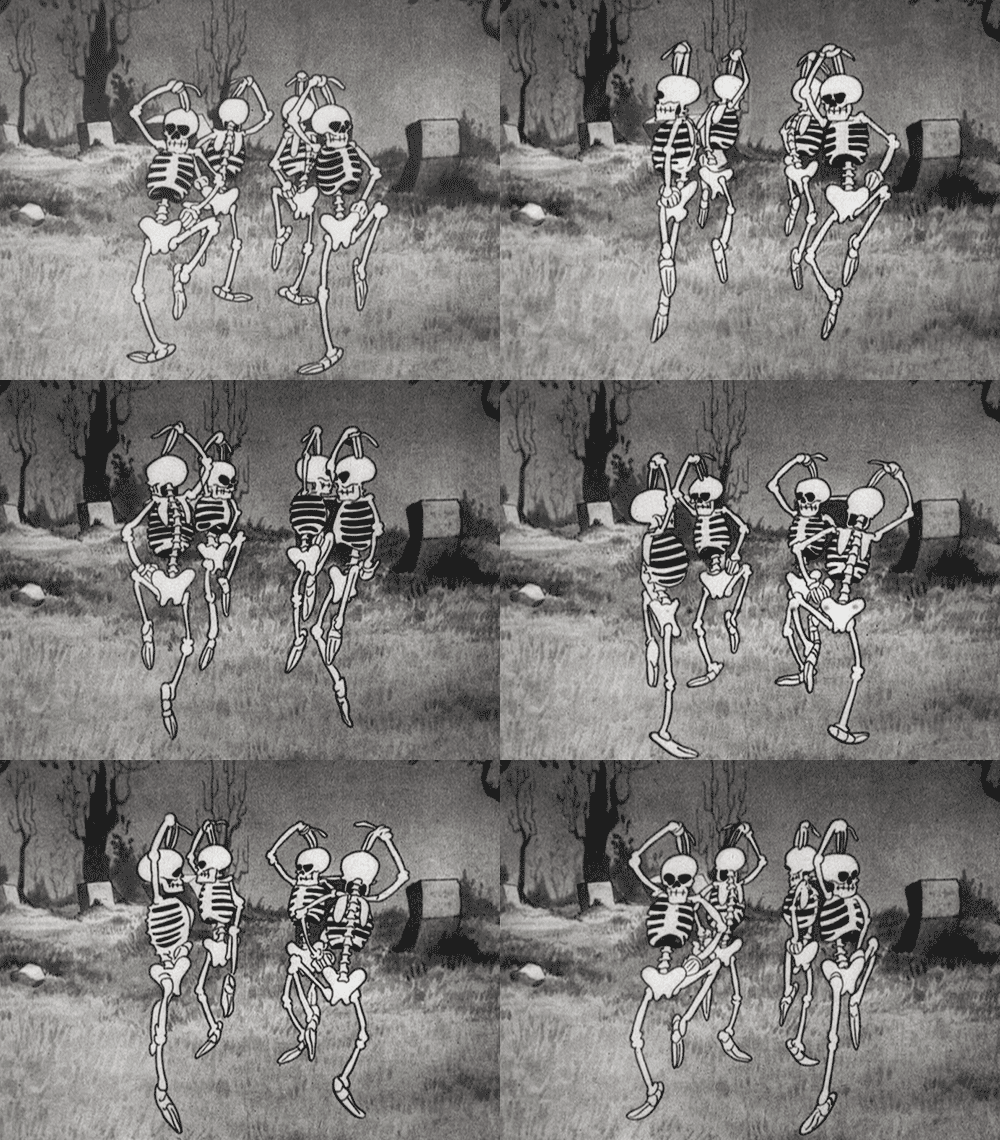
Tuesday's Forgotten (or Overlooked) Film: THE SKELETON DANCE (1929) Disney Silly Symphony Short
These early types of vintage cartoons were once all that was available - cartoon wise - as television kiddy fare. I used to wonder about the black spit. But perhaps that's a topic for another time.
In the zealous spirit of approaching Halloween festivities (of which the less said, the better), here's the link to the full cartoon on youtube.
Enjoy!
If you dare. Ha!
If you dare. Ha!
Saturday, October 12, 2013
Saturday Salon: Vintage Posters to Love
Artist: Marcello Dudovich
Artist: Achille Mauzin
Artist: Dr. Seuss
Artist: Henry Le Monnier, 1922
No artist attribution
Artist: Herbert Leupin 1942 - PKZ is a Swiss clothing company.
Artist: Ludwig Hohlwein
No artist attribution
Artist: Paul Colin
Artist: Rene Vincent
Artist: Ludwig Hohlwein
Artist: Donald Brun
Artist: Laubi, 1925
Artist: Marcello Dudovich
No artist attribution.
No artist attribution that I can read.
No artist attribution
Artist: Roger de Valerio
Artist: A. Scolari
Artist: Alexandre Steinlen - I have a copy of this one hanging in my foyer.
Vintage posters of any and all variety of stripes, are another of my personal collecting loves though I have only a few and those are copies. Still, I enjoy looking at (another thank you to the internet) and musing over the art, design (love the bold graphics) and meaning. Not to mention the era in which they were created.
Artist: Achille Mauzin
Artist: Dr. Seuss
No artist attribution
Artist: Herbert Leupin 1942 - PKZ is a Swiss clothing company.
Artist: Ludwig Hohlwein
No artist attribution
Artist: Paul Colin
Artist: Rene Vincent
Artist: Ludwig Hohlwein
Artist: Donald Brun
Artist: Marcello Dudovich
No artist attribution.
No artist attribution that I can read.
Artist: Roger de Valerio
Artist: A. Scolari
Artist: Alexandre Steinlen - I have a copy of this one hanging in my foyer.
Vintage posters of any and all variety of stripes, are another of my personal collecting loves though I have only a few and those are copies. Still, I enjoy looking at (another thank you to the internet) and musing over the art, design (love the bold graphics) and meaning. Not to mention the era in which they were created.
Thursday, October 10, 2013
"Elementary!" she squealed as she tore open the red envelope.
Lately I've been doing something I rarely do: watching a whole season of television show episodes back to back - or almost back to back. Four shows at a time on each Netflix DVD.
The series? ELEMENTARY starring Johnny Lee Miller as Sherlock Holmes and Lucy Liu as Watson. Yeah, I know, it sounds dreadful. My first instinct was to shudder with horror and swear I would never watch the show.
But guess what? I was wrong.
After several friends recommended the thing, I thought I'd take a look.
And I was hooked.
This time it's Holmes living in modern day New York city and his Watson is a woman (a non-practicing doctor) hired by Holmes's father as a kind of therapy companion to watch over his formerly drug-addled son as part of a recovery program. Sounds like nonsense, but I suppose there are people who do this sort of thing in real life though I'd never heard of it before.
As time passes, Watson will stay on with Holmes as his detecting partner - but as usual I'm getting ahead of myself.
Regardless, the main thing is the relationship and on-air chemistry between Holmes and Watson as it develops. Holmes, let's face it, is an extraordinarily annoying man who can't help being the smartest person in the room at any given time. As he tells Watson, "I'm smarter than everyone I meet..." Yes, it's true. Allowances must be made. At least that's his take - think of the wearisome frustration of always being in the presence of minds less...well, just less than your own.
Watson may have another view, although she is remarkably patient with her stubborn charge as she comes to realize what an extraordinary man he is and what extraordinary work he does as 'consultant' to the NYPD.
What can I say?
I love the show.
So far.
I actually like this better than the British modern-day SHERLOCK starring Cumberbatch and Freeman, though I like that one well enough - especially the Reichenbach Falls episode. And I'm looking forward to their Season 3.
Wednesday, October 9, 2013
EVENING IN THE PALACE OF REASON - Bach Meets Frederick the Great in the Age of Enlightenment by James R. Gaines
A book I've just finished and LOVED and am recommending to the heavens (as in highly) even if you can't read music (I can't) and are not familiar with some of the musical work mentioned (that's easily rectified).
But as much as I loved EVENING IN THE PALACE OF REASON - Bach Meets Frederick the Great in the Age of Enlightenment by James R. Gaines, I won't be reviewing it only because I rarely if ever review non-fiction, especially historical non-fiction. I find it too intimidating.
However, I will just post this heads-up for those of you who have any modicum of interest in European history, music, the workings of genius, Bach in particular (not to mention Frederick the Great) and, oh by the way, splendid writing.
I'll also thank Roberta at Books to the Ceiling for originally recommending Gaines' book a while back. You can read some of her comments at the link and also link through to a couple of stirring performances of Bach. Some of the links have faded away into oblivion since this was posted in 2010, but there's enough to whet your appetite.
Additionally, here's a link to a BBC bio (on youtube) of Frederick the Great.
Bach in Baltimore features Sunday with Bach and other musical goodies for those fortunate enough to live in the area. For those not, there's plenty of Bach on youtube. But I have a suspicion I'm going to be buying a few more CDs.
Tuesday, October 8, 2013
Tuesday's Forgotten (or Overlooked) Film: DRACULA'S DAUGHTER (1936) starring Gloria Holden and Otto Kruger
Since Halloween is just around the corner, I'll be featuring some 'overlooked or forgotten' horror films each Tuesday before The Big Day. As many of you know, I'm not REALLY a horror movie buff, but just to be contrary (as I am fond of being) I do like and enjoy 'monster movies' from the past, most of which left the blood and guts stuff to the imagination - thank goodness. It was mostly about atmospherics then.
Last Tuesday it was WEREWOLF OF LONDON (1935) and this week it's DRACULA'S DAUGHTER (1936). This is a spooky gem I haven't seen in years and years and just found recently on a neat website (not youtube) where apparently anyone can watch a very good print of this creepy old movie for free.
DRACULA'S DAUGHTER is a 1936 film directed by Lambert Hillyer starring Gloria Holden and Otto Kruger. Wikipedia has a comprehensive page detailing the wrangling over the script and cast and who would direct (it was originally meant for James Whale - director of FRANKENSTEIN - who wanted no part of another horror film) but no matter, after many re-writes (the script was only marginally based on a Bram Stoker short story), and even more wrangling with the Production Code people who objected to the film's rather obvious lesbian overtones, a director and cast were finalized.
The film was not as fabulously ghoulish or successful as its predecessor, DRACULA, starring Bela Lugosi, nonetheless DRACULA'S DAUGHTER has enough foggy atmospherics, dark shadows, mysterious murders (which happen off screen) and vampire mumbo-jumbo to satisfy those of us who relish this sort of thing - within reason. We even have the presence of the satisfyingly eccentric Professor Von Helsing and near the end a mad dash in the dead of night from London to Transylvania and Dracula's castle.
The plot:
Mild-mannered vampire hunter Professor Von Helsing (Edward Van Sloan) is picked up by Scotland Yard for the murder of Count Dracula - he was caught red-handed in a dark underground crypt near an open coffin - dead vampire within, wooden stake driven through heart. (Is it murder if you kill a man who's been dead for 500 years?)
Von Helsing spins the usual vampire tale to the cops. He is disbelieved by Sir Basil Humphrey (Gilbert Emery), Head of Scotland Yard, who assumes the good professor must be mad.
Von Helsing turns to his old student, steely-browed Dr. Jeffrey Garth (Otto Kruger), a successful London psychiatrist. Though Garth is no detective, he will try and help his friend even if he doesn't believe in vampires.
He's an 'it's all in your mind' practitioner who comes complete with a perky socialite secretary whose main job it appears, is to manage the good doctor's bow tie.
Enter the Countess Marya Zeleska, played with sleek and sinister dramatic aplomb by Gloria Holden.
She comes complete with a lamentable Servant/Henchman With Aspirations named Sandor (Irving Pichel). Sandor's grooming, unfortunately, leaves a lot to be desired. He looks as if he's wearing lipstick and worse, he parts his hair in the middle. Tsk. Tsk.
We meet the creepy pair early on when under the noses of the cops, the Countess disables a London bobby and absconds with Dracula's body. Out in the dark countryside she then sets fire to the coffin and contents, watched over by her sartorially-challenged henchman.
See, the countess figures that if she burns Dracula's body she'll be free of its cursed influence. She's not happy being a vampire. She wants to lead a 'normal' life once again. She wants to play happy music on her piano.
Sandor scoffs at her wishful thinking. He sees nothing but death in Zeleska's eyes. Let's face it, the guy is a total downer.
But as it happens, his doom and gloom prognostication is right. Zeleska's hideous compulsion is not to be denied. Soon enough, on a suitably foggy night, a dandy in top hat and tails becomes the next hapless victim.
In the meantime, Zeleska (she passes as a mysterious artist in society circles) has zeroed in on Dr. Garth (Otto Kruger) at a London party. Since he's a renowned psychiatrist he must help her fight her deadly compulsions. At first Garth is intrigued and confident he can help her - but that's only because he's not aware she's an actual member of the undead fraternity.
When a sweetly innocent (and indigent) young thing is brought to the Countess's studio to pose for a portrait (now where have I heard that story before?) she soon meets her fate as yet another of Zeleska's victims.
But fortunately not before the girl is hypnotized by Dr. Garth in her hospital bed and with dying breath clues him in to Countess Zeleska's real nature. (They also notice the two tiny puncture marks on her neck. Zeleska is not a sloppy diner.)
Somewhere in the vague recesses of my mind there lurks a scene full of creepy allegory in which the young model is strapped to an X shaped wooden cross while the Countess leers at her. But damn if I can find any proof of this scene's existence in any of my old film books. I know I've seen it and I thought I remembered reading the scene had been cut from later versions of the film. But I'm probably wrong. Of course it might have been another film altogether. You know how old lady memory works...or not.
At any rate, once the jig is up, so to speak, the Countess, who is nothing if not adaptable, insists that Doctor Garth accompany her on a late night flight to Transylvania. Once there she will welcome him into the legion of the undead and he will rule by her side forever. Sounds like a plan.
Except: Sandor balks. Wait a sec, he was promised eternal life first. But really, with hair parted in the middle - what did he expect?
The doctor balks too. He has no wish for eternal life, Zeleska must be mad.
So to ensure his cooperation, the Countess kidnaps the doctor's perky secretary (whom Garth secretly loves, of course) and off we go to Transylvania. Where the first thing we see is a happy peasant wedding and happy peasants dancing.
Until they spot a light on in the supposedly abandoned Dracula Castle. Uh-oh.
Terror has returned to the foothills of Transylvania. The peasants scatter.
Hot on the trail of the Countess, Garth lands his plane (did I forget to mention that the good doctor is also a pilot?) in the Transylvanian countryside and hires a coach with a nervous coachman to take him to Dracula's Castle. Having some iota of good sense, the coachman will only go so far and the rest of the way the doctor must manage on foot.
In the end, good triumphs over evil (in a roundabout way) as a second plane carrying the Head of Scotland Yard and Professor Von Helsing arrives in the nick of time.
A few intriguing quibbles:
Though most of this film takes place in London, there is nary an English accent to be heard in the cast. It's a mish-mash of American accents and English pretending wannabes. Even the very few English actors, don't sound quite right. The young model who meets her fate at the Countess's hands sounds positively American Southern. Very odd.
And oh by the way, since when does the head of Scotland Yard actively chase criminals? And country to country? Transylvania is not exactly next door to London (as perhaps implied in the film).
In a scene early on, Doctor Garth is supposed to be on a shooting holiday. He stands holding a shotgun stock down, double barrel pointing up at his own head while leaning against a car and talking to his secretary who has shown up to cut his holiday short. I don't know much about guns and things, but this seems not the advisable way to handle firearms. And oh by the way, does it really take a double barrel to shoot grouse?
Despite these minor blips, DRACULA'S DAUGHTER still makes for a creepily good film for any dark and stormy night - especially in October.
Since it's Tuesday, this is my entry in the weekly meme usually hosted by Todd Mason as this blog, Sweet Freedom. So don't forget to check in and see what other films and/or audio/visuals other bloggers are talking about today.
See, the countess figures that if she burns Dracula's body she'll be free of its cursed influence. She's not happy being a vampire. She wants to lead a 'normal' life once again. She wants to play happy music on her piano.
Sandor scoffs at her wishful thinking. He sees nothing but death in Zeleska's eyes. Let's face it, the guy is a total downer.
But as it happens, his doom and gloom prognostication is right. Zeleska's hideous compulsion is not to be denied. Soon enough, on a suitably foggy night, a dandy in top hat and tails becomes the next hapless victim.
In the meantime, Zeleska (she passes as a mysterious artist in society circles) has zeroed in on Dr. Garth (Otto Kruger) at a London party. Since he's a renowned psychiatrist he must help her fight her deadly compulsions. At first Garth is intrigued and confident he can help her - but that's only because he's not aware she's an actual member of the undead fraternity.
When a sweetly innocent (and indigent) young thing is brought to the Countess's studio to pose for a portrait (now where have I heard that story before?) she soon meets her fate as yet another of Zeleska's victims.
But fortunately not before the girl is hypnotized by Dr. Garth in her hospital bed and with dying breath clues him in to Countess Zeleska's real nature. (They also notice the two tiny puncture marks on her neck. Zeleska is not a sloppy diner.)
Somewhere in the vague recesses of my mind there lurks a scene full of creepy allegory in which the young model is strapped to an X shaped wooden cross while the Countess leers at her. But damn if I can find any proof of this scene's existence in any of my old film books. I know I've seen it and I thought I remembered reading the scene had been cut from later versions of the film. But I'm probably wrong. Of course it might have been another film altogether. You know how old lady memory works...or not.
At any rate, once the jig is up, so to speak, the Countess, who is nothing if not adaptable, insists that Doctor Garth accompany her on a late night flight to Transylvania. Once there she will welcome him into the legion of the undead and he will rule by her side forever. Sounds like a plan.
Except: Sandor balks. Wait a sec, he was promised eternal life first. But really, with hair parted in the middle - what did he expect?
So to ensure his cooperation, the Countess kidnaps the doctor's perky secretary (whom Garth secretly loves, of course) and off we go to Transylvania. Where the first thing we see is a happy peasant wedding and happy peasants dancing.
Until they spot a light on in the supposedly abandoned Dracula Castle. Uh-oh.
Terror has returned to the foothills of Transylvania. The peasants scatter.
Hot on the trail of the Countess, Garth lands his plane (did I forget to mention that the good doctor is also a pilot?) in the Transylvanian countryside and hires a coach with a nervous coachman to take him to Dracula's Castle. Having some iota of good sense, the coachman will only go so far and the rest of the way the doctor must manage on foot.
A few intriguing quibbles:
Though most of this film takes place in London, there is nary an English accent to be heard in the cast. It's a mish-mash of American accents and English pretending wannabes. Even the very few English actors, don't sound quite right. The young model who meets her fate at the Countess's hands sounds positively American Southern. Very odd.
And oh by the way, since when does the head of Scotland Yard actively chase criminals? And country to country? Transylvania is not exactly next door to London (as perhaps implied in the film).
In a scene early on, Doctor Garth is supposed to be on a shooting holiday. He stands holding a shotgun stock down, double barrel pointing up at his own head while leaning against a car and talking to his secretary who has shown up to cut his holiday short. I don't know much about guns and things, but this seems not the advisable way to handle firearms. And oh by the way, does it really take a double barrel to shoot grouse?
Despite these minor blips, DRACULA'S DAUGHTER still makes for a creepily good film for any dark and stormy night - especially in October.
Since it's Tuesday, this is my entry in the weekly meme usually hosted by Todd Mason as this blog, Sweet Freedom. So don't forget to check in and see what other films and/or audio/visuals other bloggers are talking about today.
Thursday, October 3, 2013
Book Review: The Return of Captain John Emmett by Elizabeth Speller
The setting is England a few years after the end of WWI - a misdirected war which left millions dead. England is much changed, still dealing with the bitter memories and often deadly after-effects of the 'war to end all wars'. Having lost a generation of young men on the battlefields of Europe does nothing for a nation's morale and many who returned would rather not speak of their experiences at all - going about in grim silence, internalizing the horrors they faced. 'Stiff upper lip' carried to the extreme. Post traumatic stress disorders were not recognized as such then. Returning men were simply expected to get over it and get on with it.
I'd hoped, going in, that I'd like this book and I did. But I'd hoped to like it even more. Unfortunately it took me a while to warm up to the main character, Lawrence Bartram and his old school friend Charles (who only occasionally shows up to lend a hand, it being more his 'job' to gather information) and I had trouble with the unlikeliness of the two of them solving such an involved series of crimes. These two men are the sorts of characters one longs to become involved with at once - a writer's knack for drawing a reader in immediately is always a definite plus in whatever I'm reading. Here it just takes longer than usual.
I know fictional amateur sleuths must bend all kinds of 'real-life' irrationalities of belief in order to get involved in the mysteries we love to read about, but I kept wondering, really, why Bartram was asked to get involved at all. His background as a World War I officer and once upon a time friendship with the brother of a woman he hasn't seen in a while (and might have had feelings for) doesn't exactly qualify him as a sleuth. The denouement, when it comes, rather happens to him than because of him.
But enough nit-picking.
Laurence Bartram is a well-to-do widower whose wife and child died while he was away at war. Suffering from guilt and self-reproach, he is a self-styled 'recluse' who only occasionally comes in contact with the 'outside' world and when he does it's usually in the company of his friend Charles, also a veteran. When it comes to war, Charles is the more pragmatic sort, eagerly keeping up with fellow members of his club (ex-soldiers and the like), gathering and hoarding gossip. He is an avid mystery reader who enjoys quoting Agatha Christie. Any help he offers Laurence is based more on his reading than on his own deductions. As a character, he doesn't really come to life until late in the book.
When Bartram is asked by a woman from his past to look into the suicide of her troubled brother, Captain John Emmett (the name in the title), Bartram is reluctant (rightly so) but game enough. He and Emmett had once been close friends, but had drifted apart over the years. Still, he is shocked to hear of Emmett's untimely death though apparently it came after a series of mental health issues.
Captain Emmett had been staying in a sanitarium under the care of a sinister doctor.
Before he knows what's what, Bartram has stumbled unto a bevy of dark secrets all seeming to stem from a horrifically botched war-time incident. The thing is, not only is John Emmett dead, but so are several other surviving vets who'd all served together in the same company.
Involved in this enigmatic mystery are a group of war poets, a crippled veteran, the nurse who is now his wife, a grieving Army man whose son was one of the very few English officers ever shot for desertion, an odd father and son psychiatric duo and an old love affair. Result: a string of murders disguised as accidents and a suicide which may or may not be what it seems.
Despite my quibbles, this did develop into an intriguing low-key historical mystery even if the character I remember most and empathize with was tragically long dead as the book began.
I am anticipating the next book in the series, THE STRANGE FATE OF KITTY EASTON. (How's that for a great title?)
Tuesday, October 1, 2013
Forgotten (or Overlooked) Film Tuesday: WEREWOLF OF LONDON (1935) starring Henry Hull, Valerie Hobson and Warner Oland
Not to worry, I'm not talking about that odiously brutal and bloody film made in 1981 (with all kinds of newfangled hairy and fang-y special effects) about two callow American youths on the loose in London - one of them a werewolf. Ugh. Not my kind of film whatsoever.
Nor am I talking about THE WOLF MAN (1941) starring the eponymous Lon Chaney, Jr. which I suppose has become the standard by which all werewolf films are judged. At least among those of us with good long affectionate memories. Plus this is the movie with the never to be forgotten Maria Ouspenskaya as a gypsy woman. If you had to pick just one werewolf film to watch above all others, this would be it.
But luckily, we're not forced to choose.
My particular film is from 1935 and offers a version of a wolf man whose terrible side-effects can be contained by the serum from a flower which only grows in the mountains of Tibet. (Of course.) And which only blooms by moonlight. (Of course.) The mariposa something or other - a supposedly Latin name which Warner Oland as a fellow werewolf stumbles over in conversation with Henry Hull who is about to blossom (so to speak) as a werewolf in the full bloom of a London moon.
WEREWOLF OF LONDON (1935) is a film directed by Stuart Walker starring Henry Hull, Valerie Hobson and Warner Oland. Despite the year, this is not as archaic as one might think or expect. In fact, it's not a bad film at all, probably because of the terrific cast which also includes Spring Byington as a chatty air-headed friend (or aunt) of the leading lady and a guy named Lester Matthews who is quite good as Valerie Hobson's childhood chum and spurned boyfriend, Paul, who has arrived back on the scene, it would seem, just in the nick of time.
Henry Hull plays Dr. Wilfred Glendon, a botanist traveling in the wilds of Tibet searching for a rare flower. While in the mountains, his superstitious bearers desert him and his traveling companion, but the two men soldier on. Hunting for flower specimens is not a job for the faint of heart.
When Hull stumbles across the elusive blossom on a mysterious ridge in the moonlight, he is attacked by a werewolf and bitten on the arm. Watching the goings-on is yet another werewolf hidden behind some rocks. Little did we know that the hills of Tibet are apparently teeming with lycanthropic bad guys.
At any rate, the scene then switches to the civilized environs of London and Dr. Glendon's home and laboratory where he is currently attempting to force the rare moon flower to bloom (he's managed, despite his tribulations, to bring a specimen back from Tibet). We meet his lovely wife, Lisa (Valerie Hobson) and their chatty friend Ettie Coombs (Spring Byington) - both of whom are forbidden entrance to the inner recesses of Glendon's lab.
It develops that the scene outside the laboratory on this particular day is that of a jovial afternoon tea party/exhibition of the collection of rare plants that Dr. Glendon is famed for. Among his many specimens available for public viewing are large carnivorous plants that eat bugs and frogs and manifest all sorts of odd behavior - kind of like that plant in Little Shop of Horrors. In fact, we notice that Ettie Coombs has a small dog and we immediately fear for its life in that garden of nasty flora. I mean, I had heart palpitations.
Fortunately for us and the little dog, the director doesn't go there - though that doesn't lessen our expectation that he might.
Well, as the party progresses, a sinister stranger (played by Warner Oland of Charlie Chan fame) named Dr. Yogami (but whom Ettie persists is calling Dr. Yokahama) shows up uninvited. He tries to get in to see the Tibetan flower he knows that Glendon has in his inner lab. Dropping hints all over the place about 'werewolfery', we are led to understand that Yogami must be the other werewolf - the one who was watching the attack on Glendon from behind the rocks. Glendon seems awfully dense about this and refuses to help Yogami.
When Glendon asks Yogami whether they have met before, Yogami eerily says, yes, they met in Tibet, in the dark. Hmmmm....
Later, Yogami goes so far as to warn Glendon that a werewolf must kill the thing he loves most. Uh-oh.
What I don't understand is how Yogami is able to keep from changing into a werewolf for what seems like an inordinate amount of time, but that's neither here nor there. We never do see Yogami growing fangs or covered in messy hair.
Later, when the blossoms are stolen from the laboratory, we see a smiling Yogami using the serum. But he knows and we know that there are only two blossoms and none readily blooming in the lab. Glendon is devastated at the loss of his moon flowers because he too was using their serum to prevent his lycanthropic tendencies from coming to the fore - as it were.
What's a werewolf to do?
Without the serum, Glendon runs riot in and out of the dark alleys of London and even goes so far as to climb up into Ettie Coombs' bedroom during a party - her new house is located at the edge of a not so nice neighborhood. Isn't it interesting how werewolfs (and for that matter, vampires and such) always seem to stick to the poorer districts. Don't the rich deserve to be killed with the same impunity? But I digress...
Ettie - being rich - manages to shriek loud enough to save herself as everyone comes stampeding into her room. Assuming she's had a bad dream (the head of Scotland Yard is one of her guests) - Ettie was taking a nap after imbibing too much at her own party - the men poo-poo her claims of being assaulted by a beast. (You'd think she'd have SOME marks on her. But apparently not.)
After several nights and several deaths of low-life women (the expendable kind), their bodies torn apart by some sort of animal, it dawns on the cops that maybe there was something in Ettie's story. Then of course, there's that unnatural howling heard in the night.
In the meantime, Wilfred's marriage to Lisa appears headed downhill. Even when he's not being a werewolf, he treats her as if she is his to command. Though she tries hard to include him in her activities, he is always too busy to take part. (Don't forget he spent months traveling in Asia without her.) And that's where Paul her childhood friend comes in. He's still in love with her and though an honorable man, he is only to happy to spend time with Lisa.
Wilfred is naturally jealous and who can blame him? But Lisa has had enough of his coldness and shutting himself up in his laboratory at all hours of the day and night, she wants to have a bit of fun. Who can blame her?
The ineffectual doctor takes a small room in a shabby neighborhood and barricades himself to spend the night. (There is a funny bit between two gin-soaked rival landladies who keep knocking each other out in their quest to rent their rooms and/or find out what is going on.) But soon as he turns wolf, Wilfred jumps through the window and off he goes. Then later he heads on up to his country manor and barricades himself in the tower much to his servant's consternation. But that doesn't help either, especially when Lisa and Paul show up so that Paul can get another look at the house he knew as a boy.
Wilfred attacks Lisa but Paul steps in and yet somehow both avoid being bitten. But the damage is done, Paul recognizes the werewolf as Dr. Glendon. Uh-oh.
Near the end there's also a fight to the death in the laboratory between the two werewolves, Wilfred and Dr. Yogami.
Wilfred survives only to be shot dead later at his home, by the head of Scotland Yard. As he dies, of course his appearance reverts to that of his human self.
The special effects in this film (the hairiness and fangs and all) are not as comprehensive as they will appear later in Lon Chaney Jr.'s version of the wolf man because, from what I read somewhere, the actor Henry Hull didn't want to spend hours sitting in a make-up chair.
Besides in this version of werewolfery, as Dr. Yogami explains:
"The werewolf is neither man nor wolf, but a Satanic creature with the worst qualities of both."
That would explain why before he heads out for a night's butchery, Wilfred puts on a coat and scarf and hat. Those cold London nights can be killers.
This is an excellent movie for Halloween or for that matter, any other night of this spooky old month when the forces of evil are exalted. If you'd like, you can watch it on youtube at this
link.
Since it's Tuesday, naturally it's Forgotten (or Overlooked) Films day. But Todd Mason who normally would gather the links has family business to take care of, so there may be no links today. Please check in at his blog, Sweet Freedom, to see what's what.
Subscribe to:
Posts (Atom)