Showing posts with label Jane Eyre. Show all posts

Thursday, September 6, 2012

JANE EYRE and the Artistry of Fritz Eichenberg


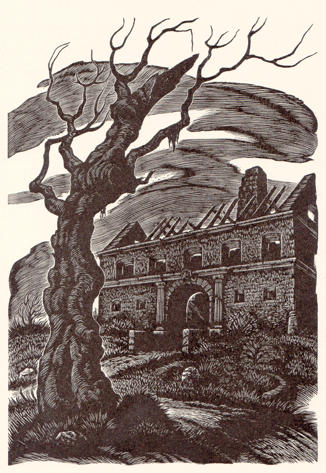
Since we talked about Jane Eyre day before yesterday and since I seem to be in a darkly, gloomy, walking on the moors (unfortunately there are no moors in NJ) sort of mood, I present to you the incredible wood cuts of engraver Fritz Eichenberg. I've only just run (figuratively) across his work within the last couple of weeks - isn't the Internet great for this sort of thing?

Though I know that many, many other bloggers got to Eichenberg ahead of me and if you were one of them why didn't you let me know? Just sayin'.

This dark and brooding 1943 version of JANE EYRE (there's also a WUTHERING HEIGHTS  for you Heathcliff fans) is certainly a work of art and since my own copy of Jane Eyre is literally falling apart, I am making it my mission to get my hands on a nice Eichenberg edition. The book has been out of print for awhile (it's possible that with all the recent talk about this amazing work, some publisher might take the hint and re-issue the book) - John of Pretty Sinister Books will know, I'm sure.

German American artist, Fritz Eichenberg (1901 - 1990) was born to a Jewish family, in Cologne, Germany. He worked as a printer's apprentice and studied at art schools in Cologne and Leipzig, before moving to Berlin to begin a successful professional career. He was interested in exposing social injustice through his work and had already formulated an anti-war policy having lived through the destruction of WWI.

With the advent of the Nazis (whom Eichenberg publicly criticized), the artist and his wife left Germany behind in 1933 and emigrated to America where he settled - mainly - in New York City. He taught art and worked for the WPA Federal Arts Project. Later he served as head of the art department at the University of Rhode Island.

Eichenberg became a Quaker in 1940 and remained so for the rest of his life.

In his prolific career as a book illustrator, Eichenberg worked with many forms of literature but specialized in material with elements of extreme spiritual and emotional conflict, fantasy, or social satire, illustrating such authors as Dostoyevsky, Tolstoy, Charlotte and Emily Bronte, Poe, Swift and Grimmelshausen. He also wrote and illustrated books of folklore and children's stories. 
(Wikipedia)

To learn more and see more of Fritz Eichenberg's work, please use this link. More artist information is available here and here . As well as on many other sites around the net.

Publishers' Weekly wrote about this edition here.

Tuesday, September 4, 2012

Forgotten (or Overlooked) Film Tuesday: JANE EYRE (1943) starring Orson Welles and Joan Fontaine


Tuesday means Forgotten Film day around here, so don't forget to check in at Todd Mason's blog, Sweet Freedom. As genial host of our weekly meme, Todd's blog is a veritable hot bed of links to other Forgotten (or Overlooked) Films(or other audio visual material, i.e. Television) posted by other movie mavens.

Artwork by Fritz Eichenberg.

Technically everyone knows JANE EYRE, the novel, and hardly a couple of years can go by without someone filming another version of Charlotte Bronte's book, so I make no claim that it's a forgotten or overlooked property. So what are you talking about, Yvette?  I'm talking about a version I do consider generally forgotten - the 1943 adaptation that had Aldous Huxley and John Houseman as two of its screenwriters. (!)


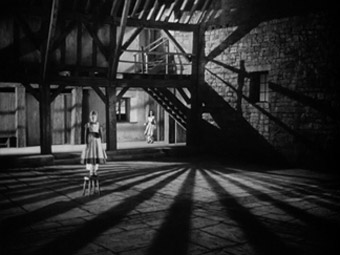
The film was shot in the gloomiest of black and white (mostly on a sound stage) by George Barnes and directed by a man named Robert Stevenson (no, not Robert Louis Stevenson) and had, far as I'm concerned, a very intriguing all star cast. Not the least of which was the very young beauty, Elizabeth Taylor, in an uncredited role. (Probably the last time that ever happened.)


I suppose some might think Orson Welles an odd choice to play Mr. Rochester, but to my eye, he is perfect. He has just the right hint of dissipation that most of the other Rochesters never really manage. Much as I loved Timothy Dalton's version, he never once looked as if he might have lived a previous life carousing on the Continent, let alone loving and marrying a Creole woman on some sweltering tropical isle overrun with sugar plantations, madness, and wild, abandoned sex. (At least according to Jean Rhys' WIDE SARGASSO SEA.)

But I can believe anything of Orson Welles. He has the look of a possible debaucher.

At any rate, I think he was an excellent choice. He looks good too. This is years before Welles gained all that weight and allowed megalomania to check his brilliance. As the dashing Mr. Rochester he has the swagger of a full blown ego - a spoiled, self-centered boy grown into a reckless man filled with regret who nevertheless, does as he pleases - and filthy rich to boot.


JANE EYRE begins with the unhappy young Jane (played very effectively by Peggy Ann Garner) being shipped off to the grim Lowood School by her imperious, hard-hearted aunt (Agnes Moorhead) who has an unreasonable aversion to the young orphan. The head of the school, Henry Brocklehurst, is played in odious fashion by the one and only sour puss of all sour pusses, Henry Daniell - hiss-s-s-s-s! He personifies everything foul and icky and you immediately know that little Jane is in for a hard time.


Sure enough, at the cheerless Lowood, the plucky Jane is treated like a pariah and cruelly punished for the slightest infraction.


Only one girl has the heart and daring to befriend her, the sweet-natured Helen Burns (Elizabeth Taylor). The two become inseparable until some sort of wasting disease (possibly pneumonia) takes the beautiful Helen away to a better place.


The doctor (John Sutton) who treats Helen does remonstrate with Brocklehurst about the girls' treatment. But truth to tell, there's not much he can do. He does manage to give a grief-stricken Jane a few words of  coping advice. Better than nothing, I suppose.


Eventually, Jane (now played by Joan Fontaine) who has stayed on at Lowood to teach, finds an escape. She advertises for a job as governess and before you can say 'mad woman in the attic' Jane arrives at Thornfield Hall, a dignified pile of rocks somewhere unspecified, maybe Northumberland.


The house is an interesting point, since its interior looks so different in each adaptation. In this version, Thornfield's interior looks like a very inhospitable, dark and forbidding old mausoleum. (Shot in black and white with lots of noir shadows and dark corners.)


Jane Eyre brings a needed breath of fresh air to Thornfield in her job as governess to a little French girl (Margaret O'Brien), Rochester's ward. Supposedly the child is the offspring of a French 'dancing girl' and 'who knows who?'. Rochester claims in an offhand way that she is not his, merely a child left orphaned when her mother, a 'French dancing girl' and Rochester's mistress, died. Even Rochester's jaded eyes were opened when he found said dancing girl preferred a preening soldier in a pretty uniform, to him. I mean, really.

Back to the present: a lonely road covered in fog on an evening when Jane is either going for an aimless walk or off to mail a letter  - whatever - the ambiance is perfect for a romantic first meeting.

After spending months living at Thornfield with just the company of a child and a chatty housekeeper (And by the way, it's never made clear in the films whether the housekeeper knew about the mad person lodged in the attic. I mean, I'm assuming she knew, but sometimes it's hard to tell.) Jane is unprepared for company. Especially that of a lone rider thundering down a dark road accompanied by a huge dog name Pilot.


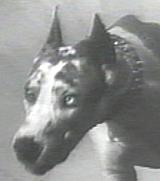
The dog is different in every film as well. In this one, it's a Harlequin Great Dane.  Just so you know.


After stumbling, Jane rises up out of the fog, confused by the sound of oncoming hoofs. Rochester's horse takes fright and rears up, throwing its rider to the ground.

A better (or more romantic) boy/girl meeting in literature and/or films has never been conceived. Charlotte Bronte may not have had much love in her lonely life, but she sure knew the meaning of romance. She recognized the heart's yearning for romantic drama. (Especially if the male in question is wearing a dashing, multi-cape coat that whips around him as he walks.)


Orson Welles is instantly intrigued by the black clad young woman he mistakes for a sprite in the dark of night. He admires her care and concern, her plucky insistence on helping him back into the saddle. Later, he comes to admire her naturalness (something not usual in women of that era), her refusal to be brow-beat or insulted. She makes him ashamed of his arrogance, I suppose. He is taken aback by the fact that she considers herself his equal - not in society but in humanity.


Again, before you can say, 'mad woman in the attic', Jane and Rochester fall in love. Though Rochester takes some sort of fiendish delight in leading Jane on - making her think he prefers the Honorable Blanche Ingram (Hillary Brooke), an icy beauty who is contemptuous of underlings, most especially, governesses. Rochester invites Blanche, her indulgent mom and assorted other high-toned locals to a house party.

Unfortunately, in the middle of the revels, an unexpected visitor arrives, all the way from Spanish Town, Jamaica.

Uh-oh.

Joan Fontaine is excellent as the unyielding, un-bending Jane - a woman who, despite her years and inexperience, knows more about life than Rochester supposes. Her natural and very moral superiority is at the heart of her refusal to overlook - all together now: the mad woman in the attic - once she realizes that Rochester is not free to marry her.

She leaves him, heart-broken and bereft, and only returns after a series of improbable events, led to him by a call heard in the wind on the moors. Did I say Bronte understood romance or did I not?

When Jane arrives back at Thornfield, it is a wreck of its former self, as is Rochester.

A classic book given a brooding, romantic film treatment, shot beautifully in black and white. I've stopped just short of calling this version of JANE EYRE, true film noir, though camera-wise, that's exactly the treatment it's been given here.


I especially love the way Orson Welles' eyes are lit to give him an eerie other-worldly intensity. Very effective.


I love the lightning hitting and severing the branch of a tree at the moment of Rochester's marriage proposal. Again, very effective. I also love all the slinky shadows and musical foreboding and the way Orson Welles gives this version of Rochester an aura of coiled tension.


Most especially, I love the ending.

Okay, I admit it, I love this film.

See the trailer here. (This link takes you the IMdB page where the official link resides.)


...sigh!

Sunday, September 18, 2011

What I Watched Last Night: JANE EYRE (2011) starring Michael Fassbender and Mia Wasikowska


Let me get right to the point: This is ultimately a disappointing film because of the casting of Michael Fassbender as Mr. Rochester. There. I said it and I'm glad.


In this  latest production of JANE EYRE based on the immortal book by Charlotte Bronte, Mr. Fassbender exudes zero sex appeal and zero allure. His make-up and general grooming is not well done (his hair looks HORRIBLE) and he never has the necessary presence that shows me, the viewer, the reason why Jane should have fallen in love with him practically at first sight.

Fassbender is not physically imposing in the slightest. There is also nothing of the tortured soul about him. Many of his lines are spoken as if they do not come from him (as they must), but from the dictates of the script.

There is only one scene in which he shows a bit of allure and since that runs only about three minutes, it isn't much to base a whole film on.


Let's face it, JANE EYRE on screen is a gothic romance (the book as well, I suppose) but the movie rests completely on the back of good casting. A good Rochester and a good Jane Eyre is imperative. Mia Wasikowska is fine as Jane, but there is NO chemistry to speak of with Fassbender. None. Zip. Zero.

The moody cinematography by Adriano Goldman is excellent as is the direction by Cary Fukunaga despite some scene set-ups which appeared a little awkward. The entire production has a dark and forbidding look and the Thornfield set is good.

The sound, not so much. In certain scenes it was impossible to understand what some characters were saying.

Judy Dench plays Mrs. Fairfax and has literally nothing to do, can't imagine why she was cast. It's practically a non-role. Not that Fairfax is a huge role in any production, but why waste Judy Dench?

One final note: The young women in this movie, Jane included, are SO alarmingly thin that I wondered if the film had been altered in some way. The waists of several of the actresses could not have been more than 20 inches, if that. I mean, minuscule. (And yes, I accounted for corset underpinnings.) Some of the camera shots pointed out this thinness and not, necessarily, in a good way. I wonder if these women eat anything at all. Scary.

So let's go from the worse to the best in one single leap:

Timothy Dalton as Rochester.

My favorite JANE EYRE production will probably always be the 1983 BBC mini-series starring Timothy Dalton. He was perfection as Rochester.


Zelah Clark as Jane (she was, perhaps, a little too old) was not as perfect, but she carried it off because of the intelligence shining in her eyes. She is a wonderful actress.

Zelah Clarke and Timothy Dalton

Another picture of Timothy Dalton....just because.

There have been many MANY versions of JANE EYRE over the years - some worked a bit better than others, some didn't work at all - George C. Scott as Rochester in the 1971 film, for instance.  I'm not sure if I'm remembering it worse or better than it was. Unfortunately the George C. Scott interpretation can't be found on Netflix. I would like to see it once again at some point.

Susanna York and George C. Scott

In 2006, there was another version of JANE EYRE, this time starring Toby Stephens as Rochester and Ruth Wilson as Jane. That casting was not very successful either.

Toby Stephens and Ruth Wilson

But Stephens was, at least, better suited for the part of Rochester than Fassbender. Though Wilson was, perhaps, a bit too cute for Jane. Still, at least the two actors generated some chemistry.

Liked the costume designs by John Bright and Andrea Galer very much.


In 1997, Ciarin Hinds as Rochester and Samantha Morton as Jane made for another disastrous pairing. I found this version almost unwatchable. Just like I'll never see the 2011 film again, I'll never watch this one again either. It was just plain awful. And I like Ciarin Hinds. He was wonderful as Captain Wentworth in the film of Jane Austen's PERSUASION.


In 1996, Charlotte Gainsbourg and William Hurt played Jane and Rochester. Not very successfully, I'm afraid. Again, zero chemistry between the lead actors, though Gainsbourg makes for an interesting looking Jane. William Hurt appeared a bit disengaged. It was difficult for me to accept Hurt as Rochester. Possibly becaue of his 'American-ness.' He never rang true for me as an Englishman of the 19th century.


I suppose my favorite cast of JANE EYRE (next to Timothy Dalton and Zelah Clark) would have to be in the black and white 1943 film starring Orson Welles as Rochester and Joan Fontaine as Jane. The cast also included Margaret O'Brien as Rochester's little French ward, Peggy Ann Gardner as young Jane and Elizabeth Taylor as her doomed childhood friend at the infamous Lowood School.

Elizabeth Taylor and Peggy Ann Gardner.

Orson Welles and Joan Fontaine.

They used some sort of tiny pin-point light apparatus to light Orson Welles' eyes. I've always loved that about these scenes. It gave him a lit from within intensity.

Another picture of Welles.....just because.

Joan Fontaine and Orson Welles at Thornfield.

The Thornfield set for this production was a bit too stark for my tastes. Though the outside was handled well enough considering most of it was shot on a sound stage. Lighting striking a tree branch as Rochester proposes marriage, is still a terrific effect.

The last scene where Jane finds the halfway blinded Rochester all bedraggled and bereft works especially well in this film. There is real passion between the two actors in their final clinch.

So what do you think? Do you have a favorite JANE EYRE version? Spill it.

(And please remember that all this is purely my own biased opinion.)

JANE EYRE was the beginning of my affection for all those darkly handsome and brooding heroes I was to read about later. Also, I might add, for the idea of an independent minded woman with a spirit as indomitable as a man's.


Thursday, March 31, 2011

Charlotte Bronte 156 Years Ago...


Charlotte Bronte (1816 - 1855), the last of the remaining Bronte brood died 156 years ago today. She was 38 and pregnant at the time. Too young to die. They were all too young. Honestly, when it comes to medicine and its practice, the 19th century appears to have been a veritable Dark Ages of ignorance.

I wonder what Bronte would think of the latest incarnation of her JANE EYRE character? The popularity, really, of all the sisters' work, but especially, JANE EYRE. I wonder if these young women could have ever suspected that their writing, done in the chilly rooms of that dark and gloomy rectory, would still be read, admired and talked about in the year 2011.

Tuesday, March 8, 2011

A New Movie Version of Jane Eyre Opens on Friday.


There's a fairly comprehensive piece on the new film version of Charlotte Bronte's JANE EYRE opening Friday, in today's NY Times online. (Can't wait to see it.) Here's a link to the new trailer. The piece in the Times has several links to previous adaptations of the story as well. While reading it I was remembering all the versions of JANE EYRE over the years and thinking I'd probably seen them all except for the very earliest. I only go back as far as the Joan Fontaine and Orson Welles 1944 film which I first saw on early television.

But there have been several that I've judged my favorites. The one with Orson Welles, certainly. He was the epitome of dark and brooding, his eyes lit by tiny pinpoint lights which heightened his mysterious allure. Joan Fontaine was a bit mealy-mouthed for Jane, but on the whole I didn't dislike her.

I liked the version with, of all people, George C. Scott as Mr. Rochester. The truth is, I mostly like George C. Scott in anything. Suzanne York played Jane. I haven't seen this in years since it's not currently available on Netflix, but maybe I can hunt it down somewhere. I really do want to see it again.

There are two I didn't like much: one with Ciaran Hinds as Mr. Rochester, he just wasn't right for the part. And the more recent one with Toby Stephens. Neither of these men embody Rochester for me. The one with Ciaran Hinds also had a not very winning Jane Eyre as well.

My favorite I must admit is the series done in 1983 starring Timothy Dalton. Though the idea of Dalton not being deemed 'handsome' is a laugher. I thought Zelah Clarke playing Jane was a bit too old, but other than that, I loved this episodic version.

Here's the Review from today's NY Times, for the new JANE EYRE film, by critic A.O. Scott.

Sunday, October 17, 2010

Sunday Salon: Six Favorite Literary Heroes

Yesterday I posted Five Favorite Heroines and so, today I'm posting Six Favorite Heroes. Fair's fair - right? (It was only going to be five, but I fudged.)

1) La Bete (Beast) in BEAUTY AND THE BEAST.
I've been thinking a lot lately about my interest in gothic lit and later, gothic suspense lit and I've realized that the original Mr. Gothic is none other than Beast, in Beauty and The...
I'm going to post a bit more on this theory of mine at a later date, but for now I'm listing the brooding beasty of my dreams as one of my favorite heroes though in truth, the story is more about La Belle than it is about La Bete. But I adore Beast as the ultimate in misunderstood males. The ultimate example of never judge a book by its cover. (Though the painting on the cover of this issue of the famous tale is lovely. I love Barrett's interpretation of the beast.)

2) Mr. Rochester in JANE EYRE
Well, we had a discussion with Carolyn on A Few of My Favorite Books on the finer and/or lesser points of Jane Eyre's beloved Mr. Rochester. I came down on the side of 'yay' while quite a few came down on the 'nay'. But my mind will not be changed. Mr. R was a favorite of mine when I was a kid, and lo these many years later, he is still a favorite. Wretched man though he may be. To my mind, all dark, mysterious men bristling with secrets, spring from Mr. Rochester and he, of course, springs from Beast. (That's my theory in a nutshell, but I'll talk more about this at some point. It's Not Byron, It's the Beast.) Rochester is definitely a man of his times, an imperious, high-handed, selfish, wealthy playboy who has committed a capital error in judgement and must now pay for it. Jane Eyre, the equally mysterious young governess, is his penance. How these two work their way into each other's lives is still a story worth the reading.

3) Stanley Hastings in DETECTIVE by Parnell Hall, and the rest of the many books in this on-going series.
As different from my previous two choices as night from day, I would still follow Stanley Hastings down any dark alley, but mostly to protect him from the bad guys. Stanley is not, what you'd call, a typical private eye and yet that is exactly what he is. A Manhattan p.i. who works for an 'ambulance chasing' lawyer, mostly tracking down witnesses to accidents that may or may not have actually happened. This is a very funny series as Stanley spends a great deal of his time wisecracking to cover his feelings of ineptitude. He underrates himself on all counts and never thinks of himself as a hero, yet that is exactly what he is. Because Stanley has a pretty prickly conscience and always wants to do what's right, he generally gets things that need doing, done. Things come right in the end because Stanley interfered. The world-weary Stanley is an anomaly in the land of hard-boiled private eyes since he is happily married and goes home to his wife every night. He is also an amateur actor (who'd rather be a professional) and occasionally gets involved in 'little theater' productions. His on-going stint as a p.i. is just to bolster his income in between acting gigs - or so he tells himself.

4) Sherlock Holmes in all the Arthur Conan Doyle stories.
I should have listed him first, but simply put: I forgot. Horrors. Hey, I'm an old lady with faulty memory. I'm lucky I remember to get up in the morning.

Anyway, yes, Holmes if my very favorite hero of all time. Yes, he's a cold fish, but I suppose I love cold fish. At any rate, I love this cold fish. I am a sucker for brilliance, especially eccentric brilliance. I am also mindful of a kind heart and I believe that Holmes, for all his thinking machine protestations, has a kind heart and a true sense of justice. When he forgets to be human he has his Watson to keep him from going too deeply into the dark.

I first read Holmes as a kid and knew right away that he was a hero for the ages. No wonder that to this day he is still read, he still gets letters addressed to him, he still continues to be larger than life. I am also very fond of the Holmes created (or maybe I should say, expanded upon) by Laurie R. King in her wonderful Holmes/Russell series begun with THE BEEKEEPER'S APPRENTICE. King has taken Holmes and added flesh and blood to his normally skeletal frame. The combo of Doyle and King is a knock-out.

5) Mr. Darcy in PRIDE AND PREJUDICE by Jane Austen
Not a big surprise. Though as I've said, Darcy can be a bit stiff-necked, he is still, at his best, the kind of gentlemanly hero many a young girl dreams of. The main thing that recommends him of course, is the fact that the smart and astute country lass, Miss Elizabeth Bennett, sees fit to fall in love with him. But Darcy can stand on his own. He is certainly dashing in a quiet sort of way, he is the epitome of stiff upper lip so he is not always complaining about this and that, or baring his soul to all and sundry like some modern men are known to do. I find that very attractive. He is also the kind of man who will sort things through and set things to rights if need be. He is the wealthy owner of a very fine house and has a very fine yearly income - nothing to make light of, that's for sure. AND he's not bad-looking, at least in the movies based on the novel. Always a good thing. PLUS, he gets to be taught a lesson in the end and is humbled by the need to learn and change for the better. (Though how deeply that change runs is another matter to be discussed at a later date.)

6) Radcliffe Emerson in all the Amelia Peabody books by Elizabeth Peters
In reality, this would be an impossible man to spend any great deal of time with, although he has his basic attractions and one tends to overlook much if the man is both brilliant and handsome. But in the fun-filled, fictional universe of the Amelia Peabody books, Emerson shines like the star he truly is. A star in his own universe. That's the most wickedly charming thing about him: he makes himself the star of his own universe and never deviates. It's up to Peabody, his equally eccentric and strong-willed wife, to smooth the waters if they get too disturbed. Though in truth, she seems to think that Emerson is entitled to behave as he pleases since he is the most brilliant archaeologist of this or any generation. Plus he does look awfully good in his work outfit of white shirt, sleeves rolled up to show his tanned muscular arms of course, and beige jodhpurs tucked into high black boots, not to mention his thick black, over-long hair blowing in the hot Egyptian winds. Sounds good to me.

Now I often say that the man, despite his attractions, is basically a lunatic (with all due respect) and I would be right most of the time. He has what I would call an Overpowering Personality, with all that those capital letters imply. He is eccentric with a capital E, brilliant (I believe I've mentioned that once or twice), possessive, kind-hearted, inclined to Dramatic Hyperbole, thinks nothing of rushing headlong into danger and has enough courage for three men. A brief example of his...uh, eccentricity: He pushes an annoyingly intrusive reporter down a flight of stairs at the hotel and then, almost immediately, denies he did any such thing - AND gets away with it because he actually believes he did nothing wrong. He cannot tolerate the slipshod methods of most of the other Egyptologists working archaeological digs and doesn't hesitate to let them know in the strongest possible voice and language. It's gotten to the point where the head of the Cairo Museum hides and refuses to come out when Emerson shows up. All of Emerson's native workers call him The Father of Curses. They adore him despite his many and various eccentricities. He is, in their estimation, a splendid man. In mine too.
Now of course, you have to post your own five or six or seven favorites.
I'll be posting more favorites myself as time goes by.
These sorts of lists are a great deal of fun to do.