Showing posts with label Orson Welles. Show all posts

Tuesday, September 4, 2012

Forgotten (or Overlooked) Film Tuesday: JANE EYRE (1943) starring Orson Welles and Joan Fontaine


Tuesday means Forgotten Film day around here, so don't forget to check in at Todd Mason's blog, Sweet Freedom. As genial host of our weekly meme, Todd's blog is a veritable hot bed of links to other Forgotten (or Overlooked) Films(or other audio visual material, i.e. Television) posted by other movie mavens.

Artwork by Fritz Eichenberg.

Technically everyone knows JANE EYRE, the novel, and hardly a couple of years can go by without someone filming another version of Charlotte Bronte's book, so I make no claim that it's a forgotten or overlooked property. So what are you talking about, Yvette?  I'm talking about a version I do consider generally forgotten - the 1943 adaptation that had Aldous Huxley and John Houseman as two of its screenwriters. (!)


The film was shot in the gloomiest of black and white (mostly on a sound stage) by George Barnes and directed by a man named Robert Stevenson (no, not Robert Louis Stevenson) and had, far as I'm concerned, a very intriguing all star cast. Not the least of which was the very young beauty, Elizabeth Taylor, in an uncredited role. (Probably the last time that ever happened.)


I suppose some might think Orson Welles an odd choice to play Mr. Rochester, but to my eye, he is perfect. He has just the right hint of dissipation that most of the other Rochesters never really manage. Much as I loved Timothy Dalton's version, he never once looked as if he might have lived a previous life carousing on the Continent, let alone loving and marrying a Creole woman on some sweltering tropical isle overrun with sugar plantations, madness, and wild, abandoned sex. (At least according to Jean Rhys' WIDE SARGASSO SEA.)

But I can believe anything of Orson Welles. He has the look of a possible debaucher.

At any rate, I think he was an excellent choice. He looks good too. This is years before Welles gained all that weight and allowed megalomania to check his brilliance. As the dashing Mr. Rochester he has the swagger of a full blown ego - a spoiled, self-centered boy grown into a reckless man filled with regret who nevertheless, does as he pleases - and filthy rich to boot.


JANE EYRE begins with the unhappy young Jane (played very effectively by Peggy Ann Garner) being shipped off to the grim Lowood School by her imperious, hard-hearted aunt (Agnes Moorhead) who has an unreasonable aversion to the young orphan. The head of the school, Henry Brocklehurst, is played in odious fashion by the one and only sour puss of all sour pusses, Henry Daniell - hiss-s-s-s-s! He personifies everything foul and icky and you immediately know that little Jane is in for a hard time.


Sure enough, at the cheerless Lowood, the plucky Jane is treated like a pariah and cruelly punished for the slightest infraction.
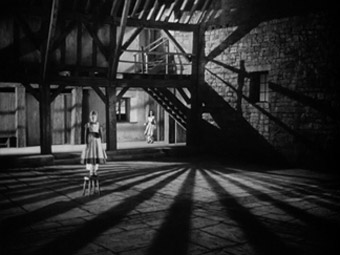

Only one girl has the heart and daring to befriend her, the sweet-natured Helen Burns (Elizabeth Taylor). The two become inseparable until some sort of wasting disease (possibly pneumonia) takes the beautiful Helen away to a better place.


The doctor (John Sutton) who treats Helen does remonstrate with Brocklehurst about the girls' treatment. But truth to tell, there's not much he can do. He does manage to give a grief-stricken Jane a few words of  coping advice. Better than nothing, I suppose.


Eventually, Jane (now played by Joan Fontaine) who has stayed on at Lowood to teach, finds an escape. She advertises for a job as governess and before you can say 'mad woman in the attic' Jane arrives at Thornfield Hall, a dignified pile of rocks somewhere unspecified, maybe Northumberland.


The house is an interesting point, since its interior looks so different in each adaptation. In this version, Thornfield's interior looks like a very inhospitable, dark and forbidding old mausoleum. (Shot in black and white with lots of noir shadows and dark corners.)


Jane Eyre brings a needed breath of fresh air to Thornfield in her job as governess to a little French girl (Margaret O'Brien), Rochester's ward. Supposedly the child is the offspring of a French 'dancing girl' and 'who knows who?'. Rochester claims in an offhand way that she is not his, merely a child left orphaned when her mother, a 'French dancing girl' and Rochester's mistress, died. Even Rochester's jaded eyes were opened when he found said dancing girl preferred a preening soldier in a pretty uniform, to him. I mean, really.

Back to the present: a lonely road covered in fog on an evening when Jane is either going for an aimless walk or off to mail a letter  - whatever - the ambiance is perfect for a romantic first meeting.

After spending months living at Thornfield with just the company of a child and a chatty housekeeper (And by the way, it's never made clear in the films whether the housekeeper knew about the mad person lodged in the attic. I mean, I'm assuming she knew, but sometimes it's hard to tell.) Jane is unprepared for company. Especially that of a lone rider thundering down a dark road accompanied by a huge dog name Pilot.

The dog is different in every film as well. In this one, it's a Harlequin Great Dane.  Just so you know.


After stumbling, Jane rises up out of the fog, confused by the sound of oncoming hoofs. Rochester's horse takes fright and rears up, throwing its rider to the ground.

A better (or more romantic) boy/girl meeting in literature and/or films has never been conceived. Charlotte Bronte may not have had much love in her lonely life, but she sure knew the meaning of romance. She recognized the heart's yearning for romantic drama. (Especially if the male in question is wearing a dashing, multi-cape coat that whips around him as he walks.)


Orson Welles is instantly intrigued by the black clad young woman he mistakes for a sprite in the dark of night. He admires her care and concern, her plucky insistence on helping him back into the saddle. Later, he comes to admire her naturalness (something not usual in women of that era), her refusal to be brow-beat or insulted. She makes him ashamed of his arrogance, I suppose. He is taken aback by the fact that she considers herself his equal - not in society but in humanity.


Again, before you can say, 'mad woman in the attic', Jane and Rochester fall in love. Though Rochester takes some sort of fiendish delight in leading Jane on - making her think he prefers the Honorable Blanche Ingram (Hillary Brooke), an icy beauty who is contemptuous of underlings, most especially, governesses. Rochester invites Blanche, her indulgent mom and assorted other high-toned locals to a house party.

Unfortunately, in the middle of the revels, an unexpected visitor arrives, all the way from Spanish Town, Jamaica.

Uh-oh.

Joan Fontaine is excellent as the unyielding, un-bending Jane - a woman who, despite her years and inexperience, knows more about life than Rochester supposes. Her natural and very moral superiority is at the heart of her refusal to overlook - all together now: the mad woman in the attic - once she realizes that Rochester is not free to marry her.

She leaves him, heart-broken and bereft, and only returns after a series of improbable events, led to him by a call heard in the wind on the moors. Did I say Bronte understood romance or did I not?

When Jane arrives back at Thornfield, it is a wreck of its former self, as is Rochester.

A classic book given a brooding, romantic film treatment, shot beautifully in black and white. I've stopped just short of calling this version of JANE EYRE, true film noir, though camera-wise, that's exactly the treatment it's been given here.


I especially love the way Orson Welles' eyes are lit to give him an eerie other-worldly intensity. Very effective.


I love the lightning hitting and severing the branch of a tree at the moment of Rochester's marriage proposal. Again, very effective. I also love all the slinky shadows and musical foreboding and the way Orson Welles gives this version of Rochester an aura of coiled tension.


Most especially, I love the ending.

Okay, I admit it, I love this film.

See the trailer here. (This link takes you the IMdB page where the official link resides.)


...sigh!

Wednesday, August 24, 2011

What I Watched Last Night: THE STRANGER starring Edward G. Robinson, Orson Welles and Loretta Young


I've seen this movie, directed by Orson Welles, a couple of times over the years and of course the only thing I ever remember was the ghoulish over-the-top ending. But when I saw it again thinking I'd talk about it on the Overlooked Movies meme held every Tuesday I finally realized what a superb botch of a movie it really is.

Here's what I figure: The editing must have been done by committee at the studio. Perhaps Welles wanted to do it and wasn't allowed to? (Wouldn't be the first time.) I don't know the behind the scenes story so I wish someone would let me know what the heck happened to this film.


It starts out to be a great story about the hunting down and destroying of a Nazi war criminal who has escaped Germany at the end of WWII. I mean, what could be better? Though the fact that the screenplay has several writers listed and John Huston and Orson Welles unlisted should have been a tip off to what went wrong. But I didn't know that until recently.

First a few words about the casting.


Loretta Young as Mary Longstreet, a naive, newly married housewife (a part usually tailor made for her) is so out of her depth here that she appears even more goggle-eyed and brittle than usual. She always did have a kind of owly look going on, but it worked for her in lighter films and soap opera. Up against a fiend of a Nazi killer, not so much. She looks simple and gullible and very foolish. Of course, that's the way the part is written so maybe it's not all her fault.


The movie is kind of an odd combination of soap opera and noir thriller. So who knows if any actress could have done any better with the thankless part. And no, the fact that she gets her revenge in the end doesn't make what came before any more palatable.

Edward G. Robinson can do very little wrong as far as I'm concerned. Here he plays Mr. Wilson, a determined Nazi hunter sent from the War Crimes Commission in - I suppose - Nuremberg, Germany, to ferret out and if not capture, kill an infamous Nazi. Wilson's wily single-minded devotion to his mission is commendable, he is the one good thing in the film. Though I question some of his tactics - involving Mary Longstreet's family members in a very dangerous game, for instance - but I suppose any port in a storm is the modus operandi for Nazi hunters. And by the way, why is he sent all alone to track down this most dangerous of escaped villains? An assistant or two would have come in handy. Maybe a bodyguard? But still Robinson makes what he can of the strong-willed, pipe smoking nemesis.

Orson Welles  looks good as the clock fancying new husband, crazed killer and Nazi villain combo. I mean, he practically seethes in every scene. Smoke comes out of his ears. Well, not really, but use your imagination. He is a cauldron of repressed Nazi villainy. He has one great speech at the dinner table in which he talks about the German soul and character, but other than that it's all skulking about, scowling and looking dangerous.(Why he has no German accent is never explained.)

The dinner scene takes place after his marriage to Mary which occurred shortly after Welles (as the newly minted Charles Rankin) has strangled (with his bare hands) a character from his past who has shown up in the sleepy Connecticut town where Rankin has established himself as a gregarious college professor. The victim is a man who had been allowed to escape from prison by the War Crimes Commission in hopes he would lead them to bigger Nazi fish.


The gist of the story:

Mr. Wilson is after a Nazi kingpin and master planner who has, apparently, escaped into 1946 New England. The trail has led Wilson to a small idyllic college town in the Connecticut countryside. (What are the odds?) Here is where the rest of the story will be played out in dramatic fashion.


At the center of town, in the square, is a church with an appropriately fancy antique clock in the tower, a clock whose works need fixing. And who else better to tinker with the works than the evil Nazi? Uh, I mean, Professor Charles Rankin, whose hobby is tinkering with clocks. Unfortunately for him, this is also the well-known hobby of the man being hunted by Wilson.

So it's apparent, really, from the first that the story will be a mano-a-mano duel between good and evil. It's nicely set up that way. The innocent looking, sleepy little town bedecked in white clapboard and peopled with checker playing denizens. Nice touches. There's a good scene in a dark school gymnasium and some interesting byplay as Mr. Wilson scopes out the lay of the land.


Pretty soon he's narrowed down the chase to Professor Rankin and soon after that, he's wormed his way into the family of Mary Longstreet as a guest of her father, a judge and antiques enthusiast. Soon after that Wilson is enlisting Mary Longstreet's younger brother (played by a sincere but very callow looking Richard Long) in his plans. I think we're meant to know that Wilson is good at sizing people up and taking advantage of what's available.


Well, we've seen Rankin strangle a man with his bare hands early on but it's not until he kills the family dog that we are truly made aware of his disgusting villainy - this man will stop at nothing! Before you can say 'now, what', he begins plotting to kill his gullible wife  - he has strung her along with the most absurd of sob stories about his past. She, of course, chooses to believe he is simply misunderstood. Even when Rankin tells her he's recently strangled a man, she decides to run away with him anyway. (She doesn't know, at this point, that he's a Nazi - just a common, garden-variety murderer. But, c'mon, woman, use your intelligence.) I guess she figures what would a Nazi be doing in Connecticut?


Eventually Mary is forced to realize the true nature of the monster she's married and she does get a measure of revenge. It all occurs in the high reaches of the clock tower where everyone has gone (including the townspeople) to watch the end of the story.

Rankin gets an appropriately ghoulish and bizarre death which is meant, I suppose, to make us feel the satisfaction of good finally triumphing over evil. But can any death really be good enough for a man so foul? Here's the problem: the ending is a botch. Badly edited and not especially well shot, much of the intended shock and awe turns to bemusement. It feels like a grand operatic death without the accompanying music. Well, except for the noise of the clock malfunctioning in the steeple. (There should have been at least an aria or two.)


Then, Edward G. Robinson's character makes a flippant remark to Loretta Young's character as he lights his pipe, and the screen goes black. I mean, huh?

I waited for more, but that was it. Obviously somebody none too handy with a scissor had done some heavy-handed slicing and dicing. What else are we to think?

In fact, most of the film is edited in a choppy manner with one scene not necessarily leading to another and occasionally odd camera angles interfering with the action. This is especially apparent in the second half of the film.

The thing that is most bothersome about it all is that it's obvious (despite Loretta Young) this could have been a memorable thriller. A new kind of movie genre: the noir soap opera.

Despite it all, I still say see the movie and make your own judgement. There are elements of it that are affecting and suspenseful. The first half of the film is well enough done. And Orson Welles was always a fascinating screen presence - even with smoke coming out of his ears. Then, of course, there's Edward G. Robinson. Though he's wonderful in just about anything, even he has a hard time saving this one.

But there are some bad films you just have to see for yourself. This is one of them.