Showing posts with label Charlie Chan. Show all posts

Tuesday, July 31, 2012

CHARLIE CHAN AT THE OLYMPICS (1937) Starring Warner Oland and Keye Luke


Along the lines of 'better late than never' here is my entry in Overlooked (or Forgotten) Film Tuesday - the weekly meme hosted by Todd Mason at his blog, SWEET FREEDOM. Head on over there for pertinent links to other movie mavens and their contributions.

I thought today's film appropriately fitting since Olympic Hoopla is currently taking place in London. (And thanks to Prashant for giving me the idea to do an Olympics themed  post.)

The always adorable Keye Luke.

It's 1936 and the Berlin Olympics are just days away. Jimmy Chan (Keye Luke) will be taking part, competing in the swimming events. At present he is on board ship with his friends and fellow Olympic contestants. As usual in these sorts of films, the 'kids' look older than they should be, but it's possible that people aged differently then.

Among the passengers is Richard Masters (Allan Lane - later to earn fame as B-western action star  'Rocky' Lane AND as the voice of TV series talking horse, Mr. Ed), the youngish romantic interest in danger of falling for a vamp's wiles, and Betty Adams (Pauline Moore) a spunky gal who is also competing at the Games and with the vamp for Richard Masters' affection.

Katherine DeMille - the 'vamp' in question

Yvonne Roland (played by Katherine DeMille in a rather obvious way), is a slinky, professional temptress - in those days, women of this sort made a living as 'vamps' - ruining young men and worming secrets out of them - at least according to tradition. Today, of course, they have google. 

The other suspicious character aboard the ship bound from New York to the Continent, is Arthur Hughes (played by perennial bad guy C. Henry Gordon - another of those terrific character types we love to hissss!)

C. Henry Moore

Of course there is a secret formula involved (you knew that was coming - right?), it's for a new airplane gizmo which allows for remote control piloting  - kind of an early version of the 'drone'.  Both Hughes and Roland are involved up to their necks.

Charlie Chan (after doing a bit of sleuthing in Honolulu where the secret formula originally went missing and a pilot killed) has caught up with the ship by utilizing the Hindenburg blimp to scoot across to Europe arriving at almost the same time as the ocean liner. He is on the trail of Masters (who is wrongly suspected of stealing the secret formula), Yvonne Roland and Arthur Hughes - all three appear to be in cahoots.

Chan is met at the dock by an officious representative of the German police in spiffy uniform (no Nazi regalia) who will assist in the on-going investigation. He looks like something out of a Viennese operetta, but hey, better than a swastika.


The rest of the film takes place in various locales, trains, hotel rooms, the Olympic stadium as well as a country villa where the bad guys hang out and a Berlin curiously devoid of any Nazi markings.

Assorted henchmen and one vamp hanging out at the villa, occasionally playing chess to wile away the hours.

We do get to see some actual newsreel of the '36 Olympics, including nice footage of Jesse Owens winning his medals. (Much to Hitler's chagrin - so much for white athletic supremacy theories.)

In the end the bad guys are vanquished, the secret formula saved, Jimmy Chan wins a medal and all is right with the world. At least for that one moment in time.

I'm happy to say that CHARLIE CHAN AT THE OLYMPICS is currently available for viewing (in its entirety) on youtube.

Tuesday, July 3, 2012

Forgotten (or Overlooked) Films Tuesday: Charlie Chan in MURDER OVER NEW YORK starring Sidney Toler


Charlie Chan in MURDER OVER NEW YORK (1940), a film directed by Harry Lachman, is my entry in today's Forgotten (or Overlooked) Films, a weekly meme hosted by Todd Mason at his blog, SWEET FREEDOM. Don't forget to check in later and pick up the links to today's participating bloggers, there are bound to be some intriguing films and/or audio visuals listed.

The Plot:


For reasons that are never adequately explained, Charlie Chan is on his way from Hawaii to New York to attend a police convention - something he does with amazing regularity over the course of several films. (Do they even have those things anymore? I mean, a trip from Hawaii to NYC in the 1940's was a heck of a trek.) And of course, murder always ensues. Usually the victim is a policeman friend from Scotland Yard. (The Yard is slowly but surely being plucked of its inspectors - at least those who are friendly with Charlie Chan.)


It's no different in this particular film as Charlie meets up with former Scotland Yard and now Intelligence agent, Hugh Drake (Frederick Worlock). Of course the minute they meet on the plane, it's uh-oh. You know the poor guy is doomed. It's too bad because Frederick Worlock can be (and is in this film) a very charming actor. You'll probably recognize him from the Sherlock Holmes films with Basil Rathbone.

While on the plane, Drake and Charlie get to talking and Drake reveals that he's on the hunt for a saboteur. You wouldn't think this is the sort of thing that would be discussed out in the open for anyone to overhear, but apparently that's not an issue in these films. Maybe all the other passengers had cotton in their ears. After all, we need to find out immediately (and quickly) what Drake is up to since we know he's not long for this world.

Turns out Drake has chased the elusive saboteur (a master of disguises) from pillar to post, well, from England to India then all over the east until finally settling on the saboteur's wife (who ran away from her nasty brute of a husband and has since been traveling incognito, on her own, doing odd jobs all over the world - yeah, I know, SO far-fetched). The wife apparently knows next to nothing about anything - she's played in a typically vacant manner by the exceedingly vacuous Marjorie Weaver, a staple in several of the Charlie Chan films.

Anyway, everyone winds up in NYC and presumably the master saboteur is there as well, disguised so well that even his own wife doesn't recognize him. She is useless as a witness.

A favorite character in the film is George Kirby (Ricardo Cortez) - you know my crush on Ricardo. I watch this film all the time just to reacquaint myself with his smoldering good looks. Unfortunately he gets bumped off later in the film and we never really know whether he was good or bad - his constantly shifty eyes made me think he was guilty of something, for sure.

Kirby meets the plane in NYC (literally, since in those days you could walk out on the tarmac and up to the plane). It turns out he's giving a dinner party for Hugh Drake that night with a guest list suggested by Drake.

Also at the airport, unexpectedly, is Jimmy Chan (Victor Sen Yung) who has driven cross country with a friend to attend the World's Fair (if memory serves) of which we hear nothing further in the rest of the film.


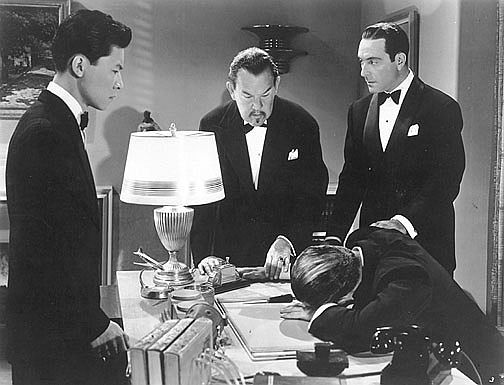
Later that same night, Drake is found dead in a room Kirby had turned over to him as an office. Oh, meant to mention, George Kirby is president of an aircraft company which has recently been hit by saboteurs. Coincidence? I think not. Though he seems remarkably unconcerned.


Among the guests for dinner at Kirby's are Ralph Percy, an engineer at Kirby's company, played by the gorgeous and resolute Kane Richmond. Richmond was a fixture in mysteries, noir films and serials of the 40's.

No reason to show this pix of Kane Richmond other than the fact that he's a hottie.

Back to the plot:

It's a relatively small dinner party with those in attendance presumably having something or other to do with the saboteur case, though Chan and the police are unsure just how they're all connected since the man who might have told them is dead. Hugh Drake was apparently killed by poison gas released from a glass pellet. The type of gas, 'tetragine' is somehow deduced by Jimmy Chan who has, apparently, been studying untraceable poison gasses at college. (!?)


It's obvious that the elusive saboteur is one of the men in attendance - but who? Suspicion falls on Kirby's butler, Boggs (Leyland Hodgson - yet another refugee from the Sherlock Holmes films). The butler did it? Nah. Don't you believe it.


The next twist comes when the saboteur's wife Patricia Shaw (Marjorie Weaver) is tracked down by Charlie Chan. The rather boring Robert Lowery in his usual role of romantic interest plays Shaw's boyfriend. He's a chemist. Get it? Chemist. Explosives. He's been working on his own, developing a new type of.......all together now: explosive! - of course.


Charlie Chan, with Jimmy in tow, must now chase around New York looking for clues. They are shot at prompting Jimmy to say, without any trace of irony, "This is the last time I go on a case without a gat." Oh Jimmy, Jimmy, get hold of yourself.

The two break into an antiques shop in the Village being used as a front for poison gas manufacturing (!?) and Charlie eventually brings all the suspects together for an unexpected flight on a new experimental plane designed by the deceased Kirby's company.

As usual, it's all preposterous (the plot really makes little sense) but tons of fun. If you like early 40's mysteries, you'll love this one. I do. But then, as many of you know, I'm a Charlie Chan fan-girl.


Friday, November 4, 2011

If you're in a Charlie Chan mood...

Warner Oland as Charlie Chan.

In case you didn't know - several of the Charlie Chan films are currently available for viewing on youtube. How cool is that? The entire movie, not just a clip. I couldn't believe it myself, but it's true. I've been having my own Charlie Chan Marathon for a couple of days. Feel free to join me.

Handy-dandy links below:

Charlie Chan at Monte Carlo

Charlie Chan in London

Charlie Chan's Secret

Charlie Chan at the Olympics

Charlie Chan at the Opera

These all star Warner Oland as Charlie Chan and Keye Luke as his son. 

Tuesday, July 12, 2011

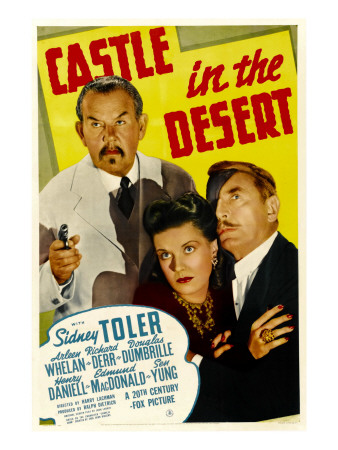
Tuesday's Forgotten or Overlooked Film: CASTLE IN THE DESERT (1942) starring Sidney Toler as Charlie Chan


This is one of my favorite Charlie Chan movies though explaining why may make it sound as if it's not so much a favorite after all. But believe me when I tell you that I have lost count of how many times I've viewed and enjoyed this film over the years, despite it's many faults. (Or maybe because of its many faults.) Whatever the reason, I have a great deal of affection for CASTLE IN THE DESERT.


I'll make a 'query' list and see if we can come to a reasonable explanation of some things about this film (directed by Harry Lachman) that have always bugged me.

The story makes little enough sense (but that's okay, very few screenplays make actual sense), but let me give you the gist of it first: Charlie Chan is on the scene in an actual castle in the California desert when  murder occurs. Okay. Though why he is actually there is never fully explained unless it is merely at the whim of a murderer. Fair enough, I suppose. One can assume that even a murderer may be prone to whims.


But I'm getting ahead of myself. The gloomy castle is the home of Paul Manderley (Douglas Dumbrille), a wealthy, eccentric and very reclusive historian who has decided to immerse himself inside the life of a 15th (or maybe 16th) century man - one of the infamous Borgias - with the eventual goal of writing a biography. To that end, he and his wife and a staff of servants live out in the middle of the desert, 35 miles from the nearest town of Mojave Wells. Castle Manderley comes complete with dungeon and apothecary and is devoid of all 20th century luxuries, i.e. electricity, phones and that sort of thing. One would assume they have running water and inside toilets. But one would only be guessing.

(Yeah, I'm noting the name Manderley, same as the house in REBECCA of 'Last night I dreamt I went to Manderley again...' fame - the book by Daphne du Maurier. Coincidence?)

As the film opens, Manderley's wife Lucrezia (aka Lucy) Manderley (Lenita Lane), Doctor Retling (Steven Geray), Manderley's physician, his lawyer Walter Hartford (Edmund MacDonald) and the lawyer's wife  Brenda (Arleen Whelan) are having cocktails. Oh, and there's one other member of the party, another historian, a younger professor, Carl Detheridge played by Richard Derr of When Worlds Collide 'fame' who, though he has star billing, has absolutely NOTHING to do in the film but stand around. He's not even in the opening sequence. Supposedly he's off somewhere doing research, though we don't even know he's in the castle until later when Charlie Chan runs across him in a library.

Wait, I'm getting ahead of myself again.

Long story short: A visiting genealogist supposedly dies of poison that same night. The incident is hushed up because Paul Manderley dreads scandal for good reason: he will lose control of his fortune if any hint of it - scandal, I mean - is attached to his name. (!?) They all suspect Manderley's wife has gone mad - because she is an actual descendant of Lucrezia Borgia - the 15th century Renaissance poisoner. Apparently Mrs. Manderley has decided on a whim (there goes that 'whim' thing again), to poison a guest in her home.

When a second murder occurs, Manderley is entreated by his doctor and his lawyer to have Lucy Manderley put away. He tells his doctor to have the lawyer draw up the papers. As if that's all anyone has to do and boom! someone is off to the loony bin. But maybe that's the way it was back in 1942.

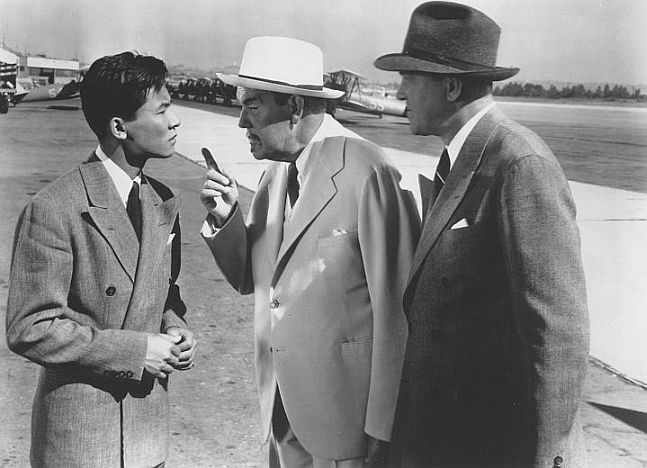
In the meantime, Charlie Chan - who is traveling in Southern California with his number two son, Jimmy (Sen Yung), fresh on furlough from the Army - has received a note ostensibly from Mrs. Manderley, the Princess de La Borgia begging him to come to her aid. He decides, on the strength of the note alone, to drop his plans and rush out into the desert. Needless to say, Jimmy follows not long afterwards though, of course, his dad has told him not to. The note says for Chan to come alone.

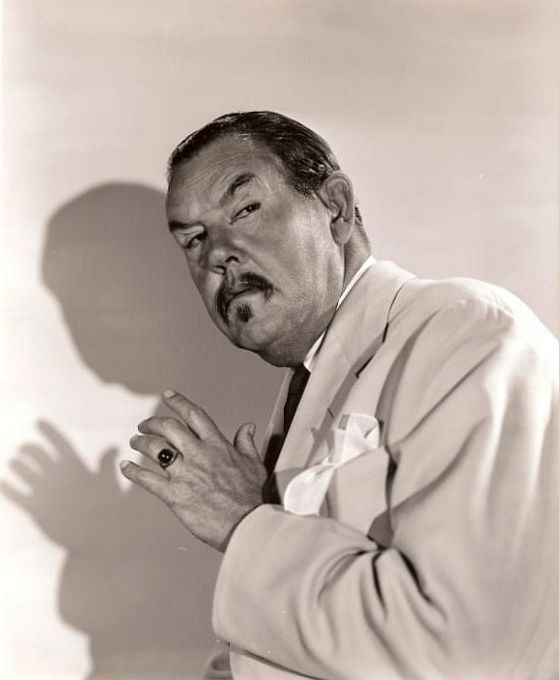
A great photo of Sidney Toler

Chan arrives in Mojave Wells and gets a hostile reception from some townies who resent Manderley's high handed lifestyle and the way he goes around town with 'half his face covered up'. Oh, did I fail to mention that Manderley has a black mask-like thing over the right side of his face? Well, he has. It's meant to cover up the effects of a horrible explosion.

The townies also resent Manderley's wife who they claim has 'put a curse on the town.'

Chan absorbs all this and when the station wagon from the castle arrives to pick him up, he and another passenger, the late arriving Watson King (played by Henry Daniell - hisssss!) are carted off to the castle. Later, Jimmy Chan shows up and hires a taxi to take him out to the castle as well. Along for that ride is the local old lady astrologer and teller of fortunes, Madam Saturnia (Ethel Griffies). She senses doom out at the castle and wants to tag along to see if she can help her friend Mrs. Manderley.

Turns out that Watson King - also known as John (!?) - is a sculptor who has arrived, at a rather inopportune time, to create a bust of Mrs. Manderley. But apparently there is more up his sleeve than a glob of clay.

When the only car (?!) in the garage has its carburetor removed, everyone is stranded in the castle with a murderer in attendance. Except that instead of an AND THEN THERE WERE NONE type scenario (as in the famed Agatha Christie story) we get a paltry single murder, to my mind, one of the main faults of the story. (The previous two 'murders' don't count. You'll know why if you see or have seen the film.)


Sen Yung and Sidney Toler

Now for my points of inquiry:

1) The casting of Lenita Lane as Mrs. Manderley. Though she is at the heart of the story, this actress's 'performance' is a lead weight that sinks every scene she's in.  OMG, has there ever been a worse actress in the entire annals of Hollywood history?

She speaks her lines as if she were a stand-in suddenly called upon to perform a Shakespearean tragedy at a supper theater in Des Moines. Every time I see this film, I marvel again at her incredible awfulness. I mean, she takes dreadful acting to new heights. It is so bad it takes your breath away. (Maybe that's part of the attraction of the film. To see again how bad an actor can be and still get a job in Hollywood.) The sing-song cadence of her speech has to be heard to be believed.


Sidney Toler and Lenita Lane

Even more incredibly, Lane appears in a couple of other Charlie Chan films. I can only assume she had some sort of strange hold over the powers that be, either in the production and casting end or at the studio.

2) The casting of an almost equally awful Steven Geray as Dr. Retling. Geray is bad, but in a different sort of way. He is this incredibly odd little fellow with a cabaret German accent and a truly creepy, faux sympathetic boyish veneer. The sort of 'doctor' one should normally take precautions against, and yet here he is, staying at this castle in charge of the health of a millionaire recluse who is as strange as he is....(Well, maybe that explains the whole connection.) He has a habit of repeating inane lines and simplistic cliches, which, I admit, are the screen-writer's fault, though I blame Geray for going along with it.

Richard Derr

3) The casting of Richard Derr. WHY IS THIS MAN IN THIS FILM? I'll tell you why. Because they needed a body to fill up the screen. He's meant to be the young lead - handsome, suave and looks great in a white dinner jacket - but he has absolutely NOTHING to do with anything in the script and there's no younger woman for him to play against. He's not even a murder victim! I can only assume that his part was lost in the editing.

4) Mrs. Manderley insists that she never sent for Charlie Chan. She has no idea why he's shown up at the castle out of the blue. So, who the heck sent for him? More importantly, WHY? This is never satisfactorily explained.

5) Who is Watson King? The part played by Henry Daniell - hissss! Is he a sculptor? A private detective? The long lost step-brother of Mrs. Manderley? Or all of the above. Someone please clear this up. The explanation in the film doesn't make much sense. And if he IS a private eye - WHO THE HECK HIRED HIM? Mrs. Manderley seems not to know him and yet she is the only likely person to have hired a private eye to check on things at the castle. Still, as played by Lenita Lane, she appears oblivious to the drama swirling around her. Apparently doesn't even know that the genealogist has disappeared.

Henry Daniell - hissss!

6)  The idiocy of Paul Manderley. Why would a man keep a shelf full of active poisons in his home in an UNLOCKED dungeon room when even he suspects his wife is not all that she should be AND his fear of scandal is at a pathological point? Why does he have an obvious shyster for a lawyer? Edmund MacDonald - come on. To look at him is to instantly clutch your wallet. Also: Why is there no emergency means of connection to the outside world? No secret phone that only Manderley knows about, for instance. (Yeah, I know, I know, because then there'd be no story.) Why only ONE car?  Yeah, it's a gorgeous woody station wagon, with the crest of the Borgias on the side, but still...

Edmund MacDonald

7) Where is the staff of servants when bad things happen? Are they all hiding out in the servants' quarters? More importantly - how do these people go back and forth into town? Presumably someone has to shop for food and the other necessities of staying alive in the middle of the desert. Is one station wagon really enough? Most importantly, how much are they being paid to put up with the extreme inconvenience of working at Castle Manderley? Lots and lots of money, I hope.

8) Last and most important: Why on earth does Paul Manderley wear a mask? The eventual denouement makes NO SENSE WHATSOEVER. I mean, jeez, talk about a non-surprise followed by a non-sensical explanation.

See what I mean? Lots to object to, but the film still works its spell on me every time I see it. I'm sorry but I can't be objective. CASTLE ON THE DESERT is just much greater than the sum of its B-movie parts. I love it but can offer no rational explanation for it. Kind of like the explanation for the mask. HA!


Henry Daniell - hissss! Sen Yung and Sidney Toler.

CASTLE IN THE DESERT has a cast of familiar actors who show up again and again in other Chan films made during the 1940's.  There seemed to be a casting department from which many of the same actors were plucked to play various roles - sometimes the villain, sometimes the window dressing. I like that. It's possible that part of my affection for these film springs from that sense of familiarity. Though I could definitely have done without Lenita Lane.

NOTE: This is my entry in Todd Mason's Weekly Meme - Tuesday's Forgotten or Overlooked Films. For more films and the posts of other film mavens, please check out Todd's blog, SWEET FREEDOM.

Thursday, July 7, 2011

A Charlie Chan Extravaganza!


For my birthday (which was last month) I treated myself to a box o' Charlie Chan films I found reasonably priced online at - gak! - Amazon. I didn't order them until a few days ago because I had to think long and hard about actually doing so. No spur of the moment spending around here, these days. Ha!


But I justified it by telling myself I couldn't pass up the opportunity. The price was just TOO good. Besides I am well and truly deserving of a belated Birthday treat. How's that? Works for me.

So, long story short: the package arrived today:

CHARLIE CHAN Volume 5 - Starring Sidney Toler

Seven, count 'em, 7(!) of my favorite Charlie Chan films in one convenient little box o' dvds collection.

CHARLIE CHAN'S MURDER CRUISE
CHARLIE CHAN IN PANAMA
CHARLIE CHAN in MURDER OVER NEW YORK
CHARLIE CHAN AT THE WAX MUSEUM
CHARLIE CHAN in DEAD MEN DON'T TELL
CHARLIE CHAN IN RIO
CHARLIE CHAN in CASTLE IN THE DESERT

Wow!!

The only favorites missing are: CHARLIE CHAN AT THE OPERA and CHARLIE CHAN ON TREASURE ISLAND. But other than those two, my Charlie Chan obsession is satisfied. I am one very happy movie maven.

This is the collection.

Note: On double-checking, it looks like there might be a chance I've never seen CHARLIE CHAN in DEAD MEN DON'T TELL. How is this possible I ask you?

The truth is, I probably did see it, but so many years ago as makes no difference to my memory. The brief synopsis doesn't sound even remotely familiar. Well, I'll soon find out. Although my Netflix film arrived today as well and I want to write about that one for Tuesday's Overlooked Films. Obviously, this is another embarrassment of riches. Am I complaining? Nope.

Monday, April 25, 2011

A Favorite Film: CHARLIE CHAN AT THE OPERA (1936) starring Warner Oland and Boris Karloff

In my probably biased opinion, there are maybe four or five really terrific Charlie Chan movies - this is one of them. I am a big fan of Charlie's, so if one of the early movies is on, I'm likely to watch it regardless. Though I like Warner Oland as Chan, better than Sidney Toler, I admit that Toler grew on me and did go on to make several favorites. But once Mantan Moreland got involved in the films and the budgets went down to zero, I stopped watching. There's a nice envelope of time - 1930's - mid 40's, when the films were still reasonably good. Most especially if you didn't care if the plots made any sense. Because, honestly, the scriptwriters/film-makers apparently didn't care either. If you break down the nuts and bolts of the mysteries, you get to the end and go, huh? But, so what. Logic is not why anyone watches Charlie Chan movies - at least I don't think so.

CHARLIE CHAN AT THE OPERA takes place in NYC, always a good town for a mystery involving an escaped maniac - or so Boris Karloff is referred to in the film. Karloff plays Gravelle (he only has one name), a former opera star who, since a horrific backstage fire, has suffered from amnesia and general looniness. He has been, as the film begins, a resident in an asylum, watched over by not-very-smart guards. The film has an absolutely perfect beginning on a rainy, windswept night at the loony bin with Gravelle sitting at the piano singing away in an agitated baritone voice. (Dubbed, I'm sure.)

When the guard brings in a newspaper, Gravelle spots a headline featuring a woman's name - that of soprano Lily Rochelle who is returning to star in the opera CARNIVAL. (It was the opera in which Gravelle had also starred years before.) Lily's name sparks Gravelle's memory, he assaults the guard and escapes from the asylum. The hunt is then on (with moody music to match) for what the newspapers colorfully refer to as 'the escaped maniac'.

In the meantime, Lily Rochelle, played with exaggerated (and charmless) diva mannerisms by Margaret Irving, goes to the police (Inspector Regan played by Guy Usher), escorted by her current paramour, tenor Enrico Borelli (played by Gregory Gaye). She's received some threatening letters and wants police protection. The cops haven't yet linked Gravelle to Lily.


In Inspector Regan's office at that moment is Charlie Chan who has dropped in to say goodbye, on his way home to Honolulu after solving a race track mystery which had baffled the cops. He is sailing later that evening.

Chan makes some astute deductions which makes Regan think that the threats to Lily Rochelle come from the escaped lunatic everyone's been searching for. He orders the opera house surrounded by cops for the opening night's performance, (This is in the old days when the cops had enough manpower to do this sort of thing, I suppose.)

When Gravelle makes his presence known at the Opera House, he scares the mezzo soprano, Lucretia Borelli (wife of the philandering tenor - who recognizes Gravelle) into cooperating with him and not letting on she knows he's hiding somewhere in the opera house. Singing the part of Mephistopheles in the opera, CARNIVAL, that night, is Enrico Borelli.His wife Lucretia knows he's been cheating on her with Lily Rochelle, as does Rochelle's husband - so there's all sorts of backstage jealousy and intrigue going on before the curtain rises.

In the meantime, the cops - including Charlie Chan - arrive at the opera and are soon made aware by a frightened seamstress that Gravelle is in the house, lurking about backstage. When Borelli finishes getting into costume (in a ridiculous Mephistopelian outfit with glitter and a mask), he is assaulted in his dressing room by Gravelle who pops in from a ceiling trapdoor. Gravelle then assumes the costume and goes forth to sing the role before anyone is the wiser.

In the first act scene, however, Mephistopheles is supposed to stab Lily (who is a little old to be playing an innocent village maiden, but what the heck) and the cops are uneasy as they watch the scene develop. Lily, herself, is aware that something is wrong since the man singing Mephistopheles doesn't sound so much like Borelli, but like the man who was once her husband and fellow opera star - a man who supposedly died in a fire. Lily is so frightened that as the act finishes, she faints and must be carried to her dressing room. Gravelle escapes from the cops who chase him backstage.

When both Borelli AND Lily Rochelle are killed - stabbed to death. The obvious culprit is the handy escaped maniac.

Oh, meant to mention, in the middle of all this, there's a young couple wandering around backstage looking for Lily and we're not supposed to know why. Turns out the young woman is Lily's unacknowledged daughter trying to get her mother's permission to marry. (One of the main reasons why the events in the script make no sense is because of this girl's supposed age coupled with the year that the fatal fire took place. Also, why would the soprano be killed off in the first act of the opera? But maybe I pay too much attention to details.)

So, Charlie Chan - with the help of his number one son, played by the wonderful Keye Luke - must solve the mystery in time to board their boat back home late that night. How he does it is to stage the first act of the opera once again with all suspects involved. So we get to hear the catchy aria that Mephistopheles sings to Lily yet again - Lily played this time by the mezzo soprano, wife of the dead Borelli.

I can't count how many times I've seen this film and yet I still enjoy watching the whole preposterous thing whenever I get a chance. It is just a great deal of fun. Maybe because it's so familiar, but I think it has to do with the whole backstage-at-the-theater thing and watching Boris Karloff play an opera singer. Also Charlie Chan has never been better. Will he and number one son make it back to Honolulu on schedule? What do you think?

One further note: CARNIVAL, far as I know. is not based on an 'actual' opera except that in the end credits you see the name of Oscar Levant listed as composer for the opera used in the film. Levant is known to us from all those MGM musicals where he generally added his sour-faced, off-key voice and personality playing side-kick to Gene Kelly or Fred Astaire but who, in reality, was actually a brilliant pianist and composer. I've always wondered too if the opera CARNIVAL by Oscar Levant, was ever finished and if so, what it sounds like.

I thought I'd add this link to my own review of: CHARLIE CHAN The Untold Story of The Honorable Detective and His Rendevouz with American History by Yunte Huang. This is a terrific non-fiction book by a Chinese American Professor which gives the background and explains the era, the when and where of the Chan character and how he was formed and based on a real Hawaiian detective. If you're interested at all in how Charlie Chan came to be and the society from which his creation sprang - then this is the book for you.


Monday, October 18, 2010

Monday Book Review: CHARLIE CHAN The Untold Story of the Honorable Detective and His Rendevous with American History by Yunte Huang

I'm going to go out on not much of a limb here and say that not everybody feels the same way I do about the fictional Charlie Chan. Some people (and I can hardly blame them for their point of view) see Chan, as portrayed by Warner Oland, Sidney Toler and a host of other white actors in the 30's, 40's and 50's as the ultimate stereotype - the Uncle Tom of an Asian American community that's had more than its fair share of distortion and tragic circumstance foisted upon it. Precisely because he was/is such a popular character Charlie Chan is probably taken as even more of an affront to racial dignity by those inclined towards this point of view.

My own personal view is based solely on the pure enjoyment I still feel while watching the Chan films. To me, Chan was, is, continues to be nothing more, nothing less than a brilliant detective who is called in to save the day when those about him haven't a clue. He is treated with respect (if not downright fear) by those around him because as I've said before, he is always the smartest person in the room. If you're going to have a stereotype, this is not a bad one to have. But that is my own personal view.

Chan is an image, a chimera. He is not real. He is, to me, the image (admittedly folksy) of rationality, of thought, of observational nuance and of brilliant deductive reasoning - Sherlock Holmes with less peculiarity. So, to my mind, if the actor playing him conveys that image successfully, he has done the job. Callously, perhaps, I don't worry about the idea that a white actor is playing an Asian yet again. I don't worry about it, because Oland and Toler, as actors, did the job so beautifully and with such dignity and style. One of the ironic charms of this book is the detailed way that author Yunte Huang reveals the nuts and bolts of both Warner Oland's and Sidney Toler's lives and their approach to playing Chan.

I have the sneaking suspicion that the author may, in many ways, feel as I do about Oland and Toler's interpretations. At the very least, he doesn't come down on Chan the fictional character, with lightning bolts from the heavens. Quite the opposite.

Yunte Huang is a scholar, a professor of English at the University of California, Santa Barbara. He was born in China and is now an American citizen. He began his literary investigation into Charlie Chan's origins a few years ago. Following a trail of clues which would lead him from the east coast, to the Midwest, to the west and finally, to Hawaii, he began to piece together the truth about Charlie Chan's non-fiction origins. In doing so, he has brought to life the not-as-well-known detective, Chang Apana (1871-1933), the son of a poor, uneducated Chinese coolie - who rose, improbably, to become a respected member of the Hawaiian police force. At a time when the very idea of a surge of Asians immigrating to this country brought terror into many an American's jingoistic heart and infamous anti-immigration laws were spawned in fear and hatred, a mid-western writer named Earl Derr Biggers (1884-1933) also improbably, created a Chinese detective character whom this very same public (paradoxically) would clamor to read.

According to historical record, it is a fact that author/creator Earl Derr Biggers and Detective Chang Apana did, indeed, meet. It is probable fact that Biggers had read of Apana's heroic exploits at some point early on; Chang Apana's fabled round-ups of Hawaiian miscreants while flashing a bullwhip, having made the stateside papers and possibly firing the imagination of a writer in search of a character.

In this luxuriously well researched and illuminating account (complete with photos), Yunte Huang clearly defines the confluence of lives and times of various characters who seemingly appeared at just the right time in history (literary happenstance), to help one way or another in the formation of the iconic fictional detective Charlie Chan.

Huang writes with a clear and concise voice, often deliberately dipped in irony but never bristling with anger. He shows the ugly nature of prejudice in well brought out historical episodes tucked into the story to help explain the state of the country in the early part of the 20th century. I was especially impressed, while reading, with the non-judgemental tone of Professor Huang's writing. Though I'm sure he has his own outraged ax to grind - don't we all? - it is never apparent in this book.

If you are a history buff and/or fan of Charlie Chan, you will enjoy this book. Even if you are not as familiar as I am with Chan the fictional detective, Yunte Huang's book is a remarkable, eye-opening adventure detailing as it does, parts of our shared American experience which many school books, to our children's detriment, do not bother to explain.

Here's a link to my earlier post on the Charlie Chan movies and a link to the books by Earl Derr Biggers, available in Felony and Mayhem Publishers editions.

Wednesday, September 29, 2010

I Still Love Charlie Chan

I was just reading artist Barbara Johansen Newman's post on her delightful blog Cats and Jammers Studio. (My favorite name for an artist's blog EVER.) This particular post is Barbara's opinion on all things Charlie Chan. We are in agreement over the idea of Charlie Chan The Stereotype and just how much we still love the Charlie Chan films.

In a nutshell: how can being smarter than everyone around you be a bad thing? As stereotypes go, I've never seen much wrong with this kind, but then I am not of Asian descent so I am not, perhaps, as sensitive as I should be. But to me, Charlie Chan is a brilliant detective who solves all the cases he takes on - he was always the smartest guy in the room. Far as I saw, he was treated with respect and deference by those around him, his thoughts, ideas and deductions always taken seriously. Plus: he ALWAYS got his murderer. At one point, he even saves the Panama Canal from saboteurs! Kind of hard to find fault with that kind of role model.

This is the excellent New Yorker piece about the new non-fiction Chan book: Charlie Chan: The Untold History of the Honorable Detective and His Rendevouz with American History by Yunte Huang.

I love the Charlie Chan films and I do continue to line them up on my Netflix queue whenever I'm in the mood for a damn good mystery.
Here's a short list of some of my favorite Chan films:
Charlie Chan on Treasure Island
Charlie Chan at the Wax Museum
Charlie Chan at the Opera
Charlie Chan in Panama
Castle in the Desert
Charlie Chan's Murder Cruise
A few weeks ago I blogged about the terrific trade paperback editions of the Charlie Chan books by Earl Derr Biggers, released last year by Academy Chicago Publishers. They are still good mystery reads.
What do you think about all this? Pro or con?

Friday, July 30, 2010

Reading Charlie Chan


Just wanted to remind everyone that the six original Charlie Chan books by Earl Derr Biggers are available in beautiful trade paperbacks published by Academy Chicago Publishers.

I love it when a publisher makes an effort to package books in well designed editions. I'm also extremely fond of 'trade' paperbacks. They fit well in the hand no matter if you're sitting in a rocking chair, lying in a hammock, or just in bed, leaning back among a bunch of pillows. The type is usually just the right size, too. If it were up to me, outside of hardcovers, ALL books would also be published in 'trade' size.

For those of you who only know Charlie Chan from the films of the thirties and forties, take a look at these books. Even if they might seem a bit dated (especially in their view of Asian-Americans), they are still well written enough - Inspector Chan is never presented as less than a dignified, intelligent detective. But then, I enjoy being taken back to times and places that no longer exist especially when there's a crime to be solved and a savy detective to pal around with.