Showing posts with label Martha Grimes. Show all posts

Thursday, September 25, 2014

5 British Crime Thrillers Lately Read

English painter Harold Knight 1874 - 1961 - source

Lately I've hit the jackpot, reading-wise. Though there have been a few non-starters which were promptly returned to whence they came - the library - there have also been quite a few intriguing surprises. I am, of course, delighted to share them with you. Fall is almost upon us and you know what that means: Full throttle READING TIME!

I recommended THE RIVER OF NO RETURN by Bee Ridgway in a previous post and now for a few more recommendations to wile away the chilly days ahead.


THE CUCKOO'S CALLING by Robert Galbraith aka J.K. Rowling

J.K. Rowling continues to amaze me. What a brilliant imagination - she is indefatigable. When she could be resting on her Harry Potter laurels (and millions) she continues to write, primarily I suppose, because she wants to - she enjoys it. It is her craft.

As Robert Galbraith she's written the first in a series which I hope will last at least as long as the Harry Potter books, but which has the excellent grounding to continue even further. She's created a bruised and flawed hero with an intriguing name, Cormoran Strike. Strike has angst to grind - what self-respecting private dick doesn't? - he's just broken free from a long-term destructive relationship with a woman he still loves. Large, rumpled and unkempt, sleeping in his office, the miserable Strike is only very barely making ends meet.

Strike is the bastard son of a famed rock star whom he's only met twice in his life. His mother, a once-upon-a-time groupie, is long dead and Strike, late of Special Forces, runs his struggling business from a small, shabby office in a London walk-up.

There he is aided and abated by Robin, a young woman first sent to him as a temp (though Strike cannot really afford to keep her on) who later proves (despite her protesting fiancee who'd rather she take a high paying job at some corporation) a tenacious and determined, not to mention, intuitive, assistant. She is someone who has always dreamed of being a private eye and now that she's found a job with Strike, she's not about to give it up without a fight. Strike, for his part, is smart enough to recognize sleuthing talent when he sees it.

Who killed Lula Landry, the rich and uber-famous super-model? When she goes flying off the balcony of her London apartment, the police label it a suicide. But when her brother shows up at Strike's office, refusing to accept the official verdict, he convinces Strike to take on the case. A case which will go a long way towards changing Strike's life.


THE SILKWORM by Robert Galbraith 

Here, in the second book in the Cormoran Strike series, Rowling takes on the dark asides of the publishing industry with gusto. Owen Quine, a pretentious, pompous, untalented and unloved writer with a taste for Jacobean dramatics, goes missing and his hapless wife asks Strike to find him primarily because she's run out of money. One grisly murder discovery later and said wife quickly falls under suspicion. But Strike believes she's getting a raw deal.

Though I enjoyed the Potter books very much and recommend them highly, what I loved best about these two Strike novels is that they are completely different from the world of Harry Potter, in tone, in flavor, in style and certainly in language. Rowling has revealed a modern gritty edge which serves this sort of book well. And though both books are slightly longer than your regular mystery/thriller, they read quickly, the pages fly by. In fact, when I got to the end I regretted having to leave Strike and Robin and wished there were even more pages.

As I said: J.K. Rowling continues to amaze.

Other books I've read lately that you might want to take a look at:


THE MALCONTENTA (1995) by Barry Maitland - The second in the Brock and Kathy Kolla, British police procedurals. On the strength of this one, I went to the library and got out as many Maitland books as I could carry.


THE DEAD IN THEIR VAULTED ARCHES by Alan Bradley - A Flavia de Luce book. I had the feeling reading this that it was the last of the series, but turns out, not. Of all the books in this intriguing mystery series featuring a precocious 12 year old girl living in 1950's England, this is the one in which the author allows 'magical realism' to take a hand in the surprising turn of events.


VERTIGO 42 by Martha Grimes - The latest Richard Jury book and I'm happy to report that Grimes has gotten her mojo back. If you love Jury, don't miss this. If you don't know Jury, go back to the beginning (THE MAN WITH A LOAD OF MISCHIEF 1981) and prepare yourself for one of the more intelligent and offbeat series. Very quirky, mind you - but that's what I love about them. Well, that, and the fact that Grimes is a terrifically inventive writer.

Friday, July 13, 2012

Friday's Forgotten Books: THE WINDS OF CHANGE (2004) by Martha Grimes


Friday's Forgotten Books is a weekly meme hosted by Patti Abbott at her blog, PATTINASE. Drop in later and check the links for today's books. It's bound to be varied and intriguing.

My entry today, THE WINDS OF CHANGE is a slightly edited version of a review I did a few years ago for the now defunct website, MYSTERYINK.

Martha Grimes is an American who thinks and writes like a Brit. She's created her own version of England and peopled it with an imaginatively inventive set of characters. This nineteenth installment in the long-running series featuring her elegiac Scotland Yard Superintendent Richard Jury, The Winds of Change -- the books are all titled after British pubs -- begins with the worst of crimes: the murder of a child on a London city street.

The sad death of this abused and unidentified, little girl is seemingly unrelated to the previous disappearance, several years before, of four year old Flora Scott, who was snatched from a public garden in Cornwall, right under the nose of her frantic mother, Mary. The loss of his step-daughter (a crime never solved) followed by the death from illness of his beloved wife, has left wealthy Declan Scott a recluse, a man consumed by grief.

Flora's biological father, London businessman, coin collector and suspected pedophile Viktor Baumann (whom the vice unit has been keeping an eye on) is linked to a notorious house in North London which happens to sit just a couple of blocks from the street where the current victim has been found.
Since there are few coincidences in crime, this is more than enough to raise an eyebrow as far as the local police are concerned.

When Richard Jury is alerted by Brian Macalvie, his old friend and divisional commander with the Devon and Cornwall police, that an unknown woman has been found murdered on the very estate where Flora Scott lived -- coincidentally shot with the same caliber gun as the little girl in London - Jury's investigation necessarily deepens. Soon he and the germ fighting, herb-tea-swilling, hypochondriac associate, Sergeant Wiggins are on their way to the southern coast of England.

For Jury this is also a personally trying time, he's just had news that his cousin Sarah, a difficult woman he was never especially fond of, has died. Since she was the only one left who shared Jury's hazy recollections of his youth, guilt forces him to reconsider their relationship and his memories as he takes time out to attend her funeral in Newcastle-Upon-Tyne. We know little, even after eighteen books, about Jury's life before he became a policeman, so it's interesting to see him interact with his few remaining relatives. Grimes is not often willing to share much about Jury's past. In some strange way, it's almost as if she guards him from our prying eyes.

Martha Grimes' books generally swoon with layer upon layer of melancholy. Her style is unique and no other thriller writer working today has her eloquent technique or her gift for staging. Dark forebodings plague her characters and often play part in establishing links between catastrophic events. The moors, the windswept coasts of the new angst-ridden England, even the London side streets reek of gloom and perished dreams. Even her animals share the human's penchant for melancholy, a unique "Grime-ism" which only she seems able to get away with. Grimes never just concocts a simple tale of murder, her stories always include that "something else," something indefinable; a sinister presence, unnamed, unexplained, unseen but always felt. Hers is a darkly gothic England which hasn't quite shaken loose its mythical demons and where secrets always rise up out of the past to snarl and bite.

But the unseen creature stirring in the woodshed in a Grimes tale is more ambiguous than a mere monster of fantasy. The monsters Grimes invents are human ones, well hidden beneath the deceptive guise of normalcy. No one is spared in a Grimes tale, not even children. Especially children. Grimes can be ruthless when it comes to the more innocent among us. She has a way of writing children, recognizably different from others in the genre. The Grimes child is always enigmatic, uniquely precocious, capricious and very much given to other-worldliness. The author obviously enjoys creating them and it shows.

And when one of them comes to harm, it seems a doubly hurtful occurrence.

The most melancholy of all characters in this series, is of course, her enigmatic creation Richard Jury. A Scotland Yard detective superintendent; Jury is a sensitive, introspective man given to reading poetry and ruminating about the exquisite darkness of life, and with just cause. He believes (like many things in a Grimes book, we're not entirely sure where the actual truth lies) he saw his mother die in a London wartime bombing which destroyed their home when he was about 4 or so. Lately though, he's begun to doubt this.

The reader gets the sense that Jury has spent his entire life in a fruitless search for the unnamed thing that his mother's death robbed him of -- but maybe not. One thing for sure, he can't seem to find and keep the right woman. A kind-hearted, attractive and intriguing man, he seems complacent in his aloneness. And can sometimes appear obstinate and obtuse. One wonders, for instance, if he will ever notice the suitability of Carole-Ann, an equally enigmatic young woman living and preening her bright plumage in London, right under Jury's nose. It's enough to make this reader occasionally shake her head in exasperation.

If Grimes' books were exclusively about Jury, the time might come when enough would be enough. As a character, he is, after all, overburdened with a gift for rumination bordering on the excessive. Upon occasion I have been heard to mutter "ENOUGH!" quite loudly in the recesses of my room. Jury can, occasionally, get on a reader's nerves.

But Grimes is astute enough to include a revolving cast of characters which serve to poke and prod the Detective Superintendent out of his self imposed inclinations and into the cold, cruel world to do battle with evil; a job at which he is superbly talented.

Grimes has a relish for quirky character names, ergo, the cast: Trevor Sly, Ada Crisp, Marshall Trueblood, Polly Praed, Vivian Rivington, Diane Demorney and the odious Theo Wrenn Browne, bookstore proprietor. We also get an assorted variety of oddly named cats and dogs (a feline named Desperado, for one) all denizens of the village of Long Piddleton - they seem to have wandered in from a P.G. Wodehouse novel. Yet somehow this disconcerting mixture works.

The Winds of Change is a darkly moody tale of murder, mixed identities and sleight of hand deception, and Richard Jury is once again on call to solve a case where the past casts a long shadow over the present.

Jury's good friend, the oh-so-upper-class Melrose Plant -- an Earl who has abandoned the title for reasons which remain unclear although in The Lamorna Wink, the sixteenth book in the series, hints are given -- arrives at Declan Scott's estate in Cornwall - incognito - masquerading as a gardener with an arcane specialty: the laying on and re-establishment of turf. Though given to cynicism, Melrose is almost impossible to dislike.
"The following day dawned clear and cold. Not that Melrose was up in it. He wondered sometimes what an up-at-dawn experience would be like, but he never wondered enough to try it."
Exceedingly rich, naturally charming (though seemingly unaware of it) and a lifelong bachelor, he is usually ensconced at his estate Ardry End, with his butler Ruthven, a fussy retainer of the old school. Both men are constantly on guard against visits from Plant's truly awful Aunt Agatha who delights in tormenting Melrose with the social niceties, and making trouble for the hapless citizens of their little village, Long Piddleton. But since Melrose is friends with Jury, he does routinely get involved in cases when Jury feels like including him.

Also on hand in this book, is the perpetually brooding police inspector Brian Macalvie. Burdened with his own private demons and dark nature, he and Jury make for an interesting, if somewhat somber, crime fighting duo. And as usual, Chief Superintendent Racer and his nemesis, the office cat Cyril, are on hand to make malicious mischief down at New Scotland Yard.

Martha Grimes works her compelling magic on the various skeins of this thorny, ultimately heartbreaking problem she's set before Jury and though all, of course, is never completely right in the end -- how could it be? -- most of the answers are revealed and life continues for the melancholy  Superintendent Jury of Scotland Yard.

Monday, April 4, 2011

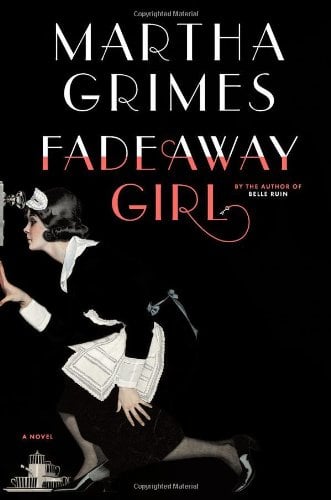
Monday Book Review: FADEAWAY GIRL by Martha Grimes


Emma Graham is a typical twelve year old girl living in a small, out of the way Maryland hotel owned by her family, except for one very important thing: she is not content to let mysteries lie fallow. Now this, of course, makes her a bit of a danger to anyone trying to keep dark and deadly secrets.

The prolific Martha Grimes writes two series, one featuring Detective Superintendent Richard Jury of Scotland Yard (which I also highly recommend) and this second one featuring child/woman sleuth Emma Graham. FADEAWAY GIRL is the fourth book in the series and the third I've read. Again, as with certain series, it's best to read this one in the order of their publication. I skipped the first one - don't know why - but started with the second, COLD FLAT JUNCTION (a brilliant book) and so, by now, I'm not surprised by the precocious Emma's need to get at the truth of things.

Emma's mother is the gourmet cook at the small and vaguely seedy, Hotel Paradise, and other than cook up meals three times a day for the few guests, she doesn't show up much in these books. Emma helps serve at breakfast, lunch and dinner and runs up and down to the fourth floor delivering the potent drinks she invents for the hotel's owner Aurora Paradise, a cranky old lady who never leaves the premises. Other than that, she's pretty much on her own to do as she pleases.

The time these stories take place has never been established, far as I know. But to me it feels like the late 50's, early 60's. This vagueness adds to the mystery of it all.

The hotel shares the grounds with several other buildings, one of which has now been turned over to Emma's eccentric and equally precocious brother Will who spends all of his time with his pal Mill, writing and producing stage productions like the just closed, 'Medea, The Musical'. Author Martha Grimes crowds these books with colorful eccentric characters who are always up to something, usually behind closed doors.

The Big Garage was once used for guests' cars and it could hold at least twenty of them. Now it was used as a theater, housing Will and Mill's productions.

Mill is Brownmiller Conroy. His first name passed down through his family. No parent could be so mean as to make up such a name. We shortened it to Mill.

As usual, there was a lot of commotion inside the Big Garage. And, as usual, at my knock, silence fell like a blanket dropped over the clamor. I don't know how they did this, I mean, silenced everything like flipping a switch. Will and Mill demanded total secrecy. They did not want anyone to know anything in advance of the production. I wondered why and decided that they wanted to burst onto the scene with all of it so new it looked like the opening of the world. As if none of us had really lived until the moment the curtain went up; as if the sun and moon had sailed around with blinkers on.

With family pretty much tied up in their own vocations, Emma is free to roam at will and solve whatever mystery she comes across. This fact has made her a kind of persona-non-grata at the local police station while giving her, at the same time, a kind of unique 'star' status. Since she'd solved a murder and survived her own attempted murder, she's been asked by the local newspaper to write about her adventures. She uses this as a kind of 'blind' to wheedle information when on the hunt for clues. (Generally the newspaper articles are the last thing on her mind.)

Emma has been interested for awhile in the alleged kidnapping of a four month old baby which took place at the Hotel Belle Ruin - since burned down - twenty or so years ago. She's never stopped wondering what actually happened. Much of the history of her corner of the world is tied up in secrets, inter-connected crimes, several murders, of which the kidnapped baby seemed to be the culmination. But since no ransom demands were ever made and the baby was never found, Emma doubts an actual kidnapping ever took place. So, what happened to baby Fay Slade?

No one but Emma appears interested in the sins of the past or solving this old mystery, much of which had been laid to rest until a no-account boy named Ralph Diggs gets a job at the Hotel Paradise and Morris Slade, the baby's father, shows up back in town.

A lot of what goes on in these books is atmospheric, there is a melancholy haze which permeates every ramshackle house, abandoned building and gloomy woods - even the names of places like Spirit Lake - which make up Emma's world. Emma herself is of an understandable melancholy nature, the sort of kid who feels things deeply and sees beyond the obvious, a kid who most of the time feels invisible in a world peopled mostly by adults. Though she is not above being devious and typically twelve when the occasion calls for it, she's learned to navigate. She has a knack of being able to manipulate the adults she comes in contact with as she travels from place to place either by a short train ride or with the use of a local taxi driven by Delbert, a talkative sort whom Emma can easily tune out while she thinks on what to do next. Most of the time though, she walks while she thinks over the latest nugget of information she's unearthed.

I crossed the short expanse of White's Bridge, barely a dozen yards, curved around Mirror Pond, where the shooting of Fern Queen had occurred, and walked the dirt road as far as Mr. Butternut's small house, a cabin, really, one great big room and a kitchen and a bedroom.

The place was lit up like a wildfire, even though it was broad day outside. A big bulbous porch light hung directly over the doorway, moth-shrouded like the ones at the hotel. He did not come directly to my knocking, so I called out, "Mr. Butternut! It's me, Emma Graham!" I heard him reply, but distinctly, and there was a shuffling about before he pulled open the door.

"Well, what in tarnation?" He sounded pleased.

I was sure for anyone to visit him was an occasion. I don't think he had any family left at all, and being stuck out here with no one around must have been hard on him.

"Hi, Mr. Butternut. May I come in?"

"Yeah, sure. You want some cocoa?"

We'd had it when I was here before, right after Fern Queen's murder. "Okay. I see you've got a good fire going in your stove."

It was an ancient cast-iron one and the fire was so hot the air felt blistered.

"Come on, come on, set yourself down."

There were two armchairs drawn up before the stove and I perched on one, then sat back as far as I could to get away from the heat. I think old people tend to be colder. "Listen, did you happen to notice a red sports car around here last night?"

"Sure did." He was rattling pans around.

I straightened, surprised I'd hit pay dirt again. I waited for him to go on, but he didn't; he just plunked down a small pan and now was getting milk out of his little icebox.

"Well...where? I mean, did he go by here?"

"You bet. My Lord, why any fool would want to drive a fancy roadster like that down this good-for-nothing road's beyond me. I ain't got no marshmallows." He was looking into an almost-empty plastic Jet-Puffed bag that I could see held a couple of marshmallows stuck in a corner. He just didn't want to share them, was all.

He poured milk into the pan and added cocoa and sugar and stirred this into a paste before adding more milk. He made a pretty good cocoa.

"Then what happened?"

"Nothin'. Things ain't always going on around here like in town." He said this with his back turned, and I could tell from the crinkle sound and his arm moving that he was sticking the marshmallows into his cup on the sly.

"I mean, where do you suppose he was going?"

"No place to go except Brokedown House and nobody don't live there except ghosts." He laughed silently, shaking like a custard. "Just Calhoun spooks. Now there use to be a lot of Randalls lived down this road, Bud Randall was one, and then there was..."

He went on with the same history about past families he'd done before. It must be that old people had to check up on the past to see if it really had been there.

It may seem as if lately there are quite a few books with 11 or 12 year old girls at the helm solving mysteries, but as I've said before, Martha Grimes' series is one of the originals. Grimes hasn't given up the capacity to surprise and shock while at the same time filling these stories with memorable eccentrics whom you want to keep reading about for as long as Grimes is willing to write about them.

To see the complete list of all of Martha Grimes' books, please go here to the 'fantastic fiction' website.


Tuesday, January 25, 2011

Four Books I Must Read or Curl Up and Die

Ha! Just kidding. (I think.) But these are the four newly released books I am most anxious to read just as soon as I can. If only the people ahead of me on the library list would hurry up and finish their copies, all would be well. In the meantime, I content myself reading other smasheroo books, i.e. KRAKEN by China Mieville, which I am liking very much and which was part of my Santa Christmas loot.

THE SENTRY by Robert Crais. I am always ready to read any Robert Crais book, but most especially his series featuring L.A. private detective Elvis Cole and his enigmatic friend, Joe Pike. THE SENTRY is the third in the Joe Pike series begun with THE WATCHMAN, extended with last year's superb THE FIRST RULE and now I hear THE SENTRY is equally superb. The original series from Elvis Cole's point of view began way back when with THE MONKEY'S RAINCOAT. (A series that should be read in order, most especially in the begining up until L.A. Requiem.) Read more about Robert Crais tomorrow when I write my Letter C post for the Crime Fiction Alphabet Challenge 2011.

FADEAWAY GIRL by Martha Grimes. I've read every DCI Richard Jury mystery, Grimes has written and mostly loved them all. It's a shame that the prolific Martha Grimes is so underrated and often forgotten about when bloggers mention great mystery writers. She deserves better, an amazing writer. FADEAWAY GIRL is the latest in the quirky series featuring 12 year old Emma Graham, the sequel to Belle Ruin.Though I don't see how anything can top COLD FLAT JUNCTION, one of my very favorite books. Somehow Martha Grimes has managed to give this series a kind of gothic quality though it's set in the American west of dry desert country and small underpopulated towns. The cast of characters is quirky, to say the least.

A RED HERRING WITHOUT MUSTARD by Alan Bradley. The third in Bradley's wonderful series ALSO featuring a 12 year old protagonist. The series is set in the English countryside of the 1950's and Bradley captures the bleak post war ambiance perfectly. The heroine, Flavia De Luce is a lonely young girl, a prodigy mostly ignored by her family and left on her own to invent, experiment with chemicals (there's a convenient laboratory on the upper floor of the family house) and otherwise keep herself busy. Which she does, often getting in the way of a murder investigation. The first book THE SWEETNESS AT THE BOTTOM OF THE PIE won just about every award for a debut novel. The second book THE WEED THAT STRINGS THE HANGMAN'S BAG was even better.

ONE WAS A SOLDIER by Julia Spencer-Fleming. This is the 7th in the Clare Fergusson series set in a small upstate New York town in which it always seems to be winter. All I can say is I've loved this series since the first book, IN THE BLEAK MIDWINTER and not a single book following that initial award winning debut has let me down. Clare Fergusson is such a unique protagonist, she is a minister and an army veteran helicopter pilot (Iraq War), now in the Reserves.

How Clare first arrives in the town of Miller's Kill and over the course of these books insinuates herself into the town and the lives of its people while often caught up in the murder investigations of by-the-book Police Chief Russ Van Alstyne makes for great reading. BUT, this is definitely a series that MUST be read in order from the beginning to get the full effect of the deepening friendship between Clare and the police chief who, from the beginning is very much married. The author has always handled this aspect of the storyline with tact and an intensity of feeling expressed mostly in silence. To see the titles of the other books in this great series, please go to the fantastic fiction website.

Thursday, October 28, 2010

Writing I Like

Thursday. A good day to talk about good writing. (When is it not?) Or, at least, what I consider to be good writing. As we all know I am a very opinionated old codger, so the samples I put forth can be viewed askance if you so wish. I don't ask that you agree, but if you disagree, give me good reasons why. I probably won't change my mind, but it will make for lively discussion.

Of course, it's difficult to judge writing out of context, but I think the following excerpts give us the flavor of style of three very different authors - Martha Grimes, Robert B. Parker and Jasper Fforde - writing three very different sorts of books.
In the first sample from Martha Grimes, I love how she lingers and gives us specific word pictures of the slightly peculiar little storybook English country town which shows up in most of her books. You might almost think you were reading a cozy from this example, but let me assure you, you are not. It's just Grimes being quirky. I love it when she goes off on one of her rambles and lulls you into thinking the world of her books is not as dark as it really is. This is also her way of draping one of her protagonists, Melrose Plant, in the raiment of surroundings which seem so out of time, so different from Richard Jury's, the Scotland Yard cop who lives in a flat in London.

THE FIVE BELLS AND BLADEBONE by Martha Grimes

They were enjoying the sublimity of a fine spring morning, drenched in the scent of hundreds of roses - tea, musk, perpetual; bedding, climbing, hedging; claret, crimson, lavender, coral, yellow; climbers cascading down brick walls and climbing up them; floribunda hedging the walk...

The dogs and cats they had passed were all sprawled in various states of drunken delight, the effect of roses, the sun, the glittering air, as if Melrose's old dog Mindy were back there at Ardry End beaming out signals to sleep, sleep, sleep.

Miss Crisp's Jack Russell, which usually took its naps on a weathered chair outside her second hand shop, had struck out on its own from the High Street, looking for action round the duck pond. But it was now collapsed by the small stone pillar atop which sat Miss Broadstairs' oafish gray cat, itself too lazy to do anything other than lie with its face against the warm stone, its paws dropped down the pillar. All dreaming of roses...

JERUSALEM INN by Martha Grimes

The dining room had mullioned windows of rose and amethyst glass, was oak-paneled and candlelit and in its mingling of tones, seemed to throw over the diners a fine patina of burnished copper. Thus the voice of Susan Assington was like a scratch upon this lovely surface. "I think," said Lady Assington, "we should have a murder."

She looked up and down the dinner table, crowded with polished plate and polished crystal and tarnished conversation. "I mean," said Lady Assington, tapping a silvery nail against her wine glass, "it's just too perfect."

Having captured the the entire table for the first time - and they were already on dessert - she was breathless for a response. Melrose, seated to her right asked politely, (when no one else took her up), "Why is that?"

"Why, here we are, snowed in! Just the sort of thing to bring one's nerves to the boiling point - "

Lady Assington was not one to worry over her metaphors, thought Melrose.


The following sample by the late Robert B. Parker is from an early Spenser book. The scene is one in which Spenser faces down the dangerous Boston crime boss Joe Broz.

THE GODWULF MANUSCRIPT by Robert B. Parker

Broz sipped a little of his drink, put it down on the bar, and swung fully around towards me, both elbows resting on the bar.

"I have been told," he said in a deep voice that had the phony quality you hear in an announcer's voice when he's not on the air, "that you are a wise-ass punk. Apparently my information was correct. So let's get some ground rules. You are here because I sent for you. You will leave when I tell you to. You are of no consequence. You have no class. If you annoy me I will have someone sprinkle roach powder on you. Do you understand that?"

"Yeah," I said. "I think so, but you better give me a drink I feel faint."


This last sample is from the second book in Jasper Fforde's Nursery Crime Unit series. It is the opening paragraph.

THE FOURTH BEAR - Jack Spratt Investigates by Jasper Fforde

The little village of Obscurity is remarkable only for its unremarkableness. Passed over for inclusion into almost every publication from The Domesday Book to Thirty Places Not Worth Visiting in Berkshire, the hamlet is also a cartographic omission, an honor it shares with the neighboring villages of Hiding and Cognito. Indeed, the status of Obscurity was once thought so tenuous that some of the more philosophically inclined residents considered the possibility that since their village didn't exist, they might not exist either, and hurriedly placed "existential question of being" on the parish council agenda, where it still resides, after much unresolved discussion, between "church roof fund" and "any other business."

Opinons? Or how about some examples of your own favorites?