Showing posts with label Gig Young. Show all posts

Tuesday, June 4, 2013

Tuesday's Overlooked (or Forgotten) Film: THAT TOUCH OF MINK (1962) starring Cary Grant, Doris Day and Gig Young


THAT TOUCH OF MINK (1962) is a film directed by Delbert Mann, starring Cary Grant, Doris Day, Gig Young and Audrey Meadows. I consider it one of Day's 'perpetual virgin' entries and as such, should be viewed through that prism.

That this movie was made a little over fifty years ago (yegads that reads like ancient history) is obvious from the fashions, the Pan American Airways planes, the Greyhound bus logo and most of all, the Horn and Hardart Automat restaurant where the wise-cracking Audrey Meadows (Doris Day's room-mate) works. Ah, the 'rock-solid' symbols of the good old days.

But more telling than any of the fondly remembered product placements (though Greyhound, at least, is still with us) are the social attitudes, the sexist drivel which is at the heart of this movie. There's a lot of nonsense spoken by Doris Day and Audrey Meadows, not to mention, Cary Grant and assorted others.

But as I watched this last night, occasionally cringing, I found myself laughing out loud (and being embarrassed the neighbors might hear) at some key scenes I'd forgotten about. (Yes, I saw this in theaters and loved it then. What did I know?)


Most of these laugh-out-loud scenes are Gig Young's doing since he steals the picture from under everyone's noses (and doesn't Grant realize it). If there's any real reason to see this ancient bit of male/female will-she-won't-she, it's Gig Young, an underrated actor with one of the sweetest smiles ever recorded by a camera. Though his personal life was tortured in a way that led to eventual tragedy, his on-screen persona was generally damned endearing.

His Oscar win however, was for a 'straight' dramatic role, the sleazy dance marathon emcee in THEY SHOOT HORSES, DON'T THEY? Young was adept at drama, but it's his comedy performances that I remember most with fondness.

In THAT TOUCH OF MINK, Young plays a perpetually hapless guy (his specialty) named Roger, an ex-academic who has, according to him, succumbed to the lure of an exorbitant salary ($50,000 - chickenfeed today, but back then seen as Big Bucks) and continued bonuses offered him by investment tycoon Philip Shayne (Cary Grant), which Roger is unable to turn down.

In his job as company right hand man to the suave Shayne, Roger is continuously maligning the life he is unable to walk away from as Shayne threatens to raise his salary. These bits are amusing and often seem ad-libbed.

Cary Grant plays the aforementioned suave millionaire (back when millions was important money) in an unusually deadpan way which makes him seem miles away while filming. It's a bit hard to understand why he is so taken with Doris Day's character, Cathy Timberlake.

It's all probably meant to be a kind of 'opposites attract' type thing, but there is not one iota of sexual energy being discharged by anyone in this film, not even by the sleazy, slimy, reptilian and repulsive unemployment insurance clerk Everett Beasley who has the unacceptable hots for Cathy (Doris Day). Beasley is played by John Astin, a very odd looking actor with, nevertheless, hidden suave, who later went on to prove it by starring as Gomez Addams in The Addams Family television series.


In truth, Grant and Astin (so diametrically opposite in looks and manner) occupy two sides of the same coin. Grant's character is rich beyond avarice, handsome, suave and looks good taking a shower or running out into the street wrapped in nothing but a towel.


He is after Cathy Timberlake in the same way and for the same reason as Beasley, but Grant does it with finesse, splendid good looks and a mink coat. Beasley does it with protruding hungry eyes and by trying to withhold Cathy's unemployment check unless she goes out with him. He simply cannot hide (as Grant can) the lascivious thoughts running rampant through his psyche when he looks at Doris.

Neither of these men are interested in marriage.

It's that either/or thing so beloved of movies of that era.


Anyway, on to Doris Day. I was never really crazy about the Rock Hudson/Doris Day pairings  beloved by many movie mavens. I preferred her with David Niven in PLEASE DON'T EAT THE DAISIES among other films, and even here, in this ancient chestnut opposite Cary Grant.

Day had a sweetly spunky (and very blond) screen persona which she played to the hilt and could often be endearing and quirky (she was also a talented singer though she is not called upon to do so here).

But you know, she really was a bit too old to keep playing the perpetual virgin as long as she did. In  THAT TOUCH OF MINK she is, again, protecting her virginity, this time from Cary Grant's rather tired playboy persona. Doris is, however, fabulous at physical comedy and has a couple of really hilarious scenes with Grant even if it's hard to believe he has designs on her person at all. (Although she does look mighty good in a sleek black evening gown.)

Cathy Timberlake (Doris Day) is an unemployed clerk from Upper Sandusky, Ohio, who first meets debonair millionaire Philip Shayne (Cary Grant) when his limo has a drive-by encounter with her clothing on a rainy day in New York. That innocent enough beginning soon leads to romantic complications, several unconsummated trips to Bermuda plus this that and the other including a wild taxi drive chase to Asbury Park, New Jersey (of all places).


It's all an excuse for several very funny sight gags (one concerning Gig Young's attempted visit to Cathy's Manhattan apartment) and some fun dialogue between Grant and Young. Not to mention Young's dialogue with his psychiatrist who mistakenly gets that impression that...But wait, you have to see these scenes to believe them.

Audrey Meadows, as Cathy's room-mate Connie, has the sort of cynical, wise-cracking lines that are clearly meant to be funny (and maybe once upon a time, they were) but in hindsight, are anything but. She plays a nagging mother hen leery of men in general but at heart, we know, anxious to fashion her own happily ever after. The only problem is that she's not really likable.


An aside: THAT TOUCH OF MINK always made me wonder why a woman needed a mink coat while traveling in Bermuda. I mean, isn't it hot there? But why digress, the mink is obviously meant as a symbol of decadence - The Purchase Price. I mean, if not marriage, then mink was the next best thing.


Dumb and simplistic. Yeah, but that's the way things worked back in the day. Though I still say that Doris Day and Audrey Meadows were both a bit long in the tooth to be worrying about this sort of thing even then.

The movie is worth watching mainly for Gig Young (I might even watch it yet again) and I did love the sight of that Pan American plane headed to Bermuda. I guess I never did understand how companies like Pan America and Horn and Hardart lost their way. They seemed such a permanent part of life back then.

THAT TOUCH OF MINK trailer can be viewed here.

Don't forget to head on over to Todd Mason's blog, Sweet Freedom, to see what other Overlooked (or Forgotten) Films and/or Other Audio/Visuals, other bloggers are talking about today. We make for an eclectic bunch.

Tuesday, February 19, 2013

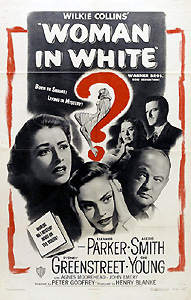
Tuesday's Forgotten (or Overlooked) Films: THE WOMAN IN WHITE (1948) starring Gig Young, Alexis Smith, Eleanor Parker and Sydney Greenstreet


If it's Tuesday, you know it's Overlooked (or Forgotten) Films day. The relevant links are listed over at Todd Mason's blog, Sweet Freedom. Please avail yourselves. We are an eccentric bunch.

Some of you may know of my late in life love affair with Wilkie Collins' two Victorian masterpieces, THE WOMAN IN WHITE and THE MOONSTONE - both of which I'd read (and written about) within the last couple of years. What can I say - I'm a late-starter.

THE WOMAN IN WHITE officially became one of my very favorite books of all time. (I loved THE MOONSTONE too, though not with the same fervor.)

But I'd never seen TWIW on film.

Imagine my surprise when I learned from Jacqueline at Another Old Movie Blog that a movie was filmed of the book in 1948 AND with Sydney Greenstreet as Count Fosco. So where was I while this was going on? Oh, growing up, I was only kid at the time. But later, I should have seen this film at some point. But no, somehow I don't think I ever did. Go figure.

By the way, you really do need to read Jacqueline's brilliant overview of the film. She has it all pinned down in ways that I'm incapable of doing. I'm just going to give a general long-winded assessment (as I like to do) and then steer you over to Jacqueline's to get the factual low-down on the film. Link to Another Old Movie Blog.

I'm also steering you to my original book review so you can get my take on the book itself when you have a moment.


THE WOMAN IN WHITE is a 1948 film directed by Peter Godfrey and starring Gig Young, Alexis Smith, Eleanor Parker and Sydney Greenstreet.

Most of the film was shot on a Hollywood back-lot with a non-British cast (which, by the way, boggles the mind - it is a British masterpiece, after all) who try but fail to hang on to any sort of appropriate accent. Not only that, but the ending of the film differs from book (it's actually a better ending, but really that's not enough of a reason to change the thing) and in between there are all sorts of changes probably in the spirit of making the film more understandable, fitted into the almost two hour time-frame. (It's a rather thick book and the story is tricky.)


Count Fosco (Sydney Greenstreet) looking disgruntled at breakfast. What is the man doing in the Fairlie house at breakfast? Beats me. Note that Gig Young (the young man with the mustache) is shackled for the entire movie in an outfit that looks very much like a chauffeur's uniform. Strange. Or maybe it's a drawing master's uniform?


A nervous John Abbott in his dressing gown, having conniptions and berating his poor valet Louie. Alexis Smith looks ready to beat both of them about the head with something heavy.

In the movie, oddly, all the characters appear to be living in the same house (not so in the book). There's the wonderful John Abbott as the very entertaining hypochondriac, Frederick Fairlie (and boy does he do everything he can to steal the movie). Abbott is a horrid delight as the sniveling, overset uncle always on the verge of a nervous breakdown. It is his vast country estate in which most of the action takes place - except for the mad house and the town scenes near the end - wait, wait, we're getting there.

Yes, there is a madhouse. You knew that was coming - this is a Victorian story. We suspect there's a madhouse involved somewhere when we see Eleanor Parker drifting along in the night shadows, garbed all in white as she accosts Gig Young on a moonlight walk late at night. She breathlessly begs for his help only to disappear into the gloom as a carriage comes rumbling down the lane. 

Hanging around Fairlie manor is the sinister Count Fosco played very...uh, sinister-ly by the wonderful Sydney Greenstreet. He is not my idea of Fosco as described in the book, but as I always say: any Greenstreet is better than none. 


In the book, Count Fosco casts a huge aura of malevolence. He is, in a word: icky. He is the evil puppet master for whom all the characters must perform. We get that in the film too, but never as chilling as in the book. Maybe Fosco is so much bigger than life that it's impossible to pin the character down in black and white reality. Though Greenstreet obviously is having fun playing him - his little chortle comes in handy.


Fosco is in cahoots with a neighboring 'noble man' who has designs on one of the heroines of the piece. Sir Percival Glyde (cool name) is played by John Emery in a way that leaves no doubt as to his evil intentions. I mean, the guy reeks of badness. He always did in any role he played - he just had that kind of face.

Poor Gig Young has to wear an insipid little mustache throughout the movie as the Victorian 'hero' who is drawn into a strange dark tangle moments after arriving on the scene. He plays Walter Hartright, hired to teach two young ladies to draw - though for the life of me I can't think why. Anyway, the two young ladies are close friends and possibly cousins (can't remember). 


Laura Fairlie is played by Eleanor Parker (supposed to be a sweet angelic young thing, she is affianced to the unspeakably vulgar low-life Sir Percival, who is only after her huge inheritance).

Problem number one: Parker seems too old and too un-English to be the naive Miss Fairlie.

Problem number two: The other young lady is Marian Halcombe played by Alexis Smith. Marian is described in the book as being rather ugly. There is no way that Alexis Smith can be described as 'ugly' in any way, shape or form. 


However, let's pretend. Okay, so Eleanor and Walter become friends almost immediately, but he has googly-eyes only for Laura. And almost before you can say, fetch the art supplies, they are seen smooching on the lawn. (This never happens in the book. In fact, in the strict Victorian society in which these people are supposed to be living, such a breach of conduct would have been unthinkable - the smooching, I mean. However, this is Hollywood and you know how that goes.)

Marian asks Walter to leave the house asap because Laura is affianced to Sir Percival (in the book Walter is understood to be a penniless art teacher) and it's the right thing to do. If he [Walter] stays, a scandal might ensue. Walter is made to understand that the relationship between Laura and Sir Percival is as binding as a marriage in the eyes of...well, everybody who is anybody.

Let me add that all this happens within the first half hour or so of the film - the screenplay really zips right along.

In the meantime, where is the Woman in White? Don't worry, she's due to make another appearance shortly.


It seems that the mysterious woman whom Walter saw on the road on the night he first arrived at the Fairlie country estate is in actuality, someone named Ann Catherick. Ann happens to be the spitting image of Laura Fairlie (we find out why near the end) and she's been incarcerated in the local loony bin by none other than Count Fosco and dear Percy.

She has escaped in order to deliver a word of warning to Laura. Clutching at Walter whom she again runs into in the dark, she tells him that Laura must NOT marry Percy. Well, hardly a surprise, we all knew that going in. But apparently she has additional info.

The warning comes too late.


When Walter (as he most decidedly does NOT in the book) tries to stop the marriage, nobody believes his accusations. (Ann has disappeared again.) Count Fosco scoffs, insinuating that maybe Walter needs to go to an asylum as well. Sir Percival smirks. Even poor deluded Marian who had assumed that Fosco was just a jovial old friend with a monkey and a canary, demands some proof. After all, she hardly knows Walter.

So off goes the drawing master in a snit.

The melodrama quotient really increases after Laura and Sir Percy come back from a honeymoon in Italy. (Ugh, the mere thought of Percy and Laura...well, you get the idea. UGH!) At any rate, after a few months on the continent, the married couple comes back to the house and the plot, as they say, thickens nicely.


Fosco stays Percy's hand since he is too much inclined to act first and think later. Marian holds Laura - they are finally beginning to understand they are in the presence of great evil.


We find out that Count Fosco has the hots for Marian (he admires her spunk) and he presses her to run off with him - never mind that he has a wife. She is repulsed but then decides to sacrifice all for Laura's sake. 

Despite the several major changes (from the book), things move right along as Laura and Marian and Ann (not to mention the Count's poor wife played by Agnes Moorehead) must work to escape the wicked clutches of Fosco and Percy and their henchmen who will stop at nothing to get Laura to sign a paper turning over all her money to Percy. 

Luckily, Walter is back on the scene and has, inexplicably, switched his affections to Marian. Not so in the book where one wishes he had as well. Laura is a nice enough widgeon, but really, she doesn't have a clue. She's the type that needs to be taken care of, while Marian is more a man's equal in brains and character. But you know Victorian novels, equality in 'brains and character' usually meant the girl was ugly - it's the helpless beautiful ditz who usually gets the man. (Funny thing, because author Wilkie Collins had some fairly un-Victorian ideas about marriage and
women.)

At any rate, there is another night time escape from the local loony bin (honestly, where is security when you need it?) and two deaths to deal with - actually three, but I won't say who, what and why - before the bad guys get their comeuppance and we get the long awaited happy ending.

I'd say that the film probably works better if you haven't read the book, but it's up to you. Jacqueline liked it better than I did, so don't forget to read her post to see what convinced her.