Saturday, January 15, 2011

Saturday Salon: A Favorite Painting


Notes from an obvious non-academic:

Summer Sunlight by the American Impressionist, Frederick Childe Hassam.(1859-1935) Simply put: when I first saw this painting it took my breath away. (I love when that happens.) It's been a favorite of mine ever since. I love most of Hassam's paintings and since he was quite a prolific painter, there's plenty to love. I've been a big fan of America's Impressionist painters since I first discovered them as a gawking teenager, either at museums or in books from the library. In my day, schools still took kids to museums as part, I suppose, of their cultural enrichment. NYC public schools still considered 'appreciation of art' part of their curriculum then, thank goodness. For someone like me who had never been to a museum with her parents, it was a portal to another world. My feelings of awe when it comes to museums, continues to this day.

This painting, Summer Sunlight, is so infused with light that it seems to radiate. Being able to paint light is such an extraordinary thing, at least in my view. I love the way the woman's dress melts into the rocks into the background. It's all of a piece, no one thing stands out except, perhaps the woman's hair, the little orange book and the saucy hat. There's just something so relaxing about the way she leans into the rocks while she reads, the charming print of her dress blending in with the spattered tones of the background. It's all about attitude, I suppose. The whole scene is one of peaceful languor. A mellow summer afternoon - perfect to view on a cold winter afternoon in January.

The colors, from afar, appear similar in tone, but when viewed up close, you can see the huge variety of color the painter used to achieve this all-of-a-piece effect. To view more of Hassam's paintings at an exhibition hall at the Metropolitan Museum of Art, please go here.
To read a bit more about the American Impressionist movement in general, please go here, to the Heilbrunn Timeline of Art History.

Friday, January 14, 2011

In the Mail Today: Books!

Two nice used copies of books arrived today. I've been meaning to read: N.C. Wyeth - A Biography by David Michaelis and APPLEBY'S END by Michael Innes. Well, now they're both here.
Yes, I'm still on a Michael Innes binge. Love his books! And my recent posts on artist N.C. Wyeth have reawakened my long-time interest in his life and work. He had a very interesting life (to say the least) and, unfortunately, a tragic end. Vanity Fair ran a fairly comprehensive piece on Wyeth several years ago and I've always meant to read Michaelis's book. (N.C. is the father of famed American painter, Andrew Wyeth and the grandfather of Jamie Wyeth.)

Doesn't This Sound Divine?


The review today from the NY Times for Brian Bedford's theatrical production of Oscar Wilde's THE IMPORTANCE OF BEING EARNEST. It looks to be hilarious.

I would so love to see this production! It's running through March 6, so anything is possible. Though the way the reviews are going, it sounds as if it will be totally sold out, sooner rather than later. Maybe PBS will video the production. If only going into the city from way out here in northern NJ weren't such a major production...Honestly, you'd think there'd be a train that dropped you right in Grand Central Station - but there isnt'. It's just a chore going by bus. You arrive in the city already haggard and weary and the day's activities haven't even started yet.

Okay, stop complaining Yvette, and make it happen.

What are your favorite Book Beginnings?


I was looking through another of the quirky books I've collected over the years, IN THE BEGINNING - Great First Lines From Your Favorite Books, Collected by Hans Bauer (1991), and came across some opening gambits that I'd forgotten or never knew. Not every author has the knack for beginning well, but those that do are off to a running start. Now all they have to do is make sure the rest of the book lives up to the beginning.

Not all of my favorite opening lines are included in this little book, obviously, or the book would be too heavy to carry, but "IN THE BEGINING presents the all-important first sentence to more than 500 novels." There are enough intriguing ones to make for fun reading and reference. And I did find some of my own favorites mixed in with many I'd never heard of before and a few I didn't agree with. There are plenty of sites online which list First Lines of books, so further exploration is easy enough.

To begin with, here are a few choices from Bauer's book:

All children, except one, grow up. PETER PAN, J. M. Barrie, 1911

It is a truth universally acknowledged, that a single man in possession of a good fortune, must be in want of a wife. PRIDE AND PREJUDICE, Jane Austen, 1813

He was born with a gift of laughter and sense that the world was mad. SCARAMOUCHE, Rafael Sabatini, 1921

All nights should be so dark, all winters so warm, all headlights so dazzling. GORKY PARK, Martin Cruz Smith, 1981

All happy families are alike but an unhappy family is unhappy after its own fashion. ANNA KARENINA, Leo Tolstoy, 1878

Later that summer, when Mrs. Penmark looked back and remembered, when she was caught up in despair so deep that she knew there was no way out, no solution whatever for the circumstances that encompassed her, it seemed to her that June seventh, the day of the Fern Grammar School picnic, was the day of her last happiness, for never since then had she known contentment or felt peace. THE BAD SEED, William March, 1954

It was a queer, sultry summer, the summer they electrocuted the Rosenbergs, and I didn't know what I was doing in New York. THE BELL JAR, Sylvia Plath, 1963

My wife Norma had run off with Guy Dupree and I was waiting around for the credit card billings to come in so I could see where they had gone. THE DOG OF THE SOUTH, Charles Portis, 1979

"So you boys want to help me on another case?" Fenton Hardy, internationally known detective, smiled at his teen-age sons. THE HOUSE ON THE CLIFF/The Hardy Boys, Franklin W. Dixon, 1927

I had the story, bit by bit, from various people, and, as generally happens in such cases, each time it was a different story. ETHAN FROME, Edith Wharton, 1911

Have you ever known a famous man before he became famous? YOUNGBLOOD HAWKE, Herman Wouk, 1962

I had a farm in Africa, at the foot of the Ngong Hills. OUT OF AFRICA, Isak Dinesen, 1937

In his new boots, Joe Buck was six-foot-one and life was different. MIDNIGHT COWBOY, James Leo Herlihy, 1965

When I was a young boy, if I was sick or in trouble, or had been beaten at school, I used to remember that on the day I was born my father had wanted to kill me. THE LAST OF THE WINE, Mary Renault, 1956

It was five o'clock on a winter's morning in Syria. MURDER ON THE ORIENT EXPRESS, Agatha Christie, 1934

The stranger came early in February, one wintry day, through a biting wind and a driving snow, the last snowfall of the year, over the down, walking as it seemed from Bramblehurst railway station, and carrying a little black portmanteau in his thickly gloved hand. THE INVISIBLE MAN, H.G. Wells, 1897

I shook the rain from my hat and walked into the room. I, THE JURY, Mickey Spillane, 1947

Under certain circumstances there are few hours in life more agreeable than the hour dedicated to the ceremony known as afternoon tea. THE PORTRAIT OF A LADY, Henry James, 1881

It is a curious thing that at my age - fifty-five last birthday - I should find myself taking up a pen to try and write a history. SHE, H. Rider Haggard, 1885

In the town there were two mutes, and they were always together. THE HEART IS A LONELY HUNTER, Carson McCullers, 1940

I first met Dean not long after my wife and I split up. ON THE ROAD, Jack Kerouac, 1957

Last night I dreamt I went to Manderley again. REBECCA, Daphne DuMaurier,
1938

In eighteenth-century France there lived a man who was one of the most gifted and abominable personages in an era that knew no lack of gifted and abominable personages. PERFUME, THE STORY OF A MURDERER, Patrick Suskind, 1985

Once upon a time there was a Martian named Valentine Michael Smith. STRANGER IN A STRANGE LAND, Robert A. Heinlein, 1961

He rode into our valley in the summer of '89. SHANE, Jack Schaefer, 1949

It was about eleven o'clock in the morning, mid October, with the sun not shining and a look of hard wet rain in the clearness of the foothills. THE BIG SLEEP, Raymond Chandler, 1939

I was never of the opinion, that the honest man who married and brought up a large family, did more service than he who continued single, and only talked of population. THE VICAR OF WAKEFIELD, Olive Goldsmith, 1766

A good sampling, I think. There were a couple of first lines listed that made me laugh out loud and not in a good way. So it seems that some of these first lines are not holding up as well as they ought, at least in my view. Here are a couple:

Indian summer is like a woman. PEYTON PLACE, Grace Metalious, 1956 I'm sorry but I just can't take this seriously, although perhaps for a pot boiler about sex and aberration in a small town, it's apt. Still, it made me laugh. I read PEYTON PLACE back then and thought it was a pretty good book, for what it was. I still think so.

"Who is John Galt?" ATLAS SHRUGGED, Ayn Rand, 1957 Okay, my immediate reaction is to answer: "Who cares?" I certainly didn't, then or now. Never could get through this book. But the opening line seems to me to be stinking with the kind of hubris that smells to high heaven. Just my own personal opinion, you understand.

Here are two of my personal favorites- more than just the first couple of lines really, but still within keeping, I think - from mystery author Parnell Hall's very first Stanley Hastings, P.I. book: DETECTIVE.

"I want to kill someone."
"Who doesn't?"
"No. I mean it. I really want to kill someone."
"Everyone wants to kill someone. It's no big deal. I, myself, have a long list, usually headed by my wife."
"You don't understand. I'm going to do it."
For the first time, I gave him my full attention.

This beginning is from the novel STRAIGHT by Dick Francis:

I inherited my brother's life. Inherited his desk, his business, his gadgets, his enemies, his horses and his mistress. I inherited my brother's life, and it nearly killed me.

Dick Francis, especially, had a talent for terrific beginnings.

I have others, of course, but Parnell Hall and Dick Francis are two that always stand out for me.

What First Lines are you most fond of?

EAST OF EDEN Video Critique in Today's NY Times

New York Times Film Critic, A.O. Scott talks, today (on video), about the classic 1955 film, EAST OF EDEN. A film based on John Steinbeck's epic book, it starred the immortal James Dean (Scott himself calls Dean 'immortal') who, as we all know, was killed in a horrible automobile accident at the age of 24 after making only three films.

It still seems almost impossible for me to believe that he died so young and so awfully long ago. What an utter waste. But at least we have the three films: EAST OF EDEN, REBEL WITHOUT A CAUSE and GIANT, to remember him with. But, goodness, think what he might have done.

Of the three, EAST OF EDEN is my favorite and I remember weeping in the theater, when I first saw it. The sountrack itself is enough to make me teary. At the time, the film was so different from anything I'd ever seen, Dean's performance so unique, that the impression it made is still alive in me today. I must mention too, that Julie Harris, in my view, more than kept up with him. The love scenes had such a tenderness to them, such a quality of mixed emotions.

I'm glad to see that A.O. Scott, one of the few critics whom I occasionally pay attention to, appreciates EAST OF EDEN and featured it today in one of his video critiques. It was a nice surprise.


Thursday, January 13, 2011

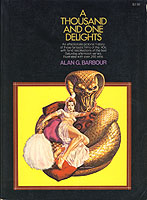
A Favorite Book: A THOUSAND AND ONE DELIGHTS An Affectionate Pictorial History of Those Fantastic Films of the 40's by Alan G. Barbour


This teeny-tiny pix is not a very good copy of the cover of the actual book, but it's the best I could find online. A lot of these older film books, while still available on the secondary collectible market, don't have cover images on google or elsewhere. I own this one but I don't have a scanner so you'll have to use your imagination: the cover is of 1940's and 50's film siren Maria Montez in COBRA WOMAN. She is shown lounging within the golden coils of a huge cobra. Perfectly apt.

In the 1940's and 50's, Latin bombshell Maria Montez (who never lost her charming Spanish accent) starred with Jon Hall in a series of lurid adventures in Technicolor. WHITE SAVAGE, ALI BABA AND THE FORTY THIEVES, ARABIAN NIGHTS, etc, films that held us spellbound when, as kids, we saw these, along with ten cartoons and a second feature, at the local theater. The price for all this magnificence? Usually no more than 25 cents. (Though, in truth, a few of these films I saw later on, on early tv, but I can't remember what I saw in theater and what I saw at home, so I prefer to romanticize the whole thing and think I saw them all in theater.)

Okay, now that I've revealed my status as an ancient, let me go back to the book:
A THOUSAND AND ONE DELIGHTS An Affectionate Pictorial History of Those Fantastic Films of the 40's; with fond recollections of the best Saturday afternoon
Serials. Illustrated with over 260 stills.
By Alan G. Barbour
Published in 1971 by Collier Books

I debated whether I should include this book among my favorites post (even though it is), as well as one more title I'll list later, because these are older books, a bit harder to find. Oh, they're available but you have to look for them on the secondary collectible market mostly. Not that they cost all that much, unless you want one in 'mint' condition in which case, you'll pay quite a bit more. But if you just want a copy sort of like mine, showing the well worn effects of being read and looked at with affection over the years, you can easily find a copy. I've had mine for years and now I wish I'd taken better care of it.

A THOUSAND AND ONE DELIGHTS (trade paperback) is filled with black and white photos of the films people my age remember very fondly, films that fueled our imaginations as kids. Mostly B-films, not top of the line studio productions, but they were still, quite good enough. I suppose, it some ways, they served the same purpose that television and later, the internet, served for kids of later generations.

I loved these movies and so when I found this book years ago, I bought it instantly. I wanted to use it as memory resource and also as a possible illustration reference. I have quite a collection of various reference books from the time I used to earn a living as a freelance illustrator. You just never knew where an idea was going to come from.

But the book is just plain fun to look through and it does contain some interesting info as well. Most especially of course, if you love movies of a certain era. The pictures, whether you're familiar with the actors and/or films, or not, appear incredibly naive in style and come from an era when the world was viewed in a totally different way.

The book is split up into different chapter headings:
THE KING AND QUEEN OF TECHNICOLOR (Maria Montez and John Hall, not to mention, Turhan Bey.)
CHAMPS OF THE CHASE
BRING THEM BACK AGAIN...AND AGAIN
AND THINGS THAT GO BUMP IN THE NIGHT
THE BEST MEDICINE
THE FUN FACTORY
SATURDAYS ARE FOR THRILLS
MURDER FOR THE MASSES
DUSTY TRAILS TO ADVENTURE
NEW WORLDS TO CONQUER
MAN OF ACTION
THE HORN OF PLENTY

And interestingly enough, there is a chapter devoted to B-westerns - DUSTY TRAILS TO ADVENTURE - which showcases the old Republic Studio western stars. When I look at them now I wonder that we ever believed any of this cowboy stuff, but we did. I mentioned in a previous post that I was so influenced by these movies I wanted to grow up to be a cowgirl. Yes, it's true. Ah, the dreams of youth.

Most of Alan Barbour's book is devoted to the 'studio stills' promised on the cover, so there's plenty to see. (Not necessarily all the pix I've included, those are mostly to give you a flavor of the sorts of movies talked about in the book.) However if you want a really comprehensive history of this particular movie era, you'll have to go elsewhere. This is purely a fun book.

The second book from my shelves, similar to this one, but a bit more difficult to find (and forget about a copy of the cover), is: LOST LANDS, MYTHICAL KINGDOMS, UNKNOWN WORLDS by Val Warren A Pictorial Excursion into the Realm of Cinematic Fantasy...Featuring Three Hundred Photographs. ISBN: 930-36840-1 This was published by Simon and Schuster in trade paperback form in 1979, and there are, included, a few b/w stills from the original Star Wars film.

This has even less text than the previous book, so it's mostly a picture-fest.

It has amazing photos of many early science fiction and fantasy films featuring actors even I have forgotten about. The science fiction of the 50's was so incredibly different from what we view today and it seems inexplicable that anyone ever thought the future would come close to looking as it was conceived in those films.

But maybe it's just as well. It helps us to look back with affection.

Wednesday, January 12, 2011

Other Beauty and the Beast Concepts

1. 2. 3. 4. 5. 6. 7. 8. 9. 10. 11. These are some of the various concepts and interpretations done of BEAUTY AND THE BEAST over many years. Since we discussed Jean Cocteau's brilliant film, LA BELLE ET LA BETE, I thought it would be interesting to see what other creative minds had come up with. Where I have a source, I've included it. If you recognize a source I have omitted, please let me know and I'll add it. Read more about the origin, story and other interpretations of Beauty and the Beast here.

1) This is artist Angela Barrett's very sensitive and beautifully rendered version of the tale. I love her interpretation of the Beast. Read more about artist Angela Barrett and see more of her work here.

2) I have no source for this illustration. It features the Beast as a lionesque or cat-like creature which is probably the most popular or familiar version.

3) This is the well-known Walt Disney interpretation. The Disney film version of BEAUTY AND THE BEAST was a huge hit, starring as it did the voices of Angela Lansbury and Jerry Ohrbach among others. Not my favorite Disney film, but I must admit I do tear up whenever I see Beast and Beauty begin their waltz.

4) Art by Walter Crane. The beast in this illustration might have possibly influenced the Disney version?

5) Art by Marianna Mayer. The Beast again has the cat-like face here. I think the feline face is most popular because of the inherrent lines of nobility in the cat.

6) Well Vogue had to get into the mix at some point or other. This is a beautiful photo. Again we have the noble lion as Beast. Portfolio by Annie Leibovitz.

7) This is famed painter Arthur Rackham's interpretation and my least favorite. His Beast looks too much like an alien from outer space for my taste.

8) Art by Warwick Goble. Here we have what looks like an equine interpretation of the fallen Beast. Interesting.

9) Art by Eleanor Vere Boyle.This time the Beast is interpreted as some sort of saber toothed cat.

10) The Beast as a bear by an artist named Bowley. Another interesting, though, perhaps not as successful interpretation. Maybe the Beast looks too cuddly?

11) I was very fond of the 80's television show. It's really too bad that Linda Hamilton left the show just after her character and Beast had come together. Didn't do her career much good and I often wonder whose advice, if any, she was following. Obviously, though they tried to carry on without her, the show didn't last long.
(I understand now, from a comment left on this post, that Linda Hamilton was pregnant at the time and had some health issues which precipitated her leaving the show.)

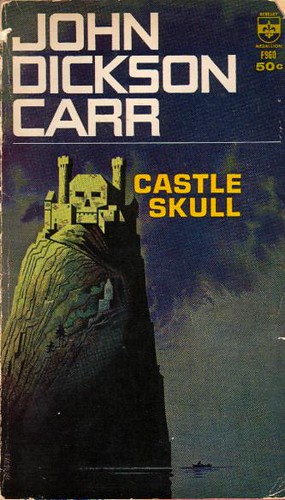
Vintage Mystery Challenge: CASTLE SKULL (1931) by John Dickson Carr


John Dickson Carr (1906 - 1977) was and continues to be the master of the locked room mystery. When you think 'locked room school of mystery', his is the name that automatically pops up. Either as Carter Dickson or John Dickson Carr, he created some of the best murder puzzles ever written. His mysteries are ingenious whodunits with seemingly impossible scenarios, clever casts of often peculiar characters and a wealth of misleading clues meant to confuse the reader and lead him or her totally astray. I'd say he doesn't play fair with the reader, but it really doesn't matter. That's not why you go to Dickson Carr. Or at least not why I've always liked his books.

I began reading John Dickson Carr /Carter Dickson as a very young woman and liked them best because they were so different (I was purposely looking for something a little different) from all my favorite Agatha Christies. In comparison, they are darkly involving books, meant to draw the reader away from the light. These are not 'happy' mysteries. They are mostly gloomy and tortuous and even in the end sometimes, after the explanation, the reader still goes 'huh'? But to me, that's part of the fun. How often can I be fooled? Plenty of times, it seems. Needless to say, none of these convoluted solutions to the crime have anything to do with 'real life', but, in a way, that's part of their charm.

While his two major detectives, Dr. Gideon Fell and Sir Henry Merrivale, are similar in corpulence and brain power (Merrivale more physically active than Fell), the Merrivale books bear the author name of Carter Dickson and the Fell books were published under John Dickson Carr. Whenever I think of Gideon Fell I can't help thinking of the old nursery school rhyme:

I do not like thee, Dr. Fell
the reason why I cannot tell.
But this I know and know full well,
I do not like thee, Dr. Fell.

But in truth, neither of Carr's creations are especially likable, they are not meant to be. They are eccentric thinking machines, pure and simple. (If they remind me of anyone, it's often Dr. Samuel Johnson.) It is within the cast of zany characters that you must look to find someone to like or sympathize with. Perhaps this is the reason why John Dickson Carr's mysteries are not more well known or more widely read today. But the books are so inventive and so craftily written, that I don't really count this as a fault.

CASTLE SKULL is one of the few puzzlers written by John Dickson Carr which features another of his detective creations, the Frenchman Henri Bencolin. (There are five in this series.)
When I first read this particular book many years ago, I thought then as I do now, that it would make a wonderful film. It's amazing to me that no one has ever tried it.

Bencolin is a brilliant detective mastermind. In appearance he is tall, thin and devilish. He has black brilliantined hair, pointy mustaches and the smile of a satyr. And of course, in dress he is impeccable. He relishes the difficult and the theatrical. No run-of-the-mill cases for him. And in CASTLE SKULL, we are as far from run-of-the-mill as you can get.

This book is all about the atmosphere of setting: an eerie castle on the Rhine river. An edifice meant to resemble the shape of a skull, it fires the imagination and casts a dark spell over boaters up and down the river. There are wild improbable tales of hauntings and mysterious doings, of course. The castle was originally owned by the famed and darkly malevolent magician Maleger, a man who, seventeen years before, went to his own unsolved death, disappearing from a railroad car, his body found downriver, bashed against the rocks. Okay, I know what you're thinking, but you have to wait to find out. Is it a red herring? Only time and Bencolin's machinations will tell.

At present, Bencolin and his 'Watson' and general dogsbody, Jeff Marle who tells the tale in first person, are visiting across the river within view of the ominous castle. Bencolin has been asked to solve the murder of famed actor Myron Alison whose grisly death seems incomprehensible to one and all. Alison was the current owner of Castle Skull, though he and his sister and assorted family lived across the river in a rather more comfortable setting -the castle inhabited lately only by a caretaker, most of the building being left to nature's harsh devices.

On the night of the murder, a rainy, storm tossed night (of course), those in the house were horrified by the vision of a man on fire running along the dark battlements of the castle before collapsing and dying in the shadows. That man was Myron Alison.

The local constabulary has called in the famed German detective and wily rival to Bencolin, Herr von Arnheim. Bencolin has been called in by Monsier Jerome D'Aunay, a troubled, wealthy business man who happened to be visiting with the Alisons at the time of the murder. The two detectives are not only jealous of each other's abilities, but enthusiastically enter into competition to see who can solve the murder first.

There are assorted doings and happenings, secret passageways, boat trips across the Rhine, mostly taking place in a rain-soaked atmosphere full of shadows and dark imaginings. Fun stuff. The castle itself serves as a major character in the story. I'm fond of that sort of thing.

The final denouement, of course, will take place at a mad, high-spirited cocktail party given in the ruins of Castle Skull itself. An occasion in which all will be revealed.

Please check out this website for a list of John Dickson Carr's books, all of which make for great and atmospheric reading but perhaps, not on a rainy night.

It was a breathtaking sight to see Castle Skull illuminated in that fashion and I have no doubt that night-travellers on the Rhine gaped up at it. The vast death's head lifted itself to stare with light. The eyes were enormous oval windows of violet-colored glass! the nose was triangular and yellow, as were also the arches forming the teeth; and all of them shone out in a devilish and sardonic blaze. As the lights moved or fluttered in the least, different expressions played over the face of the skull.

Great spot for a murder - huh? Or, at the very least, a cocktail party.

More flights of steps, past another floor where the dining room was located, and we emerged in the room which made up the entire crown of the skull. Noise rushed out at us; noise buffetted the ear-drums, swirled you again into that half-sick tensity of waiting. I saw that the roof was of glass in the shape of a dome. There were carven pillars of ebony soaring to support it. The floor seemed to be of black-and-gold mosaic in circular patterns of zodiac symbols, but I could not see what symbols because it was strewn with animal-skin rugs...and the animal-heads opened white-fanged jaws like an uncanny dead menagerie. People were tripping over them in all directions. Four immense crowns of candles hanging from the roof gave a fiery glow to the mosaic floor, but even so, the room was not well lighted. I could make out no details; shadow lay everywhere outside the candlelight.

It is in this melodramatic atmosphere that another death will occur and a murderer revealed. It's a kind of mish-mash of an ending, but in this book, it's the route to that ending that counts.
This review is an entry in the Vintage Mystery Challenge hosted by Bev at My Readers Block blog.


Wednesday: Thought for the Day


I choose books to suit my self, not my shelf.
Marcus Bryce
(Painting by N.C. Wyeth.)

Tuesday, January 11, 2011

Hooray for Hollywood: Casting Decisions


Can you imagine CASABLANCA without Humphrey Bogart? GONE WITH THE WIND without Vivien Leigh? LAWRENCE OF ARABIA without Peter O'Toole?
THE WIZARD OF OZ without Judy Garland? MILDRED PIERCE without Joan Crawford? THE GRADUATE without Dustin Hoffman? IT HAPPENED ONE NIGHT without Clark Gable? I can't either.

HOLLYWOOD'S FIRST CHOICES How the Greatest Casting Decisions Were Made by Jeff Burkhart and Bruce Stuart, first published in 1994, spills the beans. The thing I find most amazing is how many of these decisions appear to have been serendipitous. How much just plain luck plays in casting. Some of the stories, if true, are absolutely mind boggling in their chance and happenstance.

There were also, of course, the bone-headed decisions made by actors. When offered a certain role, some were unable to see the star making potential and chose to do something else instead. For instance, George Raft turning down THE MALTESE FALCON. That's what I mean by bone-headed.

When I was a kid I wanted to be either a cowgirl or a casting director. But then I grew up and reality intruded. Ha! I still think being a casting director would be lots of fun. (Don't think being a cowgirl would be as much fun anymore.) You know how some films just seem to be made to order for certain actors and then again, how some films are ruined by bad casting? You know how some film stars own their parts to the point that you can't imagine anyone else in the same role? Well, here are some behind the scenes stories to curdle your blood:

LAWRENCE OF ARABIA is one my all time favorite films and honest to goodness, I can't imagine anyone else but Peter O'Toole playing T.E. Lawrence. I mean, the guy inhabited the role. Of course he should have won the Oscar, but though he was nominated he lost out to someone else that year. (Can't remember who. Gregory Peck, I think.) If this isn't one of the all time most brilliant film performances, I don't know what is.

But, hard to believe now, O'Toole was not the first choice to play Lawrence: The first casting bombshell landed in 1959 when Sam Spiegel [producer] informed the press that Marlon Brando was going to play Lawrence. Spiegel and Brando had worked together on ON THE WATERFRONT, and [David] Lean regarded Brando as the greatest actor of all time. But casting Brando as T.E. Lawrence would have been the equivalent to having Marilyn Monroe play Queen Victoria. The announcement caused public outrage in the British press. How could an American possibly play the British liberator of Damascus? Fortunately, Brando had to back down, since he was too involved in the remake of MUTINY ON THE BOUNTY...

...Once more Sam Spiegel announced a new star for his desert epic. Lawrence would be played by newcomer Albert Finney...Lean was pleased with Finney's rather extensive screentests. But after four days of working, Finney quit the production...

...The search for Lawrence continued. Lean returned to Brando, who once again refused. He considered Laurence Harvey, Anthony Perkins, and Richard Burton, but for various reasons none of them seemed ideal. Montgomery Clift began campaigning for the part...After an exhaustive search, Lean finally took a tip from his great friend Katherine Hepburn on a young actor she'd seen at the Royal Court...the actor was Peter O'Toole. The rest, as they say, is history.

A few more casting tidbits from Hollywood's First Choice:

The eponymous role of DIRTY HARRY was first offered to John Wayne, who turned it down. Frank Sinatra was next in line, but he too was not inclined to play the San Francisco cop. Paul Newman was offered the part, but after he turned it down as well, Clint Eastwood was approached. Clint said yes - and it made his day and his career by doing so.

Tom Selleck was Steven Spielberg's first choice for Indiana Jones, but Selleck was unable to get out of his television series commitment - "Magnum P.I." - so Harrison Ford was cast instead.

Michael Curtiz was insistent about using Barbara Stanwyck for the lead in MILDRED PIERCE (1945). But after Stanwyck turned the part down - she'd already done her 'sacrificing mother' routine in STELLA DALLAS (1937) - the studio forced Joan Crawford on director Curtiz. Curtiz disliked Crawford and bullied her badly on the set. But it was worth it. Joan Crawford won an Oscar for Best Actress as Mildred in Mildred Pierce.

For his directing debut, John Huston decided on a third film version of THE MALTESE FALCON (1941). John, son of actor Walter Huston, was at the time one of Hollywood's finest screenwriters. Still, George Raft was not impressed by Huston, so turned down the part of Sam Spade. Humphrey Bogart, a contract player at Warner's, got the part instead.

George C. Scott reached the pinnacle of his career with his monumental performance in PATTON (1970). But Scott received the role of the cantankerous World War II general only after Burt Lancaster, Rod Steiger, Robert Mitchum, and Lee Marvin said no. John Wayne desperately wanted to play the part, but the producers felt he wasn't a good enough actor for the role. Scott won the Oscar for Best Actor that year for his performance, but he refused to accept the award.

Ben Kingsley won stardom, universal acclaim, and an Academy Award for his performance in GANDHI (1982), the award winning biography by Sir Richard Attenborough. But Kingsley was hardly the first choice for the part. He was selected only after Dirk Bogarde, Peter Finch, Anthony Hopkins, Albert Finney, Alec Guinness, and Tom Courtenay said no.

Casting story about the classic, CASABLANCA:

Before [Hal] Wallis set Bogart for the part of Rick, one memo from Jack Warner confirms his desire to see George Raft play the role. Raft was the perfect prototype for Rick, hard-boiled, desperate, but ultimately a 'good guy.' And Raft had made Jack Warner millions during the thirties. But Raft's judgement had been poor when, in the early forties, he turned down a number of roles that might have salvaged his fading career. Perhaps the biggest mistake he made was in turning down the part of Sam Spade in John Huston's 1941 remake of Dashiell Hammett's THE MALTESE FALCON.....After THE MALTESE FALCON, Bogart inherited another role rejected by George Raft: HIGH SIERRA, directed by Raoul Walsh. This was one of the first film noir classics of the forties, a genre Bogart's personality completely captured.

What do you think? Was George Raft one of the dumbest guys ever to come out of Hollywood or what? I mean, you have to shake your head.

I love these sorts of backstage casting stories and when I cruised through this book, my eyes were sometimes rolling out of my head and my mouth was hanging open. Ha! You have to wonder if fate didn't ultimately have a hand in some of these decisions. As for films ruined by bad casting, you'll have to read the book to find those tidbits.

Who Wrote the FIRST Mystery Novel?

Check this out. An interesting piece in today's N.Y. Times re: Who Wrote the First Detective Novel? The article is actually titled: The Case of the First Mystery Novel. I'd always thought it was Wilkie Collins with The Moonstone, but it turns out that it was yet, someone else. Technically, the first detective novel appears to have been: The serialized 8 part novel, The Notting Hill Mystery by anonymous. This debuted in Once A Week magazine beginning in November of 1862.

And since there are few secrets online, the author is no longer anonymous. Read the piece and find out who wrote the first detective mystery novel. Not Wilkie Collins, not Conan Doyle, not even Edgar Allan Poe.

A Favorite Film: Jean Cocteau's LA BELLE ET LA BETE (Beauty and the Beast)

Today we come to what I consider not only one of the best films of all time, but one of the most gorgeous films of all time, a true classic of movie-making genius. A film that is nothing less than a romantic inspiration, a dream realized, a lush, woven 18th century tapestry of movement. Jean Cocteau pulled out all the stops in this telling of the old BEAUTY AND THE BEAST fairy tale. He created a world which shifts from the mundane to the elaborate, from the banality of everyday poverty to the wish-fulfilling riches hidden behind the heavy iron gates of a castle. A world only to be found on a lonely road lost between reality and make-believe. What could be more enticing?

Jean Marais, an incredibly handsome actor and (in real life) Cocteau's lover, is beautifully cast (and beautifully photographed) as Beast, his 'true' beauty hidden away behind 'beastly' raiment. Yet, Marais is also cast as the wastrel Avenant- whose outer beauty hides an inner ugliness. The character of Beauty is kind of sappy about Avenant which doesn't say much for her level of taste. But Marais is so good looking, you almost can't blame her. Avenant hangs about with Beauty's n'er do well brother - both are loafers up to no good. It is their conspiring which brings about tragedy near the end.

Josette Day as Beauty is kind of bland in comparison. She is the all good, all dutiful daughter, so sweet and self sacrificing that she makes you want to scream. (Kind of like Cinderella.) No wonder her wretched sisters take advantage of her. And her father is an useless example of incompetent, hapless boob if ever there was one. If I were Beauty I'd choose life with the Beast without a moment's hesitation. But then, I am not all good and self-sacrificing.

Marais as the Beast is a heartbroken hero, aware of his 'beastly nature' yet drawn to Beauty like a moth to flame. He must have her love if he is to survive and break the spell which has cast him down. Marais plays this perfectly. He falls instantly in love with Beauty, of course. He must, he has no choice. But he is in torment. You see the self-hatred in his attempts to keep Beauty from knowing his need to hunt and kill his food. When he is aroused by Beauty, he sends her to her room lest he be tempted to display his beastly urges. Your own heart breaks for him because, in truth, he is dying of alienation and loneliness.

There is one scene in which Beauty allows Beast to lap water cupped in her hands which is as sexual in tone and much more effective than any dozen bedding and sweating scenes from today's 'anything goes' type of movie-making.

The castle itself, Beast's coldly luxurious lair, is amazing to behold. The art direction is a realized fantasy, the castle appears almost to live and breathe. It is an elaborate tomb in which nothing goes unnoticed. (Some of the outdoor scenes were shot at a real and very elaborate French chateau where large animal statuary added a shadowy, ominous note.)

There are many incredible scenes in La Belle et La Bete that continue to live in memory long after the final credits. But I won't elaborate, if you're unlucky enough NOT to have seen the film, I won't spoil it for you. But I will say that the art direction is unlike anything else you've ever seen. Jean Cocteau creates his own version of fantasy.

Though this 1945 film is done entirely in black and white, it is usually remembered in color. The images are that rich in texture and tone, the camera work vivid, the direction inspired and the costumes are to die for. It is a French film, of course and the beauty of that language adds to the mystic quality of the film. (Sub-titles included and not very intrusive.)

You may know my theory that Mr. Rochester and Heathcliff and other tortured romantic heroes of that ilk stem directly from Beast and this film merely enhances my view.

It is almost impossible to discuss La Belle et La Bete without gushing, as you can see from my own enthusiasm. I've loved this film since I first saw it many, MANY years ago and I urge anyone who hasn't been fortunate enough to see this AND who loves movies to get hold of a copy immediately.

Monday, January 10, 2011

Of Art and Bread

Bread, bread wonderful bread. I don't know about you, but bread is my mainstay. I love bread. I could sit and eat a fresh, fragrant, crispy crusted loaf of Italian or French bread and never bother with anything else except perhaps a little swirl of whipped butter. The smell of fresh bread...Is there anything better? If it were a perfume, I would damn my allergies, and wear it.

Over at ART IS THE ANSWER blog there's a post today on the wonderful Boudin Bakery in San Francisco which specializes in sourdough bread of all shapes and sizes, including some fun artistic ones.


LOVE the alligator!(Actually it looks more like a lizard.) LOVE the bread soup bowls!
Note: painting of baker at top of post by Millet.

Monday Review: HOWARDS END IS ON THE LANDING by Susan Hill

This is a book I've been looking forward to reading since I saw mention of its fabulousness on several blogs last year. But my library didn't have it and at the time, it seemed as if the book was only available in England. (Maybe not, but that's how it appeared to me.) Well, finally, Santa took pity and voila! Christmas morning, there it was under the tree. Lucky me.

HOWARDS END IS ON THE LANDING A Year of Reading From Home is author Susan Hill's 'journal' (really a series of essays), a tour of her own vast library and the influence certain authors have had on her over the years. Hill, a busy and prolific writer, simply decided to spend a year reading and rereading books from her own shelves, often stumbling across books she never even knew she had. She also did a bit of weeding of those shelves as she went along.

Susan Hill is based in England, she is the author of 37 books including THE WOMAN IN BLACK and is also the author of the Simon Serailler crime novels. Here is a link to her website. I admit I've never read any of her work before, but I will be making up for that this year.

It seems as if Hill has known and/or met anyone and everyone of importance in literary circles over her long career. I was most impressed to learn she actually knew and interacted with the great British composer Benjamin Britten. She tells all these stories in a matter-of-fact and very entertaining way. After a lifetime spent writing and reading, she has the true reader's love and appreciation for the literary life, and for the creators of the books which line her crowded shelves. Not to mention a positive gift for conveying that love and 'the how and why' of her conclusions.

While she muses and weeds through her books, Hill works on a list of 40 she simply could not do without. I love how she goes about narrowing down her choices, especially that of Shakespeare's MACBETH. And because of her enthusiasm, I am definitely going to start reading Virginia Woolf this year - no more putting it off. I have some Woolf here somewhere, I simply have to do my own weeding. I am also going to begin reading some Katherine Mansfield, again because of Hill's enthusiasm.

However, hard as it may be to understand, Hill is not a big fan of Jane Austen which only goes to show that no body's perfect. It isn't that she hates Austen, she just doesn't appreciate her.

...there could scarcely be be a more key author for me to miss the point of than Austen. And I do miss the point, almost entirely...

Perhaps the nineteenth century, whose style of dress and architecture, design and manners, I find cold and distancing, is to blame for my inability to appreciate Austen, whose cool, ironic style is somehow all of a piece with that formality and porcelain veneer. Yes, there is wit, there are acute asides, there is a sharpness of observation and judgement, but I never feel empathy with, or closeness to, an Austen character. That may be because their author, their creator, discourages intimacy. She is herself politely distant, keeps me at arm's length, is too private and reserved...I want someone to break out of the elegant little drawing-room circle and go mad. Lydia Bennet almost does it.

If every other book in the house was stolen and I had to spend my reading Jane Austen only, I would either become an ardent fan, after suddenly getting the point, or I would be the one to go mad.

Here, earlier, Susan Hill talks about Sir Walter Scott, finding in his journal, perhaps, a reason to second guess her own opinion of Austen.

Like Proust, like James Joyce, like War and Peace, the novels of Sir Walter Scott appear on most lists of Unreadable Books, though once they were as popular as the novels of Dickens...So it was with various failed attempts to get through Rob Roy or The Heart of Midlothian in mind that I greeted a copy of THE JOURNAL OF SIR WALTER SCOTT when it arrived on my doorstep, sent by the friend who edited it, Eric Anderson. I glanced at the book and glanced away, and for some months it sat on the low table in the drawing room resolutely closed. Then, one grey afternoon in February, I sat in the armchair, thinking to read and, before I had quite decided what I would read, picked up that book.

Two hours later, I was delightedly absorbed in the journal and making the acquaintance of a man I liked, admired and found the most wonderful company in the world. Never mind the novels, read the man himself, who speaks plainly yet whose powers of description are mighty, whose great spirit, courage, uprightness, generosity and warm humour leap out of the pages. He almost persuades me to enjoy Jane Austen, his praise of her is so high-hearted and generous.

From Sir Walter Scott's Journal:

That young lady had a talent for describing the involvements and feelings and characters of ordinary life which is to me the most wonderful I ever met with. The Big Bow-wow strain I can do myself like any now going, but the exquisite touch which renders ordinary common-place things and characters interesting from the description and the sentiment is denied to me. What a pity such a gifted creature died so early.

(Of course, in my own view, Scott was right on the money when speaking of Austen.)

Susan Hill discusses Woolf and Mansfield but also Dickens, T.S. Eliot, Ted Hughes, Roald Dahl, E.M. Forster, Trollope, Elizabeth Bowen and many, many other authors and poets she's read and values highly. Her enthusiasm is contagious. My own TBR list can't help but grow and expand. I kept outlining and making notes as I read; authors I knew, authors I didn't know but meant to know, authors I must now make sure I get to know. That's the problem with books about books, they make you realize how much, yet, you still have to read, how much you may have missed. How inadequate your own reading may have been. I've spent a lifetime reading myself, but see how much I may have missed.

Maybe one of these days I'll post my own 40 Books that would make the final cut, if I absolutely, positively had to winnow down my bookshelves for whatever reason. Horrible thought. I couldn't live except surrounded by books, so I like to think that I understand Susan Hill's compulsions very well, even if we don't agree on Jane Austen.

This review counts towards my eventual total in The Introverted Reader's Dewey Decimal Challenge which is for Non-Fiction books only.

Sunday, January 9, 2011

Sunday Salon: Summing Up: NFL Wild Card Weekend!

Yesterday was a terrific football day, well, afternoon and evening into night. The way underdog Seattle Seahawks who, with a losing season of 7 and 9 should not, according to some, have been in the play-offs at all, WON their game against the Superbowl defending (Last year's champions) New Orleans Saints! A tortuous sentence, but wanted to get it all out in one breath! Ha!

Then, wonder of wonders, the New York Jets beat their nemesis, the Indianapolis Colts! The Colts' quarterback, Superman...uh,Peyton Manning, did his best, especially in the final minutes of the fourth quarter, but still his team came up one point short. Hooray for the Jets!


I'm not even going to talk about next week's game: Jets vs. the New England Patriots. Why? You may ask and all I'll say is that the last time the Jets met the Patriots, it was total annihilation. The Jets were stomped on until they squeaked. Embarrassing.

But for now, I am enjoying the Jets' hair-raising, breathtaking win.

I LOVE IT WHEN THE UNDERDOG WINS!!

Today there are two more NFL games scheduled: the Green Bay Packers vs. the Philadelphia Eagles and the Baltimore Ravens vs.the Kansas City Chiefs I have no favorite to root for, so, as usual I'll root, root, for the Underdog! Nothing can top yesterday's wins, though. FUN!

Other than football, this was a pretty uneventful week. Lots of reading took place, I generally weeded through my Library Loot (tons of vintage I brought home on Tuesday), most of it disappointing, most of it going back unfinished. I won't bother naming names just in case others in the Vintage Challenge might want to read and appreciate these authors. Just because their work didn't appeal to me at this time doesn't mean it won't appeal to others.

We talked on the blog about Ellery Queen and how he is an acquired taste best served in small doses. But in my Loot there are two Ellery Queens that made the cut. So far. They are: THERE WAS AN OLD WOMAN and THE ROMAN HAT MYSTERY.

I also have four titles by Eric Ambler, going to read some spy fiction - not my favorite - but I've heard about Ambler's worth over the years and am going to give him a try. The four are: JOURNEY INTO FEAR, A COFFIN FOR DIMITRIOUS, CAUSE FOR ALARM and BACKGROUND TO DANGER.

I have several other titles by various vintage authors that survived the cut as well, so we'll see what happens. I am always hopeful when it comes to books. You just never know.

We had a great discussion on my Friday book rant: WHEN IS A BOOK NOT A BOOK? (When it is an 'objet d'art.) Lots of interesting comments. Maybe I'll have to 'rant' more often. Ha!

...and another wonder of wonders, I joined a new Challenge. A non-fiction one. So now I have three (3!) Challenges lined up for 2011 and I am absolutely, positively done. This new one is so simple though, I felt as if it were not a challenge at all. I read non-fiction anyway. This one is called THE DEWEY DECIMAL CHALLENGE and the particulars are available here at The Introverted Reader. I posted about it as well.

We talked about one of my all time favorite films: COLD COMFORT FARM on Tuesday. I urge you to see this delightful film if you haven't already. Read the book by Stella Gibbons too, it is a classic of its kind.

We had some more snow this week, not much to write about really. But it is accumulating. Rocky doesn't like it, so our walks have been cut short. He looks fetching though in his little winter jacket. I'm hoping we won't get hit with any major blizzards, but I think I'm probably hoping in vain. Though New Jersey often doesn't get the worst of things, weather-wise.

We'll see how it goes.