Saturday, January 8, 2011

Famous Book Titles and How They Got That Way


I love this little book: NOW ALL WE NEED IS A TITLE Famous Book Titles and How They Got That Way by Andre Bernard.

Bernard reveals the quirky stories behind some of the most famous book titles in the English language. Over a hundred titles are detailed in crisply edited, fun anecdotes. Who knew that coming up with the right title for a book could be so happenstance, so spur of the moment, so chancey?

Would you buy a fictional book titled: PANSY? Well, that was the original title of GONE WITH WIND. I kid you not. THE GREAT GATSBY was originally titled TRIMALCHIO IN WEST EGG, until saner heads prevailed.

Authors face the title dilemma with every book. Does the title really matter? "I have never been a title man," groused John Steinbeck. "I don't gibve a damn what it is called." (Despite his tough stance, this was quite untrue. Steinbeck worked hard at his titles and the results are among the most memorable in American literature.)

Author Charles Portis wrote: A writer who does cherish his title would probably do well to hold it in reserve and not present it until two or three others, all duds, have been duly rejected, leaving the editor with his editorial honor intact.

Titles We're Glad Got Changed
  • The Mute was changed to THE HEART IS A LONELY HUNTER
  • At This Point In Time was changed to ALL THE PRESIDENT'S MEN
  • Private Fleming, His Various Battles was changed to THE RED BADGE OF COURAGE
  • Judah: A Tale of the Christ was changed to BEN-HUR
  • Before the Anger was changed to ROOTS
  • First Impressions was changed to PRIDE AND PREJUDICE
  • To Climb the Wall was changed to THE BLACKBOARD JUNGLE
  • The House of the Faith was changed to BRIDESHEAD REVISITED
  • It Shouldn't Happen to a Vet was changed to ALL THINGS BRIGHT AND BEAUTIFUL
  • They Don't Build Statues to Businessmen was changed to VALLEY OF THE DOLLS
  • The Kingdom by the Sea was changed to LOLITA
A story about Raymond Chandler:
...Chandler sent the manuscript of THE BRASHER DOUBLOON off to his publisher who as usual loved the book but hated the title and who wrote back to Chandler that booksellers would pronounce 'brasher' as 'brassiere.' Chandler explained that a brasher was a late-eighteenth-century coin, but then agreed that booksellers' needs came first. "How about THE HIGHT WINDOW?" he suggested. "It is simple, suggestive, and points to the ultimate essential clue."

I've read THE HIGH WINDOW and like it very much. Funny thing: the movie version of Chandler's book went back to the original title, THE BRASHER DOUBLOON. The film starred George Montgomery as Philip Marlowe.

While finishing THE LADY IN THE LAKE Raymond Chandler wrote to his publisher, "I'm trying to think up a good title for you to want me to change."

From early in the book, I love this story of the haphazard way the blockbuster, bestseller JAWS received its evocative title:

Peter Benchley remembers that "JAWS was the last, desperate compromise between me and my editor some twenty minutes before the book had to go to press. I had fiddled with a hundred alternatives, more or less. GREAT WHITE, THE SHARK, LEVIATHAN RISING, THE JAWS OF DEATH...At last my editor and I agreed that we didn't like any of the suggested titles, and in fact, the only word we liked in any permutation was 'Jaws'. I recall saying something to the effect of, "Screw it, then, let's call it JAWS," and my editor saying something like, "Okay, what the hell..." My father didn't like it, my agent didn't like it, my wife didn't like it, and I didn't much like it. But the bottom line was, who cares? Nobody reads first novels anyway."

NOW ALL WE NEED IS A TITLE by Andre Bernard is a fun way to spend an evening when you're not feeling in the mood to read anything lengthy, involved or requiring deep thought.

Saturday Salon: A Favorite Painting


Notes of an obvious non-academic:

I'm departing a bit from the usual, I suppose, by choosing an N.C. Wyeth painting used for the cover of the 1919 edition of James Fenimore Cooper's LAST OF THE MOHICANS. But I am a huge fan of Wyeth's work and lately I've been viewing even more of his paintings and reading more about the Wyeths. See my post of the book WONDROUS STRANGE which features the Wyeth family's brilliant work but also the work of the great and wonderful Howard Pyle.

I love the strength and knowledge depicted in this painting. I love the use of outline and color and the mythical implication - the figure surrounded by clouds. To my mind, this is an image startling in its intensity. Note the dramatic setting, the mountainous region of upstate New York. Note the beautiful tattoos, the arm cuff, the hatchet, the knife in a beaded scabbard, the beauty of the figure's upper body, the strong brow, the feather angled just so. The bow and arrow ready for action.

This is a work of masculine power and envy. Yes, it is a romantic interpretation, but I see nothing wrong in that, I truly don't. Fenimore Cooper romanticized the world he wrote about, Wyeth visualizes the romance in this painting. It is a world created larger and brighter than its reality.

And by the way, if you haven't read THE LAST OF THE MOHICANS, it's never too late. I read it when I was already an adult and enjoyed it very much. You may have seen the wonderful film starring Daniel Day Lewis which is amazing in its own right, but I'd recommend reading the book if you haven't already. It's gone out of favor in recent times, but since when has that ever stopped us?

To read more about the painting, please go here. And please click here to learn more about the artist, N.C. Wyeth.

Artist, N.C. Wyeth as a young man.

Friday, January 7, 2011

A Rant: When Is A Book Not A Book?


Surely I can't be the only one who finds the whole idea unsettling? Yeah, it makes for a pretty picture. But...

Is a book a book if it's just for looks? What is the point of a book meant solely to pretty up a shelf? The point is obvious, you say, the point is that it tells the viewer that the home owner has 'taste' and money enough to indulge it. I don't understand this, I'll never understand it. I read this piece Selling a Book By Its Cover, from the NY Times with my mouth hanging open. Oh, I know there are homes, large expensive homes in which the library shelves were filled with books bought by the pound at some estate sale. Books never meant to be read, meant merely to fill up space - like props in a stage setting. Books never meant to be touched, merely to be looked at. But I'd hoped this kind of thing was only occasionally to be found in stately homes where no one actually lived. Why that should make the idea more palatable, I don't know.

(Now, I'm not talking about books being used in film and/or theater settings, I know there are businesses that deal in this sort of necessary thing. I'm not even talking, I guess, about the guy who makes pretty trees out of books. I think I view this as recycling.)

But while reading the Times, I felt a surge of nausea at the thought of books being used in this way in a private home. Books wasted, languishing on shelves, all in uniform color covers, merely to satisfy some control-freak idea of decorating. Books as 'texture' - yegads! Books chosen by size and weight, never for content. Books used to make some sort of artsy-fartsy statement. And what's more, there are people making a living supplying this sort of thing to people with too much money and very little taste. People without any elemental sense of the fitness or the rightness of things. People without the heart to value books in any way except as decorations, as God forbid, objet d'arts. See slide show, and try not to be dismayed.

And yes, maybe in a way it IS recycling too, but honestly, the whole idea of this sort of thing makes me cringe. In this kind of atmosphere, books become invisible. They fade into the background, like wallpaper.

What do you think of all this? Am I too sensitive? Is the world coming to an end?

Short and Sweet: Update on Laurie R. King's Latest Holmes and Russell Book: THE PIRATE KING

THE PIRATE KING is due out this September. As you probably know by now, Laurie R. King is one of my all time favorite writers. Her Sherlock Holmes and Mary Russell books are my favorite series. Read all about THE PIRATE KING here. I'm having a hard time waiting patiently for this one.

Thursday, January 6, 2011

Dewey Decimal Challenge


Not exactly sure why this is called the Dewey Decimal Challenge, but I've decided to join up anyway. I know, I know, I said two challenges were the max for me. But, here's the thing, I'm planning on reading non-fiction again this year, so why not do it in a challenge format? When I saw that this is a simple enough challenge to follow - just read as little or as much non-fiction as you want - I thought, why not?


The Challenge was originated by Jen at The Introverted Reader. You can read the rules and sign up for the Challenge on her blog. Any book that qualifies as non-fiction is permitted: Memoirs, History, Travel, etc. I'll be doing several biographies this year as well as history.

The Challenge runs from Jan. 1, 2011 - Dec, 31, 2011.

Here are the levels:
  • Dilettante - read one non-fiction book
  • Explorer - read two
  • Seeker - read three
  • Master - read four
See what I mean? Nice and simple. Hardly a challenge at all. Or so I've convinced myself.

My level will be Seeker, even though I know I'll read more non-fiction than that. I'm just playing it safe for now.

Here are some of the non-fiction books I'm interested in reading this coming year:
(Subject to change on whim.)

Howard's End Is On the Landing by Susan Hill

N.C. Wyeth - A biography by David Michaelis

Gladstone - A biography by Roy Jenkins

Enslaved by Ducks by Bob Tarte

Cleopatra's Nose by Daniel J. Boorstin

Making the Mummies Dance by Thomas Hoving

Evening in the Palace of Reason by James R. Gaines

Sounds like a plan. We'll see what happens.

Things Good To Know: Today is Sherlock Holmes' Birthday

Had he been 'real', Arthur Conan Doyle's immortal fictional detective would have been 157 years old today. (Even if he had been 'real', he would have still been immortal.) You know, if a character can be judged by the affection, admiration and esteem he has been held in over lo, these many years, then Sherlock Holmes, probably to his eternal befuddlement, has to be seen as one of the more beloved of ALL fictional characters. And, at least according to the author of THE VELVETEEN RABBIT's theory, the more a make-believe character is loved, the more he is 'made real'. So, for all intents and purposes, Holmes still lives. (I'm sure being compared to a velveteen rabbit, would have pained him enormously.)

Make no mistake, I fell in love with Holmes when I was a teenager and I've never fallen out. (I was also smitten, early on, by Hercule Poirot and Nero Wolfe. Obviously I'm a big believer in the lure of brain power.) So, for me, Holmes can do no wrong. But mostly I am a purist: it is the Holmes of Victorian gas lit London streets that I love best.

I'm including a link to the fabulous (and worthy of Doyle's original creation) Granada Television series featuring Jeremy Brett's incredible performance as Holmes and David Burke or Edward Hardwicke as his Watson. You can watch all the series of adventures unfold instantly at Netflix. You can also read about Brett and the series in a post from my blog linked here. If you scroll down a bit, on the left side of my blog you will also find a link to various posts on Holmes I've made over the last few months.


Thanks to The Rap Sheet blog for the heads up on this auspicious birth day.

Wednesday, January 5, 2011

Wednesday: Thought for the Day


"A true poet does not bother to be poetical. Nor does a nursery gardener scent his roses."
Jean Cocteau

Tuesday, January 4, 2011

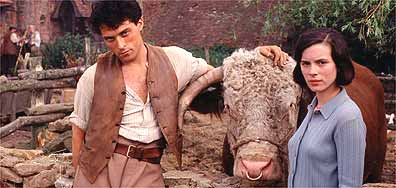
A Favorite Film: COLD COMFORT FARM starring Kate Beckinsale, Rufus Sewell, Eileen Atkins, Ian McKellen


I read the book, saw the film, loved both. But today I'm just talking about director John Schlesinger's film starring Kate Beckinsale who, by the way, is sheer perfection as Flora, 'Robert Poste's child.' This 1995 film is just about as good an adaptation of a book as I've ever seen. If you loved the 1932 book by the merciless Stella Gibbons, you will probably love the film from the wonderful animated opening credits forward.

Though the film is not as witty or grimly dour as the book (hilariously so), it still manages to capture a lot of the 'doom' and 'gloom' of the Starkadder's farm in the back of beyond, English countryside. True, the dirt and gloom at the farm is a kind of movie make-believe dirt and gloom, but it works. This is not, after all, a true to life tale of redemption and/or lifestyle reconfiguration. The film is dark fairy tale on the outside, heart of gold on the inside. The book, not so much.

From the very beginning when Flora Poste, newly orphaned and impoverished by vague circumstance, shows up at her friend Mary Smiling's London townhouse - Mary is played by the wonderful Joanne Lumley who doesn't have enough to do in the film, my only complaint - we are instantly smitten. It is the 1930's and the conversation between the two women is just so fetchingly right. Flora and Mary discuss the future and Mary decides she must seek a home with one of her countrified relatives because she is not inclined to earn a living. Her goal is to 'live' life then write a grand novel about it. "When I am 53, I hope to write a novel as good as Persuasion, but in a modern setting." Flora's gift is for 'management'. She loves managing people and setting things to rights. So, where would she fit in best?

One of my favorite little scenes in the film is due purely to film invention and casting. In it, Mary Smiling's butler Sneller, played by the exquisitely wonderful Trevor Baxter, serves her little teacakes while she and Flora sit and ponder Flora's problems. It is in the way the butler operates and the little bits of dialogue in the scene that will charm the pants off you. (Figure of speech.) Lumley makes it clear in a few charming gestures, that she relies completely on her butler. She also collects women's undergarments and appears to have a room devoted to this collection displayed on mannequins, but let's not dwell to much on this little bit of weirdness.

Another fabulous early sequence in the film is when Flora writes to and receives answers from her eccentric relatives (Schlesinger does this in brilliant little vignettes). They are hilarious. Is it just me or does anyone else agree with me that the Brits invented eccentricity? Finally, Flora chooses the Starkadder's at Cold Comfort Farm as the lesser of three evils. "There have always been Starkadder's at Cold Comfort Farm."

The farm itself is delightfully run-down, gloomy, and provincially depressing. The Starkadders, from the funereal widow Eileen Atkins, to hunky farm stud Rufus Sewell, to the religous zealot Ian McKellen and the rest of the oddly assorted lot, including the very creepy and appropriately named Urk, all dance attendance to the strange head of family, Aunt Ada Doom. It is she who controls the purse strings. Played perfectly by Sheila Burrell ("I saw something nasty in the woodshed!"), she is a grumpy old lady who lives upstairs in the ramshackle farmhouse and never leaves her room.

How Robert Poste's child, Flora, moves in and shakes up, not only the farm, but the entire neighborhood, sets everything to rights, figures out happy endings for everyone then takes off (literally) in the end for her own happy ending, is sheer delight, not to mention funny as heck.

Flora is a force of nature.

This is one of my all time favorite films and I urge anyone and everyone who has not seen it to do so immediately. If you, like me, love wry, witty British humor, satire and just plain silliness (but not empty-headed silliness), you will love this film.

The excellent movie site, Internet Movie Data Base has a great set of pix from the film. Shots of the characters in costume, scenes, etc. Found the trailer elsewhere.

Off the Cuff 'Review' of Robert A. Heinlein's THE DOOR INTO SUMMER

This is not really a regular review. But I've just got to share the comments by a character in Robert A. Heinlein's affectionate look at time-travel, A DOOR INTO SUMMER. The character narrating is inventor Daniel Boone Davis, the hapless hero of the tale, and his comments are about his cat, Petronius the Arbiter, otherwise known as Pete.
The comments are just so funny and so right on the money when it comes to cats that I laughed out loud. At the same time, I fondly remembered how it was to live with a cat many years ago. (Unfortunately, I can no longer keep a cat because of late-onset allergies, but I grew up surrounded by them. My late mother kept a cat until the last moment of her life.)

Why just an off the cuff review? Well, it was a spur of the moment read and I already have my reviewing schedule fixed in my mind. There will be an extra review this week beside my usual two (Monday Review and A Favorite Read review), part of my Vintage Mystery Challenge deal.

Long story short: Dan Davis is an inventor of robotic household helpers. In 1970, after several wars and an attack by an unspecified country (I'm assuming USSR) on our shores, the country is familiar but not. For instance: insurance companies sell something called the Long Sleep, in which a client can be cryogenically put to sleep and wake up years later when, supposedly, all his troubles should be over. It's a nice runaway device, I suppose. Anyway, Dan is betrayed by his fiancee and his partner, they get hold of his patents and company and he [Dan] figures out a way to use time travel and the Long Sleep to get even. That's the gist of it.

So, anyway, this is just an excuse to share the cat commentary. Here is Dan talking about a house he and Pete once lived in.

...the lack of plumbing made the rent low and what had been the dining room had a good north light for my drafting board.

The drawback was that the place had eleven doors to the outside. Twelve if you counted Pete's door. I always tried to arrange a door of his own for Pete - in this case a board fitted into a window in an unused bedroom and in which I had cut a cat strainer just wide enough for Pete's whiskers. I have spent too much of my life opening doors for cats - I once calculated that, since the dawn of civilization, nine hundred and seventy-eight man-centuries have been used up that way. I could show you the figures.

Pete usually used his own door except when he could bully me into opening a people door for him, which he preferred. But he would not use his door when there was snow on the ground.

While still a kitten, all fluff and buzzes, Pete had worked out a simple philosophy. I was in charge of quarters, rations, and weather, he was in charge of everything else. But he held me especially responsible for weather. Connecticut winters are good only for Christmas cards; regularly that winter Pete would check his own door, refuse to go out it because of that unpleasant white stuff beyond it (he was no fool), then badger me to open a people door.

He had a fixed conviction that at least one of them must lead into summer weather. Each time this meant that I had to go around with him to each of eleven doors, hold it open while he satisfied himself that it was winter out that way, then go on to the next door, while his criticisms of my mismanagement grew more bitter with each disappointment.

Here is Dan talking about his would-be fiancee, Belle, in relation to Pete:

Pete was another matter, and if I had not been in love I would have seen it as a clear sign that Belle and I would never understand each other.....liking cats is hard to fake to a cat person...Cats have no sense of humor, they have terribly inflated egos, and they are very touchy. If somebody asked me why it was worth anyone's time to cater to them I would be forced to answer that there is no logical reason...So I put iodine on Belle's scratches, then tried to explain what she had done wrong. "I'm sorry it happened - I'm terribly sorry! But it will happen again if you do that again!"

"But I was just petting him!"

"Uh, yes...but you weren't cat-petting him; you were dog-petting him. You must never pat a cat, you stroke it. You must never make sudden movements in range of its claws. You must never touch it without giving it a chance to see that you are about to...and you must always watch to see that it likes it. If it doesn't want to be petted, it will put up with a little out of politeness - cats are very polite - but you can tell if it is merely enduring it and stop before its patience is exhausted." I hesitated. "You don't like cats, do you?"

"What? Why, how silly! Of course I like cats." But she added, "I haven't been around them much, I suppose. She's pretty touchy, isn't she?"

"He.' Pete is a he-male cat. No, actually he's not touchy, since he's always been well-treated. But you do have to learn how to behave with cats. Uh, you must never laugh at them."

"What? Forevermore, why?"

"Not because they aren't funny; they're extremely comical. But they have no sense of humor and it offends them..."

Okay one last scene - this had me laughing so hard, even now as I'm copying it, I'm laughing and finding it hard to type. This is a scene about mid-book when Belle and Dan's partner Miles show their true colors as they apply to Pete and everything else. Belle has doped Dan so that he can only move at her command. He can partially see what's happening but do nothing about it.

"I've wanted to kill that damned cat for months." She looked around for a weapon and found one, a poker from the fireplace set; she ran over and grabbed it.
Miles picked up Pete and tried to put him into the bag.

"Tried" is the word. Pete isn't anxious to be picked up by anyone but me or Ricky, and even I would not pick him up while he was wailing, without very careful negotiation; an emotionally disturbed cat is as touchy as mercury fulminate. But even if he were not upset, Pete certainly would never permit himself without protest to be picked up by the scruff of the neck.

Pete got him with claws in the forearm and teeth in the fleshy part of Mile's left thumb. Miles yelped and dropped him.

Belle shrilled, "Stand clear, Chubby!" and swung at him with the poker.

Belle's intentions were sufficiently forthright and she had the strength and the weapon. But she wasn't skilled with her weapon, whereas Pete is very skilled with his. He ducked under that roundhouse swipe and hit her four ways, two paws for each of her legs.

Belle screamed and dropped the poker.

I didn't see much of the rest of it. I was still looking straight ahead and could see most of the living room, but I couldn't see anything outside that angle because no one told me to look in any other direction. So I followed the rest of it mostly by sound, except once when they doubled back across my cone of vision, two people chasing a cat - then with unbelievable suddenness, two people being chased by a cat. Aside from that one short scene, I was aware of the battle by the sounds of crashes, running, shouts, curses and screams.

But I don't think they ever laid a glove on him.

I never realized Heinlein was so witty or so funny. I'd never read him before. But Nancy Pearl recommended this book as one of her favorite Time Travel reads, so on impulse, I got a used copy and read it within a few hours the other night. I'm glad I did. Good book. Very funny, especially the bits about Pete.


Unfortunately, I can find no 'sources' for the three cat pictures featured. If someone squawks, I'll insert credit or remove the pix. Thanks.

Monday, January 3, 2011

Monday Review: A BUTTERFLY IN FLAME by Nicholas Kilmer

Since the very first book, Harmony in Flesh and Black, I have been a huge fan of this intriguing series by art historian Nicholas Kilmer set within the suspicious hot-house haze of the art world. Clayton Reed, Boston Brahman and collector of art masterworks is the sort of man of whom it can easily be said that 'refined' is not too refined a description. From his thick shock of restless white hair to the tip-toes of his bespoke shoes, he is a man for whom the upper class would have had to have been created had it not already existed.

A character who, generally, lives in his own fantasy world of art (a Beacon Hill townhouse in Boston), indulging a sort of philosophical seclusion which only the wealthy can support. The 'modern' world is a constant frustration to him. In his devotion to chicanery - when it comes to getting his hands on original paintings - he stops short of outright thievery. He will pay, but he will pay as little as he can possibly get away with. I've come to believe, from having read all the books in the series, that Clay delights in the hunt - though he'd probably claim otherwise.

But Clay doesn't hunt alone. In fact, he rarely shows up at auctions or sales or any other sort of place where a hidden masterpiece might lurk and Clay's presence immediately drive up the price. Instead, he hobnobs with other Boston Brahmans (family name still counts in these circles) and keeps his ears tuned to gossip and undercurrents. He seems to have a sixth sense when it comes to picking up the possibility of a long hidden or about-to-be dumped masterpiece.

For the actual and particular, not to mention peculiar, work of tracking down major artworks, Clayton has his go-to guy, Fred Taylor. (Fred is the star of the series, though in one of the books, the brilliant DIRTY LINEN, Clay steals the show.)

Fred Taylor is a Vietnam vet, a sensitive tough guy (sound familiar?) with an intimidating persona and, really, the heart of an aesthete. An intuitive nose (as well as a great deal of arcane art knowledge) is his speciality. He is a scent hound when it comes to art. Put him on the trail, give him just a couple of oblique references and he is reliably on the hunt.

There's a great deal of fascinating art history entertainingly woven through throughout these tales of murder and mayhem. Who knew the art world could be so violent?

Fred lives (more or less) with a librarian named Molly and her two children - it took him several books before he actually moved in with a few of his things. Because of his war experience, Fred has a bit of a problem relating to possessions and relationships. He owns a house in a borderline neighborhood which he uses as a kind of home base though he rarely, if ever, sleeps there. He allows the house to be used as a kind of sanctuary by homeless vets needing a place to sleep. He's a good guy as well as a hard-nosed investigator.

Are he and Clayton Reed friends? I don't know. I think so, but really it's an odd relationship. Clayton pays Fred's salary, so technically, he's the boss. But each knows the other's limits and the boundaries of their good faith. They each have qualified trust in each other, each knows what to keep from the other. Clay because of paranoia and Fred because of his knowledge of that paranoia.

In A BUTTERFLY IN FLAME, Fred is sent by Clay - at the behest of a couple of his snob-circle friends, Parker Stillton and lawyer Abraham Baum - to pose as an English teacher at the Stillton Academy of Art in Stillton, Massachusetts a small, private and very provincial institution. Fred will be there 'to teach', search and ask questions. The real English teacher has gone missing, along with a much younger girl student. The police have no clues except a curious note left by the girl. The two are assumed to be unlikely runaways. Or something more sinister, thinks Fred. The school is pushing a suicide pact solution for a variety of reasons, but Fred thinks not. His knowledge of Emily Dickinson poetry, self-admittedly limited, helps him figure out that if the teacher and his student are dead, it's not suicide. He's also figured out, mostly by intuition and his knowledge of Clayton Reed's psyche, that there is more to the story than he's been told. Fred sniffs the wind, gets the lay of the land at Stillton and the strange little town that surrounds it, and realizes that somehow, some long lost painting must be in the offing. Perhaps hidden and forgotten in one of the school's old buildings.

After a couple of murders and other general chicanery at a school which is, ostensibly, trying to get a much needed accreditation, Fred resorts to a spot of breaking and entering, a spot of blackmail and a bit of strong arm to get the desired result.

This is a terrific book.

Though it doesn't advance our knowledge of Clayton Reed and Fred Taylor, nor, for that matter, Fred's relationship with Molly, that's not really what the book is about. The book is about the very satisfying salvation of a struggling institution whose devoted and talented students are being short-changed by a rapacious bunch of directors who care nothing about art.

Final total (thanks to Fred Taylor): Art: 1. Greed: 0. (More or less.)

Here are some sentences from A BUTTERFLY IN FLAME, clues to the wry writing style
of Nicholas Kilmer:

Both of Clay's visitors were dressed, like Clay, for Boston: gray suit, white shirt, and tie. Stillton and Baum were patently bedecked by Brooks Brothers. Clayton's version of exactly the same outfit came from a place where you are out of luck unless they know you.

"Poetry is always a bad sign," Clay said. "We want you to find out what happened."

Parker Stillton's cough reminded the world of his importance.

I don't mind exposition at all, if it's interesting. Here, Fred questions Meg, one of the art instructors: Meg went on talking. "Fine. Since we are accidental neighbors, I'll assume you are ignorant...Stillton Academy: it might be the only almost genuine 19th century French academy of art left in this country, maybe in the world. There's nothing left like it in France, anyway, not for the last fifty years. I teach first-and-second-year drawing, painting for second-and third-year students. And as I said, I run the life room. Also I teach figure modeling. That's clay. It works out for me. Clay's my medium."

"The life room", Fred said, presenting her with the damp glass and a tall can of Ballantine ale. He carried another can with him to his chair. "That's where students work from the model."

"The live model. Always nude," Meg said, "until the second half of the third year, when we let the painters start working with drapery as well. I said we were 19th century, but not even we work from cadavers. Not since about seventy-five years back."

This is the assignment that Fred (make-believe English teacher/full time investigator) gives his class on his first day at Stillton:

"...Here's the assignment. Take any poem by Emily Dickinson. Find your books, share them, whatever. Copy the poem. Write it again making it better by subtracting six words. Write it again, making it better by adding six words. Write it again, making it better by removing twelve words and substituting twelve different words. For extra credit write an extra stanza of your own and stick it in somewhere. Make it so much like one of Emily's that we can't tell - A stanza is one of those blocks of lines, usually four lines in Emily's poems - that we can't tell which is the fake. Right." He looked at his watch. "Get started."

Here we have the moment when Fred, out of the blue - it's been hovering on his sub-conscious -realizes who the artist is whose work he's been looking for, the artwork that somehow, Clayton Reed has divined is hiding out within Stillton's crumbling buildings. Fred is just finishing a meal:

There were all of seven diners. Each of them, even the little girls, was involved with either one lobster or a matched pair. It wasn't until his coffee that Fred exclaimed, "For God's sake, it's Albert Bierstadt!"

Everyone in the place looked at him, alarmed.

"It's OK, folks," Fred reassured his fellow diners - as well as the hovering waiter and the woman back of the cash register. "Perfectly OK. AB is Albert Bierstadt."

I checked Albert Bierstadt's work and I've posted one of his paintings below. Kilmer always uses 'real' artists in his mysteries, just the mentioned work is fictitious.


Meant to mention: A BUTTERFLY IN FLAME was part of my Christmas Book Loot from Santa.

Sunday, January 2, 2011

Suffering from Time-Warp

Okay, this cover has convinced me there's a place for Lurid on our blogs. When I first saw this while searching for quite another author's cover, I stopped dead in my tracks, did a double take, then laughed. It's not often I sit at my computer and just laugh out loud. But the title, the artwork, I mean, it's just too much. Every now and then when I come across one of these types of covers, I simply must talk about it. Maybe we could do a regular post: Lurid Cover of the Week, Month, Year. Maybe.

I'm sorry but this cover is just plain fun. Though it's lurid (and garish) as all get out, it's also funny and, judged by today's standards, kind of innocent in its obvious prurience. I think that's the drop dead charm of these old covers - artwork which seems so neat and tidy no matter how nasty the titles and blurbs may be. I mean, the blond is wearing a beret, for goodness' sake. She's actually got on an outfit. You think she went to 'Hussies Are Us' and purchased it all in one box? Maybe this is the officially sanctioned street corner outfit. You see what I mean? It's probably got it's own logo. Did women EVER look like this? (Come to think of it, she does look a bit like Anne Francis in BATTLE CRY.)

And look at the guy leering at the blond. He's wearing a blazer! (Well, the fact that it's brown probably indicates his fall from grace.) What side of town did he wander in from? Obviously these two are headed for a very bad end. After all, according to the book they are living life on the skids.

Ah, the good old days.

Sunday Salon: Short and sweet.

Not doing much of a Sunday Salon since I've already done my Summing Up this past week (of 2010), so not much left to sum up. Rocky and I are looking forward to the new year, day to day, seeing what it brings. So far, so good.

Between Christmas and New Year's Eve, I read a total of one book: A BUTTERFLY IN FLAME by Nicholas Kilmer, which was part of my Christmas book loot from Santa. (Review tomorrow.) I'm also finishing up a good non-fiction read: THE POISONER'S HANDBOOK by Deborah Blum. A thought provoking look at poisons and how almost impossible it was, in the first half of the 20th century, to uncover murder by poison. Very interesting stuff.

(The Nicholas Kilmer book brought my reading year to an end at 121 books. Seems like a lot, I suppose, but I thought I'd done better. I do wish I had better retention of what I read...I used to. I plead old age and let it go at that. Some books are easy enough to remember, some are not.)

Spent a few days this week fighting with a sinus infection, not a lot of fun, but I seem to be doing better and better each day, so can't complain.

That's about it for this past week.

Now if only the Jets and Giants win their respective games, all will be sweet.
Note: Artwork at bottom of post by the one and only Racey Helps, one of my favorite illustrators in the whole wide world. (As if you didn't know.)


Lured By the Past

Okay, it seems I am in danger of sinking back into the past and indulging my love of Vintage Mysteries to the exclusion of anything else - at least for now. See, here's the problem: once I begin reading - in this case, Ellery Queen - I get caught up in the ways of the past, the rhythm of the writing, the social niceties and strictures, the fashions (the hat wearing, especially, and the dressing for dinner), but most importantly, I get caught up in the aura. I'm a sucker for aura, not to mention a nice, lurid cover. The past speaks to me.

I am in real danger of fading away here.

I wonder if this happens to anyone else? If so, how do you hold it in abeyance? I'm seeking a balance here. Because if allowed to run riot, I'll go to the library and check out every Vintage Mystery author they have in stock. Balance is what's needed. Obviously. Some kind of mantra I can hum to myself when in danger of overdosing on Dorothy Sayers or anyone else from that era. Something soothing I can use to quell my Vintage mania. (I knew this would happen when I joined the Challenge, but I went ahead and did it anyway. Obviously, I must like to live dangerously.)

The ideal, of course, would be to strike a good balance between past and present, for instance, I could go this reading route: vintage, modern, vintage, modern, vintage, Victorian, modern, vintage, Victorian, modern, vintage, modern, vintage.....you get it. But I have a feeling I'm going to have trouble with this . Yup, trouble is coming down the pike. (I am looking around for this Ellery Queen mystery merely on the strength of the cover. Love it.)

What will happen when I begin reading Victorian classics for my Victorian Literature Reading Challenge, I just don't know.

Some cogent words of advice would be nice just about now.


Please note: I can't make out the name of the artist of the wonderfully atmospheric courtroom scene at the top of my post, but the painting is so right on the money, I thought I'd post it anyway. If anyone knows who the artist is, I'll be glad to attribute. (Or if anyone squawks, I'll remove the painting entirely.)

Saturday, January 1, 2011

Vintage Mysteries: Book One


First book of the New Year:

Coincidentally, the book I'm reading on this first day of the new year is not merely a great mystery, but a great vintage mystery (published in 1949) - perfect for kicking off the Vintage Mysteries Reading Challenge hosted by My Reader's Block.

The book is titled: CAT OF MANY TAILS. All about a mad strangler at large in NYC. It's part of a three book anthology I picked up at the library.


I'm sure there will be even more Ellery Queens on my TBR pile before the end of this year. I though I was starting out with one I'd read many years ago, but as I'm reading it, I'm thinking well, maybe not. We'll see as I go along. Terrific story, so far.

First Day of the New Year! 2011

First day of the brand new year - 2011. Okay, so now what do we do with it?


The clock is ticking. But, no pressure. Ha!

Note: Painting at top by Jessie Wilcox Smith