Showing posts with label art mystery. Show all posts

Friday, October 5, 2012

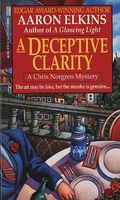
Friday's Forgotten (or Overlooked) Book: A DECEPTIVE CLARITY (1987) by Aaron Elkins


(Best I can do, cover-wise. Nothing better to copy on line. It's a shame really because these three books have gorgeous paperback covers. Something you can't really appreciate with this tiny version which blurs if I enlarge it.)

Friday is not only the end of the work week, but it is also, as most of you know, the day to post about Forgotten (or Overlooked) Books. This weekly meme is usually hosted by Patti Abbott, but this week, Todd Mason is doing hosting duty at his blog, Sweet Freedom. So don't forget to check in and see what other neglected books other bloggers are talking about today.

A DECEPTIVE CLARITY is the first book in the Chris Norgren series which, unfortunately, is only three books strong. (At least so far. I live in hope that the author will revive the series sometime.) Aaron Elkins is well known for his terrific 'skeleton doctor' books featuring forensic anthropologist Gideon Oliver (I've read every one) but I am also a big fan of Chris Norgren. Chris is a San Francisco museum curator, a low-key, likable kind of guy who just happens to be brilliant - at least when it comes to his specialty: Renaissance and Baroque art

Chris also has a kind of fumbling knack for getting involved in mysteries and coming to the attention of the  very nasty bad guys who lurk in the shadows of the museum and art business. Who knew the art biz was so rife with skulduggery? I mean, it's a hot-bed of intrigue which, in this case, means murder most foul.

So here's the plot: Chris is in the middle of a divorce after ten years of marriage (his wife ran off with a stockbroker) and is only too happy to head to Europe at his boss's request. There he is to assist his immediate supervisor, the charmingly patrician Peter van Cortlandt as he, in conjunction with the U.S. Army in Berlin, arranges an important show of recovered paintings plundered by the Nazis.

The exhibition is entitled The Plundered Past and is featuring, among other looted treasures, several paintings recently uncovered in a German cave - an astonishing discovery after so many years. The paintings, a Vermeer, a Titian and a Rubens were/are originally owned by the very wealthy Italian, Claudio Bolzano who, though jittery, is lending them for the show. Bolzano is elderly and sickly, but still astute enough to want to make sure that nothing further happens to his beloved paintings. Paintings he'd thought lost forever.

But there appears to be a fly in the ointment. Peter hints strongly that there's something wrong with one of the paintings found in the hidden cache. Something he can't quite explain and will Chris take a closer look while Peter is away smoothing more ruffled feathers connected with the show?

With little to go on, Chris takes a second look at the paintings and we get lots of fascinating tidbits about the art of forgery as well as the specific way in which the Renaissance masters worked. I don't know about you, but I find this sort of detail incredibly interesting - this is an art mystery after all.

When Chris travels to Florence to reassure Bolzano, he stops at his favorite hotel near the church of Santa Maria Novella, a destination Chris considers his own personal pilgrimage.

"Five minutes after I'd checked in and been effused over by Alberto like the old client I was, I was inside the church, standing before a shadowed fresco in pale browns midway down the let wall of the nave. Inconspicuous, washed-out-looking, pretty much ignored in this city crammed with fabulous art treasures, it is  a landmark in the history of art.

There have been lots of landmark artworks and a lot of landmark artists, but only once has a painter single-handedly launched with a single painting a movement that changed art forever. The painter was Masaccio, the painting was the Holy Trinity, and the movement, if that's a strong enough word, was the Renaissance. In painting, anyway; Donatello and Brunelleschi had already gotten the ball rolling in sculpture and architecture.

The twenty-four-year-old Masaccio's innovations were stunning. He used light as no painter before him had. Even the great Giotto's light had been flat, sourceless, an obvious necessity but no more. Masaccio illuminated with it, hid with it, molded with it. And Masaccio's figures are the first 'clothed nudes'; they look as if they could get out of their robes if they wanted to, and nobody in a painting had ever looked that way before...."

(If ever I go to Florence, this is one of the first places I'll be headed to and I hope I am capable of the same sort of awe.)

Back to the story: When the fastidious Peter van Cortlandt turns up dead outside a sleazy German brothel, Chris realizes that something is amiss. He makes the connection between the death of the curator and the possible forgery in the show with the coaching of a good looking Army Major named Anne Green,  protocol liaison.

The plot thickens as Chris begins to get at the truth and attempts are made on his life and an El Greco is blown up along with some guards. And you thought all museum curators did was...uh, curate.

Written with Aaron Elkins customary wit and obvious enjoyment of his craft, A DECEPTIVE CLARITY is definitely worth your time and and any trouble to find it.

For a complete listing of all of Aaron Elkins' books, including the three art mysteries featuring Chris Norgren, please use this link.


Monday, January 3, 2011

Monday Review: A BUTTERFLY IN FLAME by Nicholas Kilmer

Since the very first book, Harmony in Flesh and Black, I have been a huge fan of this intriguing series by art historian Nicholas Kilmer set within the suspicious hot-house haze of the art world. Clayton Reed, Boston Brahman and collector of art masterworks is the sort of man of whom it can easily be said that 'refined' is not too refined a description. From his thick shock of restless white hair to the tip-toes of his bespoke shoes, he is a man for whom the upper class would have had to have been created had it not already existed.

A character who, generally, lives in his own fantasy world of art (a Beacon Hill townhouse in Boston), indulging a sort of philosophical seclusion which only the wealthy can support. The 'modern' world is a constant frustration to him. In his devotion to chicanery - when it comes to getting his hands on original paintings - he stops short of outright thievery. He will pay, but he will pay as little as he can possibly get away with. I've come to believe, from having read all the books in the series, that Clay delights in the hunt - though he'd probably claim otherwise.

But Clay doesn't hunt alone. In fact, he rarely shows up at auctions or sales or any other sort of place where a hidden masterpiece might lurk and Clay's presence immediately drive up the price. Instead, he hobnobs with other Boston Brahmans (family name still counts in these circles) and keeps his ears tuned to gossip and undercurrents. He seems to have a sixth sense when it comes to picking up the possibility of a long hidden or about-to-be dumped masterpiece.

For the actual and particular, not to mention peculiar, work of tracking down major artworks, Clayton has his go-to guy, Fred Taylor. (Fred is the star of the series, though in one of the books, the brilliant DIRTY LINEN, Clay steals the show.)

Fred Taylor is a Vietnam vet, a sensitive tough guy (sound familiar?) with an intimidating persona and, really, the heart of an aesthete. An intuitive nose (as well as a great deal of arcane art knowledge) is his speciality. He is a scent hound when it comes to art. Put him on the trail, give him just a couple of oblique references and he is reliably on the hunt.

There's a great deal of fascinating art history entertainingly woven through throughout these tales of murder and mayhem. Who knew the art world could be so violent?

Fred lives (more or less) with a librarian named Molly and her two children - it took him several books before he actually moved in with a few of his things. Because of his war experience, Fred has a bit of a problem relating to possessions and relationships. He owns a house in a borderline neighborhood which he uses as a kind of home base though he rarely, if ever, sleeps there. He allows the house to be used as a kind of sanctuary by homeless vets needing a place to sleep. He's a good guy as well as a hard-nosed investigator.

Are he and Clayton Reed friends? I don't know. I think so, but really it's an odd relationship. Clayton pays Fred's salary, so technically, he's the boss. But each knows the other's limits and the boundaries of their good faith. They each have qualified trust in each other, each knows what to keep from the other. Clay because of paranoia and Fred because of his knowledge of that paranoia.

In A BUTTERFLY IN FLAME, Fred is sent by Clay - at the behest of a couple of his snob-circle friends, Parker Stillton and lawyer Abraham Baum - to pose as an English teacher at the Stillton Academy of Art in Stillton, Massachusetts a small, private and very provincial institution. Fred will be there 'to teach', search and ask questions. The real English teacher has gone missing, along with a much younger girl student. The police have no clues except a curious note left by the girl. The two are assumed to be unlikely runaways. Or something more sinister, thinks Fred. The school is pushing a suicide pact solution for a variety of reasons, but Fred thinks not. His knowledge of Emily Dickinson poetry, self-admittedly limited, helps him figure out that if the teacher and his student are dead, it's not suicide. He's also figured out, mostly by intuition and his knowledge of Clayton Reed's psyche, that there is more to the story than he's been told. Fred sniffs the wind, gets the lay of the land at Stillton and the strange little town that surrounds it, and realizes that somehow, some long lost painting must be in the offing. Perhaps hidden and forgotten in one of the school's old buildings.

After a couple of murders and other general chicanery at a school which is, ostensibly, trying to get a much needed accreditation, Fred resorts to a spot of breaking and entering, a spot of blackmail and a bit of strong arm to get the desired result.

This is a terrific book.

Though it doesn't advance our knowledge of Clayton Reed and Fred Taylor, nor, for that matter, Fred's relationship with Molly, that's not really what the book is about. The book is about the very satisfying salvation of a struggling institution whose devoted and talented students are being short-changed by a rapacious bunch of directors who care nothing about art.

Final total (thanks to Fred Taylor): Art: 1. Greed: 0. (More or less.)

Here are some sentences from A BUTTERFLY IN FLAME, clues to the wry writing style
of Nicholas Kilmer:

Both of Clay's visitors were dressed, like Clay, for Boston: gray suit, white shirt, and tie. Stillton and Baum were patently bedecked by Brooks Brothers. Clayton's version of exactly the same outfit came from a place where you are out of luck unless they know you.

"Poetry is always a bad sign," Clay said. "We want you to find out what happened."

Parker Stillton's cough reminded the world of his importance.

I don't mind exposition at all, if it's interesting. Here, Fred questions Meg, one of the art instructors: Meg went on talking. "Fine. Since we are accidental neighbors, I'll assume you are ignorant...Stillton Academy: it might be the only almost genuine 19th century French academy of art left in this country, maybe in the world. There's nothing left like it in France, anyway, not for the last fifty years. I teach first-and-second-year drawing, painting for second-and third-year students. And as I said, I run the life room. Also I teach figure modeling. That's clay. It works out for me. Clay's my medium."

"The life room", Fred said, presenting her with the damp glass and a tall can of Ballantine ale. He carried another can with him to his chair. "That's where students work from the model."

"The live model. Always nude," Meg said, "until the second half of the third year, when we let the painters start working with drapery as well. I said we were 19th century, but not even we work from cadavers. Not since about seventy-five years back."

This is the assignment that Fred (make-believe English teacher/full time investigator) gives his class on his first day at Stillton:

"...Here's the assignment. Take any poem by Emily Dickinson. Find your books, share them, whatever. Copy the poem. Write it again making it better by subtracting six words. Write it again, making it better by adding six words. Write it again, making it better by removing twelve words and substituting twelve different words. For extra credit write an extra stanza of your own and stick it in somewhere. Make it so much like one of Emily's that we can't tell - A stanza is one of those blocks of lines, usually four lines in Emily's poems - that we can't tell which is the fake. Right." He looked at his watch. "Get started."

Here we have the moment when Fred, out of the blue - it's been hovering on his sub-conscious -realizes who the artist is whose work he's been looking for, the artwork that somehow, Clayton Reed has divined is hiding out within Stillton's crumbling buildings. Fred is just finishing a meal:

There were all of seven diners. Each of them, even the little girls, was involved with either one lobster or a matched pair. It wasn't until his coffee that Fred exclaimed, "For God's sake, it's Albert Bierstadt!"

Everyone in the place looked at him, alarmed.

"It's OK, folks," Fred reassured his fellow diners - as well as the hovering waiter and the woman back of the cash register. "Perfectly OK. AB is Albert Bierstadt."

I checked Albert Bierstadt's work and I've posted one of his paintings below. Kilmer always uses 'real' artists in his mysteries, just the mentioned work is fictitious.


Meant to mention: A BUTTERFLY IN FLAME was part of my Christmas Book Loot from Santa.