Showing posts with label Vintage Mystery Reading Challenge 2012. Show all posts
Friday, August 10, 2012
Friday's Forgotten Books: CHAMPAGNE FOR ONE (1958) by Rex Stout
If it's Friday, it's Forgotten Books day, the weekly meme hosted by Patti Abbott at her blog, Pattinase Today, while Patti is is traveling, Todd Mason has rounded up the links on his blog, Sweet Freedom.
I'm off to another late start, but that seems to be the way of it lately. It doesn't help that it's a dreary, rainy day - perfect for lounging around in bed, the ceiling fan going and Rocky (my chihuahua) snoozing.
Anyway, don't forget to check in at Todd's and see what other forgotten (or overlooked) books other bloggers are talking about today.
CHAMPAGNE FOR ONE by Rex Stout is my entry even though I don't think it's, technically, a 'forgotten' book. I mean, if you love Rex Stout's work as much as I do, by inference you love Nero Wolfe and Archie Goodwin, so you might not have forgotten this one. I'll admit though, that I hadn't re-read it in years - couldn't find my copy in the house anywhere - so I bought it again online and this time I'm keeping an eye on it.
This is also the copy with an introduction by Lena Horne, a lady I admired very much. It seems she and her hubby were personal friends and neighbors of Rex Stout and his family.
Even though CHAMPAGNE FOR ONE prominently features a bunch of 'unwed' mothers - an idea that no longer shocks - this is still a book that, otherwise, hasn't aged much. It also seems to have gotten better or I've changed or - who knows? Never one of my favorites, it has now moved up into my top ten Wolfe books. Go figure.
Archie Goodwin gets a phone call from Dinky Byne (you can tell right away from the name that the guy is a dilettante) requesting a favor. Will he [Archie] attend the annual high society dinner for unwed mothers (that's what it amounts to) given by Mrs. Robert Robilotti?
It's that evening at seven and yeah it's short notice but Dinky has a bad cold.
Though Archie is suspicious of Dinky's real reason, he goes to the dinner all dolled up in a tux as requested. Mrs. Robilotti is the unwitting (and rather stiff-necked) benefactor of a charity begun by her late first husband, which funds a halfway house for unwed, pregnant young women to come and stay. The facility also arranges for adoption of the newborns.
There's lots of condescension involved since the evening (at Mrs. Robilotti's luxurious townhouse) involves the appearance of ten young mothers and ten society stalwarts (not that Archie counts as 'society' but he is a last minute replacement and beggars can't be choosers) to dance attendance on the women and buck up their supposedly low spirits.
When one of the young mothers, Faith Usher, dies in full view of a crowded room, everyone but Archie assumes it's suicide by poison.
The police, the party-goers, Mrs. Robilotti, everyone involved wants the bad episode simply to go away. It must have been suicide because NO ONE could have poisoned Faith Usher except herself.
But Archie is stubborn.
A fabulous book in which Nero Wolfe must accept that Archie's intelligence, experience and observational skills trump the evidence of everyone else's eyes. Wolfe knows Archie and so accepts his version of what happened though Wolfe was not there. Ultimate trust between friends and cohorts. It's a wonderful thing. Even if it makes for a very difficult and exasperating murder problem.
My post today also counts as an entry in Bev's Vintage Mystery Reading Challenge 2012.
Friday, August 3, 2012
Friday's Forgotten Books: SKULDUGGERY (1979) by William Marshall
It's Friday and I'm late with my entry, but it's Forgotten Books day all day. Patti Abbott has off, so Todd Mason is doing the link collecting and display duties. Don't forget to check in and see what other forgotten (or simply overlooked) books other bloggers are chatting about today.
William Marshall is a prolific Australian writer with sixteen books in this particular series. To check out all of Marshall's titles, Yellowthread Street and otherwise, please use this link.
Yellowthread, a shabby street set among the back alleys of the Hong Bay section of Hong Kong is the address of the local - and not very much feared - constabulary. A dreary, neglected building in need of repair serves as headquarters to a harried bunch of locals who do their best to keep law and order in this colorfully byzantine area of the world.
This is Hong Kong 1979, Britannia rules. Brit officers are in charge though discipline is not as stiff-upper-lip as one might think. It is a very eccentric setting for a lively police procedural which most of the time had me rolling my eyes and laughing at the slighly bizarre (okay, not so slightly) doings. Author Marshall has an assured way of handling absurdity as if it were commonplace and creating memorable characters who deal with life in this exotic and complicated locale with as much aplomb as they dare to.
Three current crimes being investigated by the Yellowthread bunch, headed by phlegmatic Chief Inspector Harry Feiffer:
1) Muggings in a two person elevator in a building where the rich live on the top three or four floors and the rest below. The problem is that the coshing and money snatching occur when the elevator indicates it is on the third floor landing even though the door on that landing has been nailed shut by inhabitants tired of being mugged. An ever more frustrated Sgt. Auden has been riding up and down in the elevator for six straight hours or more, waiting to be mugged while trying to figure out how it's done. There are no clues since the muggees have not been able to describe their attacker.
2) The Deaf and Dumb Gang has struck again. Handicapped robbers (one of them blind) who cannot or will not speak and apparently cannot hear are robbing jewelers at an alarming rate. Hopeful of rounding up the gang, the police place a dragnet (well, sort of) around a store likely to be robbed and wait for the gang to show up. Inside the store, the easily distracted Sgt. Spencer sits on the stairs in the storeroom, shotgun in hand, ready to spring into action.
Mr. Fan, owner of P.P. Fan Jewelers, counts his money trepidaciously and none too optimistically, while giving Spencer, sitting behind a half open door, a lecture on career opportunities.
3) A 20 year old skeleton washes up on a beached wooden raft, ankles tied and accompanied by farm fresh sweet potatoes, a dead fish, a set of false teeth and a ten inch length of iron drain pipe. It's murder all right. The problem is the bones belong to an American still very much alive.
Just another typical day for the cops of Yellowthread Street station.
Time to hunt around for that other William Marshall book I'm sure is around here somewhere.
Friday, July 6, 2012
Friday's Forgotten Books: THE GREAT MISTAKE (1940) by Mary Roberts Rinehart
Today is FFB day around these parts, the weekly meme hosted by Patti Abbott at her blog, PATTINASE Don't forget to check in at FFB Central and look over the list of bloggers posting forgotten or overlooked books today. Patti has the links.
Two, THE GREAT MISTAKE, which somehow I'd NEVER read but vaguely remember ordering at some point in the past. How did they wind up on a pile on my bookcase - overlooked for weeks - for me to notice them at this particular point in time? I'm thinking it's the work of book fairies. No other explanation.
The plot: Our unsuspecting young heroine, Patricia Abbott (not our meme host) goes to work at The Cloisters (the property of the moneyed family in this story) as a kind of social secretary/companion to elderly and likable Maud Wainwright, a widow. Mrs. Wainwright is a nice enough woman but apparently burdened with secrets which she isn't about to reveal to anyone until it's too late and maybe not even then.
Also living at the house is the heir to the Wainwright fortune, the handsome and unhappy Tony. He falls for Patricia and she for him - hesitantly. No big surprise there. But still it's nicely done by an author who is always good at handling these sorts of entanglements.
Patricia can't help but pick up on the undercurrents permeating The Cloisters, especially when Maud Wainwright begins acting strange to the point that her health is affected, but refuses to explain and continues to pretend that everything is fine.
Then out of the blue, who should turn up but Tony's heretofore unmentioned wife, Bessie. The brassy blond is, to put it mildly, a gold-digger with a heart of stone. But Tony was young and impressionable when he met her and bowled over by her flashy (and now fading) good looks, he was hooked. Bessie has refused to give him a divorce though they have been living apart for quite some time. Why should she divorce him when his mother, Maud, continues to pay all her bills?
Bessie isn't the only one to turn up out of the blue. Don Morgan, a neighbor's feckless, charming and long lost husband who'd run off years before with a young employee also turns up, claiming he's ill and doesn't have long to live and would his abandoned ex-wife and daughter please take him in and take care of him in his last days. Cough. Cough.
Before long, murder occurs. A dead body is found on the side of the road clad in silk pajamas. Secrets continue to pile upon the detritus of other secrets. Poor Patricia is dragged further into the muck of the rich. The cops begin hanging around and everyone manages to look guilty as sin. Actually, the cops look pretty silly too as they keep detaining and releasing people.
As is usual in a Mary Roberts Rinehart story there's plenty of the 'had I but known' type thing going on and occasionally, you just want to shake the heroine and say TELL ME ALREADY!! But Patricia is determined to tell the story in her own way. We must be patient or flip to the back pages.
Before long, another murder occurs and our heroine finds herself in the same untenable position all of Mary Roberts Rinehart's leading ladies usually find themselves in. It always makes me wonder why they don't just grab a gun, sit everyone down and DEMAND to know what the hell is going on. But that wouldn't be lady-like.
Therefore, we must ask ourselves these questions:
Will the Wainwright family secrets ever be revealed?
Will the cruel murderer ever be caught?
Will Bessie ever stop sneering and haranguing?
Will the cops ever get a clue?
And most importantly, will Patricia and Tony EVER live happily ever after?
Read the book and see.
This is not top notch Mary Roberts Rinehart, but really, it's quite good enough.
This review also qualifies as an entry in Bev's VINTAGE MYSTERY READING CHALLENGE 2012.
Check out all the wonderful vintage books other bloggers have been posting about. Links at Bev's blog: MY READER'S BLOCK.
Monday, June 25, 2012
Vintage Mystery Reading Challenge: THE HOLLOW NEEDLE (1909) by Maurice LeBlanc
THE HOLLOW NEEDLE (1909) is the first novel I've read by Maurice LeBlanc, a Victorian era French writer who was a very early practitioner of the mystery/detective story. He created Arsene Lupin a conniving thief and clever gentleman turned detective who went on to star in 21 books and collections of short stories, though admittedly, with a broken heart. The broken heart part we learn about near the end of THE HOLLOW NEEDLE. In this book, the second in the series, Lupin is still very much a thief and criminal genius.
I understand that LeBlanc originally created these stories as a kind of French response to the popularity of Arthur Conan Doyle's Sherlock Holmes. In comparison of course, there is no comparison. Holmes rules. But I still find it interesting viewing the two different approaches to story-telling.
THE HOLLOW NEEDLE is written in the overwrought Victorian style with strict attention paid to manners and mannerisms. It was still possible in those days to tell a person's occupation by the clothing they wore and even by the accents of their speech. Class divisions were creaky but firmly entrenched in this long ago world before WWI. The mixture of view-points and even at one point suddenly jumping from third person to first and back again can get a bit confusing. But thankfully it doesn't happen often.
I suppose in comparison I might mention Wilkie Collins, but again, Collins is really the better writer. He's also more humorous than LeBlanc whose prose is probably dampened by the sort of French irony which is not as engaging to the English ear - probably loses something in translation.
The plot of THE HOLLOW NEEDLE is fairly convoluted - not surprising - but definitely intriguing, especially in the first half of the book. It features surprises around every corner and a wonderfully clever young high-schooler/amateur detective (it's not called high school in France, but that's the practical equivalent) who becomes a thorn in the side of the great Arsene Lupin. In my view, the young man, Isidore Beautrelet is the single most appealing character in the story even if the first time we meet him he is wearing false whiskers.
The story begins late one night at the chateau of the wealthy Comte de Gesvres. Loud noises in the night. A terrible commotion. Thuds. Grunts. Groans. The Comte's daughter Suzanne and her cousin Raymonde (an orphan whom the Comte has taken into his household) rush down from their rooms but not before they've spied (from a window) some men crossing the property carrying heavy bags and disappearing into the shadows. Robbery or worse!
When the young women reach the library, they find the Comte barely conscious and his private secretary, Jean Daval dead of a stab wound to the neck.
'Brave and plucky' Raymonde rushes to a window and spots a man running away. She raises the pistol she'd appropriated upstairs earlier and shoots the interloper. He falls, wounded, but crawls away into the bushes. Nearby, barely visible, are the crumbling walls of the old Cloister - an Abbey which sits on the grounds of the chateau.
The servants run out into the night convinced they'll find the fallen murderer within a few feet of the house. But the wounded man has disappeared - one of many inexplicable mysteries which will occur that night and into the next few days.
The local magistrate and his minions drive up in horse drawn traps and the story begins to make less sense when the Comte tells them that nothing is missing from the house. Nothing has been stolen, though Monsieur Daval is no less dead.
The Comte owns four Rubens paintings and a medieval tapestry, all worth a fortune, yet he appears to have had little if any security. Nevertheless, the paintings are still on the wall and nothing is missing. What were the 'robbers' carrying?
The magistrate orders his men and the servants to search the property - including the ruins of the Abbey - but they find no one. The search is temporarily called off after several hours and guards placed near the house.
In the morning, when a few members of the press find their way into the house, Monsieur le Juge d'Instrucion (the magistrate) confronts one of the reporters who is unable to produce identification or the proper papers. Once he removes his false whiskers, the erstwhile 'reporter' turns out to be a 17 year old school boy named Isidore Beautrelet, a particularly clever high-schooler traveling (for the Easter holiday) at the urging of his elderly father. Isidore is looking for adventure and finds it.
He proceeds to tell all the incredulous adults that he knows what's missing even if nothing is declared missing and what's more, he knows where the wounded man must be and who the murderer is. The murderer is not the wounded man? No, declares Isisdore Beautrelet with charming aplomb.
But of course, this being a mystery, he's not allowed to tell all he knows (and how he knows it) until later in the story. (Isn't that always the way?) Later he also announces that the wounded man (who, presumably is still hiding on the grounds of the chateau) is none other than Arsene Lupin, famed thief and adventurer - brilliant adversary of the French police. Said police are dumb-founded, though easily brought around to Beautrelet's way of thinking.
Now, obviously, Holmlock Shears has a rather obvious ring to it. A simple re-arranging of Sherlock Holmes' name - author Maurice LeBlanc's little bit of fun, I suppose, but very un-ironic, I'd have thought.
But wait there's more: A lost treasure, a document written by Louis XVI, a notation by Marie Antoinette, something called The Hollow Needle mentioned even by Voltaire....Phew! At this point I admit I was ready to throw in the towel, but I persevered.
Read a bit more about the problem of the Hollow Needle here. (the 'needle' is supposed to hold the legendary treasures of the Kings of France).
The second half of LeBlanc's book is basically a continuing battle of wits between the established genius of a master criminal and the untutored genius of a 17 year old boy. Near the end we also have the perspicacity of Holmlock Shears (who'd been released from captivity months before) thrown in for good measure, precipitating an event which will change Arsene Lupin forever. Or so we are led to believe.
I think I would like to read the next installment just to see what Arsene Lupin gets up to next, what Maurice LeBlanc has planned for him. I'm also hoping to meet up with Isidor Beautrelet once again. LeBlanc was prolific, so there's plenty to look forward to.
Going in, I knew nothing about these stories except the name, Arsene Lupin. But it's been fun to discover LeBlanc's creation and to learn more about the very early days of mystery fiction. (Even if I had to contend with reading on line off my computer screen.) I read this book at Project Guttenberg where it's available for free.
HOLMLOCK SHEARS?? What are you, kidding me? Apparently not.
This is my umpteenth entry in the Vintage Mystery Reading Challenge 2012 hosted by Bev at her blog, MY READER'S BLOCK.
Friday, June 15, 2012
Friday's Forgotten Book: MIGHT AS WELL BE DEAD (1956)by Rex Stout
Not really forgotten, of course, not by Nero Wolfe aficionados like you and me, but I've just finished reading it for the umpteenth time and thought this would be a good time to mention it. Don't think I have before, except in passing.
It's Forgotten Book Friday once again, a weekly meme hosted by Patti Abbott at her blog, PATTINASE, so don't forget to check in and see what other forgotten or overlooked books other bloggers are talking about today.
Being that this book was published in 1956, it qualifies as well for the Vintage Mystery Reading Challenge hosted by Bev, at her blog, MY READER'S BLOCK.
MIGHT AS WELL BE DEAD features several nasty murders, one of which hits very close to home for gargantuan detective Nero Wolfe and Archie Goodwin, Wolfe's right hand, confidant, secretary, bookkeeper, bodyguard and all around, general purpose henchman. This, of course, makes them even more determined to catch a crazed killer who has already allowed an innocent man to be tried, convicted and sentenced to death.
A prospective client, James R. Herrold, arrives from Omaha, Nebraska especially to hire Wolfe to find his long lost son, Paul. There had been a falling out and the son has severed all contact (after being kicked out of the family home) except for yearly holiday cards mailed to his mother and sisters from New York City. That's all Paul Herrold knows, but he is adamant about finding the boy who had been accused - years before - of stealing money from the family firm but has since been found to have been innocent.
This is one of Rex Stout's more inventive plots - it begins one way then takes a surprising detour almost immediately. The son, when he is found, has - once more - been wrongfully accused of a crime. (This guy just cannot catch a break.) But Paul Herrold aka Philip Hays has refused to help in his own defense despite his lawyer's entreaties. He tells Archie Goodwin that he 'might as well be dead' for all the good anyone can do for him. He refuses to admit who he is and refuses as well, to see anyone, including any family.
Inspector Cramer of the NYPD is not happy that a case he thought solved and over with has been re-opened by Nero Wolfe. And within a couple of days, when the murderer strikes again, then again, he is forced to admit that they may have arrested the wrong man. This sort of thing makes Cramer even grumpier than usual.
Though no one can out-grump Wolfe when he's forced, by circumstance, to work. As Archie is fond of saying: "When a hippopotamus is peevish, it's a lot of peeve."
As bodies pile up, Archie and the gang work to find the glimmer of light which will lead Wolfe to the truth.
As in many of Rex Stout's stories, some of the motivation is a little iffy, but I overlook that since I do especially like the way the plot of MIGHT AS WELL BE DEAD comes together bit by bit, an angle here, an angle there, until it all begins to make sense, even if it is melodramatic sense. Plus there's a great love story at the heart of it. I did mention melodrama.
Friday, June 1, 2012
THE SWIMMING POOL (1952) by Mary Roberts Rinehart
I wish I'd had this copy, but mine has a less lurid cover.
This is another entry in the Vintage Mysteries Reading Challenge hosted by Bev at her blog, MY READER'S BlOCK. I haven't forgotten about it, Bev, I'm just lagging behind everything lately, playing catch-up. Apologies for that.

This is how I look and feel when I'm not enjoying a book as much as the person who recommended it.
You know when someone recommends a book and says it one of their favorites, you have a pretty heavy-duty obligation to like if not love it. But sometimes that's not the case and that's when guilt sets in. Ryan at his blog, WORDSMITHONIA, raved about THE SWIMMING POOL by Mary Roberts Rinehart and so of course, I had to get my own copy since I am a huge Rinehart devotee. (Ryan's review is from last year yet somehow I only ran across it recently.)
Oh, I liked it well enough Ryan - I just didn't love it as much as you did. I wanted to, but I just couldn't. But hey, any Mary Roberts Rinehart is better than none. So, no frowny faces, please. I feel bad enough as it is.
************************
THE SWIMMING POOL is one of Mary Robert Rinehart's more wordy and convoluted stories. I mean, there's everything in here but the kitchen sink. (Sort of like one of my reviews.)
1. You got dark forebodings in a large country manor. (Rinehart's specialty.)
2. You got a dead body in the swimming pool, multiple murders and a couple of attempted.
3. You got an ugly miscarriage of justice.
4. You got not one but two murderers.
5. You got suicide and some long hidden, down and dirty family secrets. (What would a Rinehart book be without 'em?)
6. You got blackmail to the tune of $50,000 bucks. (Big money back in the day.)
7. You got a heroine who appears to know next to nothing about her own family.
8. You got a HUGE and very interesting (if it had been developed) red herring that kept sidetracking me. Well, yeah, Yvette that's what a red herring is for. But still....
9. You got the heroine's brother who is as annoying a character as Rinehart ever created. I mean, the man is even more obnoxiously clueless (and proud of it) than the heroine and that's saying a lot.
10. You got the stock market crash of 1929 and its ramifications.
11. Last but not least, you got the odd actions of a nefarious butler. Speaking of which, judging from this book, I don't think Mary Roberts Rinehart thought much of the breed.
The Plot:
Judith Chandler is the beautiful and glamorous sister who married well and went off to become the darling of the New York society pages - her escapades, legendary. But now, after twenty years or so, the wild child is getting a divorce from her stodgy and very correct husband, Ridgely Chandler, and returning to the bosom of her family, much to the chagrin of her sister Lois and her brother Phil, not to mention the housekeeper Helga who isn't keen about the news either. The two siblings lead rather sedate lives and resent the intrusion of DRAMA that always surrounds their sister.
Sure enough, Judith isn't there five seconds when she barricades herself in her room and refuses to come out. Obviously she is deathly afraid of someone. But she won't say who what when or why. If she did, then things might have been cleared up and possibly more death averted.
Earlier, on a divorce trip to Reno with Lois in tow as a sort of minder, Judith had fainted on the train at the sight of something or someone. Of course she won't tell Lois what's wrong. (No, she's not pregnant.) So back to the country house they go. There, Judith will spend most of the book hiding out, skulking and jumping at shadows, and only occasionally coming out at night in a black cape, to lurk around the grounds - for exercise, I suppose. Most of her behavior makes little sense even when explained later.
Most Mary Roberts Rinehart books are of the had I but known variety and this one is no different except that what Lois and the rest of 'em should have known is so darned convoluted (secrets upon secrets upon coincidences that boggle the mind) that for a while I lost track of what it was all about even when I knew what it was all about.
What did I like about THE SWIMMING POOL?
I liked the setting. I'm always a sucker for spooky doings in a country house, especially in the dead of night - this is what kept the pages turning for me. I liked that I wasn't sure who the murderer was, so that part of the plot was well constructed. I sort of liked the addition of a fairly tame love story (there's usually a love story in any Rinehart book) between the hapless Lois and a guy named O'Brien who turns out to be a cop on leave who has conveniently moved into the caretaker cottage on the Chandler property.
Look, maybe I'm being picky, but Mary Roberts Rinehart has written some classics (check my 101 Favorites list) and I really expected more from THE SWIMMING POOL. Though truth to tell, the book was still better than a lot of what gets published these days under the guise of mystery or 'cozy'.
Friday, March 30, 2012
Friday's Forgotten Book: THE MUMMY CASE MYSTERY (1933) by Dermot Morrah
Friday is Forgotten Book Day, a weekly meme hosted by Patti Abbott at her blog, PATTINASE.
Don't forget to check in at Patti's for all the links to bloggers who are talking 'forgotten' tomes today. It's always intriguing to see what other readers come up with.
My post today also counts as an another entry in Bev's VINTAGE MYSTERY READING CHALLENGE. Link on over there to see what other vintage reads other bloggers have read and recommended.
Today's book is a kind of repeat since John already talked about it on January 13th for FFB.. But I'd forgotten that particular little tidbit and since this is the book I'd earmarked for today I'm kind of stuck with it. But all in a good cause if we help shine a ray of light unto a forgotten but deserving, author.
The link to John's initial review: Pretty Sinister Books.
********************************
THE MUMMY CASE MYSTERY by Dermot Morrah is a book by another writer I wasn't familiar with, but with a title like this (plus John's recommendation), I had no choice but to look around for a copy. I love mysteries with these sorts of fairly innocuous titles - nothing fancy, just the right choice of words - enough to intrigue and easy to remember. Throw in 'mummy case' and what's not to like? Those are the magic words.
The setting is terrific as well: Academia - Beaufort College, Oxford and the time is 1933. When Egyptology Professor Benchley's newly acquired mummy of Pepy I is used to disrupt Commemoration Night festivities, it will not be the first untoward event of the boisterous evening.
Later that same night, Benchley's room at the college will go up in flames and nothing but a charred, blackened body will be found within. But is it the Professor's body? Or the mummy's? The police don't seem very interested in prolonging the investigation and the coroner is in a hurry to declare the whole thing an unfortunate accident. Several of the professor's personal items were found on the body so ipso-facto, it must be Professor Benchley's charred remains.
However, Professors Denys Sargent and Humphrey Considine, surely two of Oxford's most laconic Dons, have doubts. For one thing: where is the mummy's body? There should have been two bodies found in the burnt ashes of the room. Between the last time Benchley was seen alive and the fire, there simply had been no time to dispose of a huge Egyptian mummy case and the mummy therein.
But perhaps the professor had been duped and the mummy case has been sold to him empty? Not hardly, Benchley was a renowned Egyptologist, of course he would have double checked to make sure the mummy was who and what and where it was purported to be by the seller - one Professor Bonoff, a down on his luck refugee (and Egyptian specialist) in need of cold hard cash.
So, without the aid of the police who are satisfied they know what happened, Sargent and Considine begin their own halting investigation. The interesting thing about all this is that a lot of the book is just Sargent and Considine talking things over, considering alibis and times, surreptitiously looking around for a missing mummy case with or without a body.
Professor Bonoff (the mummy seller), currently living on the Isle of Wight, was also the man with whom Professor Benchley had been carrying on a feud - opposing theories and strongly worded letters in the Times, that sort of thing. But the feud appeared to have dissipated with Benchley's capitulation and the purchase of the mummy (the oldest ever found) for rather a large sum of money.
As their investigation gathers a bit of steam, Sargent and Considine pick up the help of two bright young things - a pair of women students who have stumbled upon the missing mummy case lying in a punt (!?) and are more than eager to lend a hand. Sargent and Considine are impervious to their pleas to be included in the mystery, Considine, especially, appears to be a misogynist in the making.
This is a delightfully dry book - if you're looking for action, keep looking - this is all British wit, entertaining conversation peppered occasionally with Latin quotations, conflicting alibis, mistaken identities, red herrings and that indefinable attraction that mysteries dripping with college ambiance seem to have. Of course near the end of the story, our heroes are kidnapped and face dire consequences, so it's not all tea and crumpets.
Their hunt for a killer takes the two professors to the tiny Isle of Wight and brief residence at the Flossington House and Tea Garden. The delightfully ramshackle house is owned by Edward Bunny, a retired Naval officer. He and his wife and brood of eight children, live all tucked together with several cats and dogs and whatever neighbor or island visitor happens to stray in for tea or gossip or even possibly to rent some rooms.
My favorite interlude in the book - I loved the Bunnys. They reminded me so much of the family Hercule Poirot runs into in one of Christie's books - where he's forced to stay at a decrepit guest house while solving a murder. In the end, finally, he is forced to teach the charming but hapless owner how to make an omelet good enough to eat. The Bunnys though, are not hapless at all, in fact, just the opposite. Their happy eccentricities made for a kind of perfect cock-eyed sense.
It is on this Isle of Wight excursion that Sargent and Considine pick up the final pieces of the puzzle.
The grand denouement in THE MUMMY CASE MURDER - which we're led to in a nicely convoluted, blind alley sort of way - is a great deal of fun even if murder was at the heart of events which appear more than a trifle bizarre once explained.
Oh yes, and to add to the mix, Humphey Considine decides to get married.(Remember the women students eager to help?) And don't think we didn't see that coming.
Friday, March 23, 2012
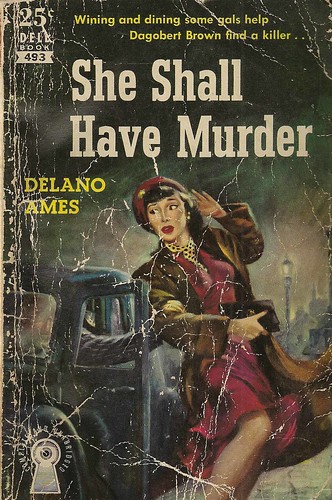
Friday's Forgotten Book: SHE SHALL HAVE MURDER (1949) by Delano Ames
Kind of a beat-up old cover, but best I could find online of the cover I actually have.
Today it's a combo: SHE SHALL HAVE MURDER is my Friday Forgotten post as well as my entry in Bev's VINTAGE MYSTERY READING CHALLENGE.
Don't forget to check in at Patti Abbot's website, PATTINASE, to see what other forgotten books other bloggers are talking about today.
I was not familiar with this author, though his name rings some sort of bell - maybe it's just that the Delano part reminds me of Franklin Delano Roosevelt. Anyway, I read a review of this book on one of the blogs (can't remember which one) and decided to take a look. I mean, how could I resist reading a book in which the hero's first name is Dagobert? And what's more, no one in the cast of characters seems to think this is a odd name. So maybe it wasn't - way back when.
I wonder how it's pronounced? I'm assuming - Dago-Bear. Please correct me if I'm wrong.
Dagobert Brown is a guy who avoids work as best he can (one wonders how he pays his rent) and is currently determined to have his girlfriend Jane write a mystery set in her office, featuring characters similar to her work-mates. He would write the book himself but he's too busy (doing what - who knows?) and besides, someone has to think up the plot.
Jane Hamish is a very tolerant working girl - a law clerk in an office run by an elderly type named Playfair, an attorney who thinks nothing of postponing work in favor of crossword puzzles. In fact, he prefers to treat his employees as members of one happy family. He's kind of engaging, really. I have to say that of all the characters, Mr. Playfair won me over immediately.
Jane narrates the story and turns an almost blind eye to Dagobert's wilder inclinations and mental leaps of fancy.
Anyway, the law-office has its fair share of typicals with typical problems, including a Lothario named (for reasons I can't figure) Major Jimmy Stewart (no one appears to notice that the name is the same as a famous movie star, but perhaps it's old news ) who's dated every woman on staff. Besides Jane there's Sarah, the young typist and Rosemary, the older chief clerk who has delusions of romance. There's also a six foot tall weisenheimer office boy who's not above chicanery and a spot of blackmail.
When Mr. Playfair's elderly client, Mrs. Robjohn - a muddle-headed eccentric - dies suddenly of natural causes after first having declared over and over that she was being stalked by killers, Dagobert Brown suspects murder. Though only the day before he'd stated that Mrs. Robjohn was hardly the type to get murdered, it would just be too obvious.
No one else suspects the old lady was done in, but Dagobert will have his way.
Working independently of the cops and with the not-so-willing Jane as his sleuthing partner, Dagobert begins the search for clues - anything that will involve anyone and everyone at the office. He also advises Jane to write every thing down as it happens - for their manuscript's sake.
That's the gist of the plot and the fun, I think, of this mystery is in the personalities of the various characters, as well as the often snappy dialogue. There's also the fun, I think, that Ames obviously had in writing this story.
I'm going to try and locate a couple more Delano Ames books just to see what's what with Dagobert and Jane.
To get a list of all Delano Ames titles, please use this link.
Friday, March 16, 2012
Friday's Forgotten Book: DEATH'S BRIGHT DART by V.C. Clinton-Baddeley
Friday is Forgotten Book Day, a weekly meme usually hosted by Patti Abbott, but today she's on assignment so Todd Mason is doing hosting duties at his blog, SWEET FREEDOM. Don't forget to check in and see what other forgotten books other bloggers are talking about today. Link.
Can't remember who first recommended V.C. Clinton-Baddeley to me, I just know I'd never read him before - hadn't heard of him either. I think his name is one I might have remembered, even if it is a bit of a tongue-twister.
His complete name (according to Steve at Mystery File) was Victor Vaughn Reynolds Geraint Clinton-Baddeley, so perhaps he was wise to shorten it for publication purposes.
...his mystery writing career consisted of five detective stories that came out between 1967 and 1972, all featuring Dr. R.V. Davie as his continuing series character.
Baddeley's style of writing is a bit different from any of my other favorites of the period - just slightly enough to impress me, but not so much that it interfered with my enjoyment of the book. He is obviously erudite, his characters think nothing of spouting all sorts of learned quotes and phrasings, some relatively obscure enough to add a bit of additional mystery to the proceedings.
Dr. Davie's choice of reading - in this case, Magyar Terror, a non-fiction account of the anonymous author's turbulent life in Hungary adds to his understanding of the current on campus crisis as well, especially when he deduces who the author is.
Baddeley has a kind of sideways angle approach to the crime which, in this case, is murder at a fictitious college at England's Cambridge University. He really is rather clever though. Can't think who he reminds me of, so maybe he is unique unto himself.
But his books are hard to find, so we'll see how it goes. I'll definitely be keeping an eye out. I'm always thrilled when I make a new mystery discovery. So thanks to whoever it was who first brought this author to my attention.
******************************
Baddeley's main protagonist, Dr. R.V. Davie falls under the heading of the amateur detective who sticks his nose in where the cops have already tread or failed to. He is some sort of college don who doesn't really have many duties except to go poking about in peoples' business. (The story takes place in and around a university conference at a holiday break.)
It's very well Davies does a bit of clever snooping too or the truth of the murder of Dr. Brauer, an ambitious, hard-working professor, lecturer and writer, might never have come to light.
While at the podium, Dr. Brauer is felled by a poisoned dart in front of a packed audience. All the events then leading up to his demise come slowly into focus. Turns out Dr. Brauer had a deadly past - a truly heavyweight secret which alters not only the ending of the book, but the good Dr. Davie's handling of it.
There are plenty of suspects, both at the college and attending the conference, as Dr. Brauer's success was resented by some and his personality was such that he had no time to suffer fools, especially undergraduates. But he was a handsome ladies' man so emotions were churning in that area as well.
There are some red herrings too, very cleverly inserted. So cleverly, that I though I'd picked out the murderer early on, but was proved wrong in the end.
Baddeley has a slightly Dickensian gift for names - just the lovely sort of thing I like to find in my English mysteries. There is Ada Trott, Mrs. Pilsworthy, Dr. Willow, Dr. Zinty and Miss Ramble and best of all, two undergraduates - one named Baggs and the other, Mostyn-Humphries. Mostyn-Humphries has some peripheral involvement with the plot, but I just liked reading his name and saying it out loud.
Though the murder happens in front of us, DEATH'S BRIGHT DART would still be considered a cozy, I suppose. Lately I seem to be reading several of these types of mysteries taking place at or near universities - happenstance.
Just to give you an idea of the flavor of the writing, here's a snippet from a few moments after Dr. Davie has had to confront an unsavory bookseller (straight out of Dickens) named, Mr. Stumpf. Books are not the only thing Stumpf is selling or buying.
In the small office the weedy young man was on guard by the tray of photographs and a respectable looking middle-aged man was endeavoring to pretend that he was only standing there by accident. Unfortunately the young man would not take a hint.
..."Good morning," said Davie on his way through.
"Morning," said the young man. "Did you get what you wanted?"
"Unfortunately no."
"Thought you wouldn't."
Outside Davie paused in the dazzling sunlight, watching a military pigeon strutting in the road tirelessly engaged on the quest for provender. He was not aware that he, in his turn, was being inspected by Mr. Stumpf from the window above the shop.
In view of what happened later it was a good thing that Davie turned left into Great Russell Street. At least he had not given Mr. Stumpf the impression that he was staying at the Gainsborough Hotel. He was in fact bound for L'Etoile in Charlotte Street, where he proposed to treat himself to an admirable luncheon.
The line about the pigeon's 'quest for provender' is perfection.
All in all, a pleasant concoction (with very dark undertones and several deaths) - perfect for when you're in a literary mystery sort of mood.
To read a review of one of V.C. Baddeley's other books and to get a list of all five titles, please link here to Mystery File.
Friday, March 2, 2012
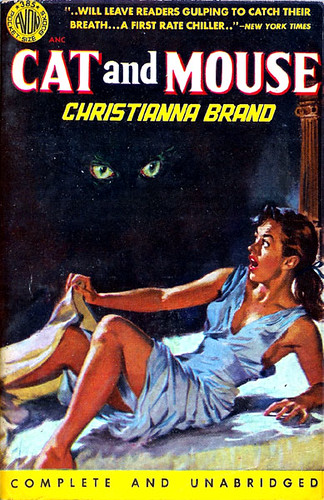
Friday's Forgotten Books: CAT AND MOUSE (1950) by Christianna Brand
Today is Forgotten Books Day - the weekly meme hosted by Patti Abbott at her blog, PATTINASE. Don't forget to take a look and see what other forgotten books other bloggers are talking about today.
Again I'm writing about a book which works as an entry in Bev's Vintage Mysteries Reading Challenge so I'm very pleased about that. Kind of handy how it all works out. (Check the link in the box on my left sideboard to check in with Bev's Challenge.) Even if the book was not up to my expectations.
Reading the enthusiastic blurbs associated with this book, I really thought I was in for an exceptional read. After all, I'd read a couple of Brand's books before and liked them very much. This one is even touted by Julian Symons as one the Hundred Best Crime Stories.
Obviously, somewhere, somehow, one of us went wrong. It's hard for me to believe that the same Christianna Brand who wrote GREEN FOR DANGER and TOUR DE FORCE also wrote this maudlin, mawkish gothic-infused 'young woman in danger' mystery. A tour de force, it is not. Though I suspect it was meant to be.
Let's put it this way, there are enough strange histrionics, red herrings and dopey misdirections in this story to swell the pages of several of those nice 1950's books with covers featuring a woman running away from a castle, hair flying in the wind. In the gloom of night, of course.
Well, obviously, the book is not a total disaster or I wouldn't be writing about it. I did finish reading it, skipping around a bit, but eventually muddling through. After all, this is Christianna Brand we're talking about.
The first chapter is delicious. Really. You think you're in for something pretty special. Plus, the story is based on a true incident relayed to Christianna Brand by a friend. Sounds good.
We begin in the offices of a magazine called, Girls Together which is exactly what it sounds like. It's one of those necessaries filled with fashion inspiration, make-up tips, advice to the lovelorn - the usual.
Two editors, referred to as Miss Friendly-wise and Miss Let's-Be-Lovely (the titles of their columns) are discussing the latest letter from a regular reader of the magazine, a woman named Amista. The lovelorn Miss Amista has been unburdening herself (for months) on Miss Friendly-wise, seeking advice on anything from how to keep her hands from tanning and feeling rough to the trials and tribulations of making the man she loves, love her back.
The letters' return address is a house in Wales, and Amista claims to be the ward of a moody, mysterious, darkly handsome man named Carlyon. He is older than her, but what does age matter?. She worships the very ground he walks on.
It's all too, too Jane Eyer-ish.
Miss Friendly-wise and Miss Let's-Be-Lovely enjoy kibitzing at Amista's expense.
But when a final letter arrives stating that Amista has won her man - a proposal to which she, practically throws herself at her adored's feet in acceptance - it seems as if a happy ending is in the works and all's well that ends well.
But, not so fast.
Miss Friendly-wise, aka, Katinka Jones goes on holiday in Wales and decides to drop in on Amista and see how she's getting on with her beloved Carlyon. After all the letter writing, Katinka is keen on seeing the happy couple in the flesh. Just to see - you know. She's not really being nosy. Not really. Well, she is a bit curious.
Unfortunately, the house is set on an isolated spot with access only by water. A small boat runs back and forth to deliver mail and/or milk. Usually once or twice a day. Other than that, you're stuck.
The not-so-shocker is this: once Katinka arrives at the village and begins asking for the whereabouts of Amista and her mysterious hubby, she gets some baffling responses.
Everyone knows of Carlyon, the reclusive renter of the only house on the small but mountainous island, but no one seems to know about the wife. No one appears to have heard of the woman known to Katinka, as Amista. Far as anyone knows (or admits) there is no wife up at the house.
But Katinka thinks they must be putting her on or else they've just never met Mrs. Carlyon aka Amista. She decides to go across to the house anyway, on the next milk run. One of the men who's been hanging around the dock decides to go along. His last name is Chucky and later he will tell Katinka that he is a police inspector though she will not believe him. Can you imagine a policeman called Inspector Chucky? She thinks he's a reporter nosing about for some sort of story.
The funny thing is, he thinks Katinka is a reporter nosing about for some sort of story as well. He's an annoyingly friendly type though and when they arrive at the house, he lingers in the background as Katinka ask to see and speak to Mrs. Carlyon.
Where is Amista? later becomes, who is Amista? But I'm getting ahead of myself.
When Katinka meets the darkly brooding but-oh-so appealing Carlyon, it is love at first sight. For him as well, it seems. And when later she learns of the tragedies which have followed Carlyon about, she is disposed to feel sorry for the man. No wonder he broods. He's got a lot on his plate. Not the least of which is a madwoman in the attic.
Well, no, not really. But there is a woman in an upstairs room and she's not Amista. Turns out Carlyon is married but not to who we think. The mysterious woman is suffering from the after-effects of a tragic car accident which has left her totally disfigured and unable to speak. Carlyon was at the wheel - in France - and he blames himself for the wreckage of his wife's physical beauty. That explains the seclusion and the reason why they've come to this out of the way place.
AND it turns out that Chucky is actually there at Carlyon's behest to protect him from Katinka's asupposed nosing about, or so Chucky claims. Odd job for a policeman I'd have thought. Sounds more like a spur of the moment claim to me.
Anyway, from there, things go from bad to worse.
See, here's the thing, the more we get into the story, the less any of it makes any sense. A mystery, to be effective, has to make some sort of sense. Don't you think?
Even in the end when we get an extra dose of histrionics meant as shock and awe, it STILL doesn't make any sense. First, this one is Amista. Then that one. Then, no, it's the other one. And what about that ring? The ring did what? And who is Mrs. Carlyon - really?
How many Mrs. Carlyons are there? And how many revisions of the truth can there be? And why is Chucky so damned annoying? No wonder Katinka longs to kick him out of the house.
Oh, I forgot to tell you that poor Katinka fell down (the countryside is slippery) and twisted her ankle. Yes, yes, she really did.
So of course she has to stay on at the house, resting quietly and comfortably. Even though she's locked in her room and nobody in the house wants her there.
Oh it's all too, too Jane Eyre-ish, just as Miss Let's-Be-Lovely suspected all along. Except that by the time you get to the final denouement, it's not much of one.But you do get to roll your eyes a bit and that's always good excercise. The truth is, I was so exhausted by all the contrived skulking about that I really could not have cared less who did what to whom and who was about to do it again.
I can only recommend the book as a curiosity. On that alone, I'd say, read it and see what you think. Maybe I am totally wrong.
After all, the critics at the time, appear to have loved CAT AND MOUSE.
Friday, February 24, 2012
Friday's Forgotten Book: THE SINGING SANDS (1953) by Josephine Tey
Today is Forgotten Book Friday - as usual - but my book also qualifies as an entry in Bev's Vintage Mysteries Reading Challenge. Funny how that works out.
THE SINGING SANDS is Josephine Tey's last book and while it has a highly unsatisfactory ending (in my view, at least) it is still one of the more elegantly written mysteries I've ever read. On that aspect alone I would highly recommend it, even if you're not familiar with Tey's policeman protagonist, Inspector Alan Grant of Scotland Yard.
I'm not sure quite how to describe this book since so much of it does not fit the regulation whodunit, but I'll do my best.
Alan Grant is off to Scotland to stay with friends and recuperate from a plague of nervous fatigue which has taken the form of claustrophobic panic - a kind of post traumatic stress. Though we're not told exactly why this has come to pass. His unfeeling boss isn't happy to see him go even for a short while, he wonders why Grant can't just shake the thing off.
While on the train, just before his station, Grant chances upon a dead body in a compartment - B7, to be exact. But Grant is on recuperative holiday, so, despite misgivings, he leaves the death scene in the hands of a conductor and the local police.
But Grant has taken a look at the face of the young man and been impressed by what he's seen. The dead man has the face of someone Grant would have liked to have known as a friend.
Grant is fairly knowledgeable about faces and types since he is, after all, a cop. The dead man intrigues him. Primarily because the face with the arched eyebrows has the look (even in death) of an adventurer. It is a poetic, intelligent face which continues to pop up in Grant's thoughts as he goes about his days spent with friends, fishing and trying to relax, trying to free himself from his damned claustrophobic debilitation.
By chance, Grant's picked up a memento of the death on the train - a newspaper which was lying in the dead man's compartment. Grant had tucked it under his arm and walked away with it - hardly without meaning to. Turns out the dead man had been scribbling lines of poetry on the pages of the paper. The very enigmatic lines mention 'the beasts that talk, the streams that stand, the stones that walk, the singing sands...'
When the police investigation deduces that the man, Charles Martin - apparently a Frenchman - was falling down drunk and died an accidental death, that is the end of the investigation. Especially when he is identified by the Martin family (through an old photo) as their missing son.
Except that Grant thinks the handwriting in the paper - in English - smacks of English schooling. It has the look and feel, to him, of the Englishman.
On this vague deduction and the feeling evoked by the scribbles of 'poetry', Grant begins his own, slowly evolving investigation, on his own time, in between the fishing and the trying to be a reasonably good guest to his caring friends. Friends, by the way, who have even invited a beautiful lady with a title (whom Grant is nearly smitten with, much to his chagrin) to stay for a few days.
An aside: One of the reasons the book's ending was so unsatisfactory to me, is that this character, Lady Kentallen is quite spirited and delightful company. She pops into the story midway, then is left behind and never mentioned again as Grant returns to London a week early. There is also a second character who pops in later in the book as well, an American named Tad Cullen who is searching for a missing friend NOT named Charles Martin. He too is a wonderful addition to the cast, a young pilot who will 'flesh' out the character of the dead man and make me mourn his lost and trusting friend.
But let's return to Scotland: Try as he might Grant can't shake the nagging feeling that the death of Charles Martin isn't settled at all. He'll get no thanks from headquarters for messing about with an open and shut case, but Grant is not easily diverted when he gets an idea into his head.
On a hunch, he takes a side-trip to the Hebrides, to Cladda, a fairly isolated windswept spot where legend has it, 'the singing sands' can be heard while walking the miles of deserted beaches. While there, Grant is made no wiser about the mystery of Charles Martin - no one's ever heard of him - but he manages to cure himself of what ails him through enthusiastic soul searching, long walks, and spirited philosophical talks with himself, adding his own poetic ramblings to the mix.
Grant is a cop, but he is also a multi-faceted, humane man. The isolation and the stark beauty of Cladda nourishes him, refreshes his spirit and sends him back down to his friends a relatively 'new' man.
There is much going on in this story, besides a murder mystery. Josephine Tey has also given us a tale of self-discovery, adventure, lost cities in the desert, friendship and loyalty and the unrelenting search for truth.
What really happened to the man in the train with the English schoolboy handwriting and the face of a poet?
Eventually, with the help of Tad Cullen, the roots of an insidious murder plot are revealed and as vile a murderer as you will ever read about, is uncloaked.
To read this book is to take a journey inside Alan Grant's heart and soul, to selfishly wish, in the end, that Tey hadn't died soon after, if only because we'd have liked much more of Grant's company AND his deliberate, rationalized sleuthing. A complex, amazing man, whose company I will miss.
Even if he decides, in the end, that marriage is not for him.
Monday, February 13, 2012
Vintage Mysteries Reading Challenge 2012 - Review: THREE BLIND MICE by Agatha Christie
I hadn't read this collection of Christie short stories in many years so I think reading it again qualifies for Bev's Vintage Mystery Reading Challenge. I have the old Dell version (cover shown above) but I have to hold it very carefully as some of the pages are falling out. I love these old Dell copies.
Anyway, this collection is a mixed bag of stories featuring not only Hercule Poirot, Jane Marple, Mr. Satterthwaite and Harley Quinn, but also the stand-alone THREE BLIND MICE which gives the collection its name.
According to Les Blatt, one of our favorite vintage mystery bloggers, THREE BLIND MICE was written after a radio production of the same name - originally created for Queen Mary by Christie - had aired. She then expanded the earlier radio piece into a three act play, THE MOUSETRAP - which has been running now for sixty years!
I was lucky enough to see a production of it in the 80's while in London and enjoyed it very much. Though I knew the ending, I was still caught up in the mystery and suspense.
A couple of the stories in this collection have been turned into excellent PBS Mysteries, all done in the early years of David Suchet's reign when the producers were staying true to the stories.
This particular group is available for instant streaming on Netflix. My favorites of that year are FOUR AND TWENTY BLACKBIRDS and THE THIRD-FLOOR FLAT. Just wonderfully done even if a few odds and ends are added to fatten out the stories. Never mind a bit of that if it makes sense and stays in tune with the characters. In truth both of these stories are actually better in the filmed versions than on the page. Both very visually interesting, both having Captain Hastings added to the mix.
In the short story collection, I enjoyed THE TAPE MEASURE MURDER very much. It features a well-known murder mystery trick which has been used over and over in the years since Christie was turning out her wonderful stories. It's a very tidy murder.
THREE BLIND MICE I didn't like as much as I remembered because the two main characters, Giles and Molly, a newly married couple, are just so 'limp'. (They work better in the play.) And the 'surprise' ending has also been used often enough since then. But I did like Mr. Paravicini, the black market 'Santa Claus.'
THE THIRD FLOOR FLAT is also a good, quick read. Murder in the very same London apartment building in which Poirot has a flat. It is a pleasure reading (or watching) Poirot interact with some 'bright young things'. Very touching watching David Suchet's face as he wistfully looks at one of the beautiful girls involved in the case. Suchet is such a thinking actor. I simply adore him.
Then I noticed that the last story in this collection, THE LOVE DETECTIVES has the very same murderer's trick as in the Jane Marple novel, THE BODY IN THE LIBRARY. Though the short story features Mr. Satterthwaite and Harley Quinn, the most enigmatic of Christie's creations.
It's obvious to me that Christie often expanded on ideas she would use in her short stories. EVIL UNDER THE SUN is a primary example. (Though the short story TRIANGLE AT RHODES is not included in this collection.)
STRANGE JEST, one of the Jane Marple stories that is included, uses the very same clever 'hidden' treasure trick as was used in the Audrey Hepburn, Cary Grant film, CHARADE. I wonder if the screenwriter read Agatha Christie?
Friday, January 27, 2012
Friday's Forgotten Books: Hag's Nook (1933) by John Dickson Carr
Friday is Forgotten Book Day, a weekly meme hosted by Patti Abbott at her blog, PATTINASE. As usual, don't forget to check in and see what other Forgotten Books, other bloggers will be chatting about today.
As chance would have it, this is also my entry in the Vintage Mystery Reading Challenge being hosted by Bev at her blog, MY READER'S BLOCK.
This is my second John Dickson Carr book this year and Dickson Carr's first Gideon Fell book - an incredibly well written mystery of the old locked room school. Certainly one of Carr's creepiest.
HAG'S NOOK would be a great book to read aloud for Halloween. I wonder if there's an audio version - that would do the trick. It is a ghoulish, frightening tale full of dark imaginings and murder most ugly and foul. The story takes place mainly at night - for atmosphere - since ghoulishness doesn't work as well in the light of day and of course, it's always raining.
The pages of the book felt damp and chilly at times - the effect of Dickson Carr's gift for atmosphere.
A cup of tea by your side while reading, would not be amiss.
At any rate, the setting for the story is the area around Yew Cottage, Dr. Gideon Fell's pleasant, book-filled home in the country - though very little of what happens, happens there. It is however, the starting point. We do get to meet Fell's nearsighted, quirky little hen of a wife who seems the sort of woman you'd have expected Fell to marry. She is delightful. Though I don't remember her showing up in later books.
Fell's cottage sits within handy walking distance of a tumbled down, dilapidated old prison perched on a precipice called Hag's Nook. It is on land belonging to the Starberth family. Here's where most of the action takes place. The family Starberth (or what's left of them) are Fell's closest neighbors.
A wicked ancestor was the first governor (warden) of the prison and his horrible death gave rise to the curse which appears to have followed the Starbert kith and kin down through the years.
The original will states that the Starberth heir must spend an hour in the dark and dismal, rat infested office known as The Governor's Room. This fiendish caveat has been at the heart of the Starberth madness. In fact it is from the balcony of this very room, that the deranged ancestor threw himself to his grisly death, impaled on spikes. Ugh. Said hideous spikes surround a large stone well once used to dump the bodies of those hanged at the prison. It's no wonder that cholera overtook the place and helped speed along the end of the building's official use.
In this sinister room a Starberth must open a safe and deal with whatever mysterious thing he finds there. No one knows what this might be since the heir is forbidden to speak of it afterwards. As is the lawyer who handles the fine points of this absurd ritual which, unfortunately, is legally binding.
It is a heavy curse to hang over a family and no one feels it more than the present three descendants. Martin Starbert, the heir facing the lonely hour in the prison tower, is comforting himself with liquor and outbursts of frightened drunken emotion. His brother Herbert appears to be the only one who can control or keep him calm enough as the hour of the prison ritual approaches. Their beautiful sister Dorothy tries to control her own hysteria as she fears for her brother's life.
Their father's death months before has precipitated this current wretched event. A death which had been thought a riding accident, but which Gideon Fell now believes was murder.
Dorothy, at least, can turn to young Tad Rampole, an American college student whom she's met on the train early in the story. Rampole is Dr. Fell's guest and so it all works out nicely. In fact, the burgeoning love story is exceptionally well devised and written. I kind of fell in love with Rampole myself.
When the murders begin again (as we know they must), it's up to Fell to figure out how a man can be in two places at once.
A dreadfully dark and macabre story, but it makes for an enjoyable read and a great introduction to the Gideon Fell mysteries and the work of the finest exponent of the locked room puzzle.
Friday, January 20, 2012
Friday's Forgotten Books: THE CASE OF THE CONSTANT SUICIDES (1941) by John Dickson Carr
Friday means Forgotten Books, a weekly meme hosted by Patti Abbott at her blog, PATTINASE. Don't forget to check in to see what other Forgotten Books other bloggers are talking about today.
Since my book was written in 1941, it also qualifies as an entry in Bev's VINTAGE MYSTERY READING CHALLENGE. As I said last week: two birds with one stone.
In the Highlands of Scotland, near Inveraray, sits the Castle of Shira, the ancestral home of the Campbells - or at least what's left of them. It is a gloomy picturesque pile - the perfect spot for a murder or two. THE CASE OF THE CONSTANT SUICIDES by John Dickson Carr, famed for his locked room expertise, provides a fiendishly fun antidote to the winter blues.
Invited to attend a family counsel after the death of Angus Campbell who tumbled from a tower window and was dashed on the ground below - a likely suicide - are two professors who begin their relationship by bickering over the historical details pertaining to the persona of the Duchess of Cleveland.
The professors are Kathryn Campbell who teaches at a woman's college and Alan Campbell who teaches at a male. Forced to share one compartment because of a name mix-up - the professors have just met for the first time - they are, unfortunately, overheard in the heat of their all night argument by a newspaper reporter in the next compartment. An incident which will have repercussions later in the story.
The London reporter is named Charles Swan. He has been summoned to Shira by Aunt Elspat, an ancient crone who rules the roost. She had been the mistress of the now dead Angus.
Once this troupe of travelers arrive at the castle, they are met by the elderly Colin Campbell, Angus's gregarious, whiskey loving brother as well as the family law agent (Scotlands's term for lawyers) who has come visiting. In the mix that same evening is Walter Chapman, an insurance agent who argues that his company won't pay the premium on a suicide.
So it behooves the family Campbell to prove that Angus was murdered. Angus had one enemy, Alec Forbes, his ex-partner in several preposterous get-rich-quick schemes. Forbes has immediately fallen under suspicion.
When the cranky Aunt Elspat joins the company downstairs she furiously denies having sent for Swan the reporter and has him thrown out. This will not be the first indignity suffered by the hapless, though intrepid Swan. Aunt Elspat is not to be trifled with.
Later, Doctor Gideon Fell joins the group, summoned by Duncan the law agent to try and decide if Angus's death was suicide or murder. The matter is further complicated by the near death of Colin Campbell who falls from the same window as Angus after insisting he will spend the night up in the turret no matter that a ghost with no face was seen at the open window.
Are you with me so far?
The scene of the crime is thus: Angus Campbell fell to his death from a window in his locked bedroom. A locked dog carrier minus a dog is found under his bed. The dog carrier has metal grating at one end to allow for any occupant's breathing. What did Angus OR the killer carry into the room inside a dog carrier?
The family Campbell is in dire straits, financially. If Angus was murdered, then the insurance - a tidy sum - will be enough to keep Colin and Elspat for the rest of their days. But if Angus died by suicide - the family gets zip.
When Colin almost meets the same end as his brother, it most definitely is not an attempted suicide. But who could possibly want to kill Colin?
Join the confusion as master of the locked room mystery, John Dickson Carr pulls the wool over our eyes yet again. Though this time I did catch on to one of the tricks before Doctor Fell. Ta-DA!
But for the rest of the crime solving duties I defer to the rotund lexicographer whose genius cannot be denied. He dashes about, pipe smoking, wild hair flopping and loud voice exclaiming and before you know it, all is made right again.
Even if now and again Fell manages to cheat the law, he catches the culprit, saves the day after yet another suicide(?) occurs and reveals the nasty convoluted truth, thus assuring that Colin and Elspat will spend the rest of their remaining days in comfort.
What more could you want?
Oh, there's also a satisfactory love story with a happy ending.
Friday, January 13, 2012
Friday's Forgotten Books: BODIES IN A BOOKSHOP (1946) by R.T. Campbell
Today is Forgotten Book Friday, the weekly meme hosted by Patti Abbott at her blog, PATTINASE I'm killing two birds with one stone as my entry is BODIES IN A BOOKSHOP by R.T. Campbell and since it was written in 1946, it also qualifies for my Vintage Mysteries Reading Challenge - ta-da! The Challenge is hosted by Bev at her blog, MY READER'S BLOCK.
Head on over to Patti's to see what other Forgotten Books other bloggers are talking about today, then head on over to Bev's to see how the Vintage Mysteries Reading Challenge is coming along and maybe you might even want to sign up.
From the back of my copy of BODIES IN A BOOKSHOP:
At the time of the Second World War, Scottish-born poet, scholar, art critic and fantasy novelist Ruthven Campbell Todd (1914 - 1978) wrote a series of detective novels, using the pen name R.T. Campbell. Todd soon abandoned detective fiction for other literary projects and was quickly - but unjustly - forgotten as a mystery novelist.
I'd never heard of him, for sure. That is until I read a review of this book on one of the blogs. But damn if I can remember which one. John was it you? Or maybe Bev? Or maybe Les Blatt at CLASSIC MYSTERIES?
At any rate, I found a used copy of a Dover reprint and plunged right in because the title said it all for me. Murder and bookshops go great together.
Max Boyle is a young botanist and book lover who stumbles over two dead bodies in a back room of a dusty old bookshop on the Tottenham Court Road in London. He'd been hunting books not bodies and had actually spent about an hour in the store before realizing that something was not quite right. For the book lover out on a book buying trip, concentration is definitely focused.
Max works for a curious old codger, an eccentric crime solving botanist and criminologist (an odd combo I'd have thought), named John Stubbs. 'The Professor' as he's known is full of the sort of Gideon Fell and Gervase Fen high spirits used to better effect by both John Dickson Carr and Edmund Crispin. He is a total eccentric given to drinking copious amounts of beer and smoking a foul smelling pipe. He speaks in dialect annoyingly spelled out by the author for no good reason I can think of.
"That's fine," Professor Stubbs put in suddenly, "I'm beginnin' to think I could do wi' some moisture. I'm dehydratin' fast." See what I mean? A little of that goes a long way.
That's my only problem with the characters and the story which is actually a tight little mystery filled with a whole cast of suspicious characters, including book dealers, a blackmailer and a dealer or two involved in the buying and selling of pornographic material which, by the way, was then against the law in England.
Max Boyle himself is a nice enough bloke, an amiable, unassuming associate all the while trailing after the Professor and wishing he were on holiday in the Scilly Islands. He tells the story in the first person which helps things along.
The third character of this crime-solving triumvirate is known as The Bishop, he is Chief Inspector Reginald F. Bishop of Scotland Yard. With his help, both the Professor and Max set out to solve a double murder. Or perhaps I should say that with Scotland Yard's unlikely help, the Professor sets out to solve the double murder. The Bishop often seems a well-mannered, calm and bemused bystander rather than the official lead in a murder investigation. The Professor's histrionics can be quite intimidating, I suppose.
Though I easily figured out who the killer was the story was still enjoyable and part of the final denouement was still a surprise.
This is a straight if somewhat anachronistic, detective whodunit which takes place in the rarefied world of book dealers and collectors and as such, there's plenty for the reader to learn about old books and collecting and even bits about old prints.
An entertaining and literate mystery.
Monday, January 9, 2012
Review: DEAD MAN'S WATCH (1931) by G.D.H. and M. Cole
Well it's a brand new year and this my first entry in the 2012 Vintage Mysteries Reading Challenge hosted by the wonderful Bev at her blog, MY READER'S BLOCK. She'll be keeping tabs on our reading lists as the year goes on as we read and report. I've earmarked three categories in this year's Challenge, see my post on Bev's Challenge here.
DEAD MAN'S WATCH qualifies for Lethal Locations.
*******************
I must thank John at PRETTY SINISTER BOOKS for sending me my very own adorable little copy of G.D.H. and Margaret Cole's sinister English countryside mystery, DEAD MAN'S WATCH. It's a particularly snug and handy version (4 1/4 " X 6 1/4"), published by Collins' Clear Type Press of London and Glasgow in 1931. (Not the version shown in the above cover pix.)
Oh, if only all books could be published in this handy, comfortable size. Thank you, John. You're a peach.
This version of DEAD MAN'S WATCH is a clear reminder, to me at least, of the reason why e-books simply cannot compare to the 'real' thing. Once I held this oh-so-attractive little book in my hands I simply couldn't imagine something as unengaged, charmless and static as an e-book ever having the same reading 'oomph'. It's hard to cozy up to something that isn't 'real'.
Frankly, the charm of this copy added to the whole enjoyable reading experience.
******************
DEAD MAN'S WATCH is a fast moving, traditional mystery which is part whodunit and part how-dunit. It's a clever tale of confused identities and murder which begins when a body is found drowned and the police as well as an amateur sleuth, Sir Charles Wylie, a local baronet, suspect murder because of one significant clue: the victim's beard was shaved after death.
The meddling baronet is given short shrift by the local police so he decides to investigate the crime himself with the help of Miss Dolly Daniells, a spunky gal and doting friend of Ronald Bittaford, the rather hysterical young man who's found the body and keeps insisting it's his uncle Percy. Unfortunately for Ronald, everyone else insists that Percy has been dead and buried for six months.
Midway through the book there are several delightful letters exchanged between Dolly and Wylie as they write back and forth trying to make heads or tails of the mystery. Dolly has been sent to keep a comforting eye on Ronald as he, poor dispirited soul, has been squirreled away at the domicile of the dead man's widow.
It's a pretty puzzle for the impetuous Wylie and eventually, the police, especially in the stalwart person of Inspector Wilson of Scotland Yard, when they come around to the idea that things are not what they previously seemed.
I figured out what was actually going on in DEAD MAN'S WATCH about halfway in, but that didn't stop me enjoying this fast-paced old school mystery.
Inspector Wilson, by the way, is a Coles recurring character. I would hope that Dolly Daniells and Charles Wylie would be also, but I have no idea.
I'm not familiar with the authors (I'd never heard of them until John introduced me his blog post), but now that I've read DEAD MAN'S WATCH, I'll be keeping an eye out for more books written by this talented husband and wife team.
Note: According to Wikipedia, the Coles wrote tons of mysteries and the big mystery to me, is why I'd never heard of them before. Read more about the Coles here.
Subscribe to:
Posts (Atom)