Showing posts with label Friday's Forgotten Books. Show all posts

Friday, June 2, 2017

Friday's Forgotten Books: THE BURNING OF BILLY TOOBER (1974) by Jonathan Ross


 Jonathan Ross is the pseudonym of prolific British writer and former Detective Chief Inspector John Rossiter born in 1916 and apparently still alive at the age of 101. I believe though, that his last book in this particular series was written in the late 90's. I happened across his books at my old local library when I lived in N.J. They were a happy surprise, for I'd almost run out of mystery and thriller writers to read (or so I'd thought) at the time. Little did I know then that thanks to my handy-dandy computer, I'd soon discover many other wonderful writers I'd never heard of, much less read.

THE BURNING OF BILLY TOOBER is a decidedly noir entry in a series that seems to have been overlooked or forgotten by nearly everyone. It is one of the grittier and grungier of Ross's engrossing police procedurals set in London (of the 1960's - 1990's) and its environs. The nattily dressed and perpetually randy Detective Superintendent George Rogers and his crew are back once again to solve the murder by incineration of Billy Toober, a police informant and small time crook.

The book has a terrific opening hook: His mother loved him. So did his brother. It was impossible to believe anybody else could.

Billy Toober had been hoping to evade the retribution of Roy Grattan, the crime boss he helped send to prison. But when Grattan's brother - a violent tough known as Dummy - a large, afflicted sort who can only communicate by grunting or garbling his words - is sent to teach Billy a lesson, Billy turns to Detective Superintendent George Rogers for help. Rogers, not the comforting type, tells him he can do nothing.

The next day a body is found in the park, burnt to a crisp.

This particularly grisly murder sets off several other killings which will keep Rogers and his minions busy as they try to untangle the plots and ploys of London's sleazier denizens. A job made all the more onerous by the actions of a mother bent on grim revenge.

In between, Rogers must contend with the sordid mess he's made of his own personal life. He is not, by his own words, "...a very practised adulterer." But that won't stop him trying. He is currently involved with  Dr. Bridget Hunter, the Medical Examiner. Rogers' wife - no fool she - suspects the worst.

While reading several of the books in this series, I've often wondered what it is that women see in Detective Superintendent Rogers. He's a good cop, but he is relentlessly unsparing, "...bloody-minded and destructive..." and inclined to occasional bouts of self-pity.  But there has to be something about Rogers that women like; he does get an awful lot of them to fall for his hidden charms.

"Bigger men that you, George, have told women they love them"

He tried to recollect some who had and couldn't. "I don't believe it," he said cynically...."I'm sorry...if it's any consolation, I've never thought of any woman in terms of being in love."

Although his infatuation for her was no perfunctory passion, neither was it deep-rooted. His stubborn honesty refused the easy solution of telling her he loved her; women did it as a matter of course, to whitewash promiscuity. And there was still the ridiculous stumbling block of picturing himself as a lover and an adulterer. Astronauts, rent collectors, gynaecologists, insurance salesmen and company directors; he could imagine them all in situ without loss of dignity. But not, somehow, his own grey-suited persona as a Detective Superintendent.

In a strange way, this is part of the draw of these books - to see who Rogers will chase after next - once his eventual divorce becomes final. Also, I suppose, to wonder if and when Rogers' will allow himself to feel anything but the bare basics for any woman. I mean, he can be such a slug. But still a hell of a cop and the mysteries are good ones and over the course of the books I grew fond of his second in command, Detective Chief Inspector Lingard who actually reminds me a bit of the second in command in Cynthia Harrod-Eagles' Bill Slider police procedurals. (Another often overlooked series worth searching for as well - but the Slider books must be read from the beginning which is just as well, because the early books in that long-running series are really the best.)

Of course, a man of George Rogers' blunt caliber will make enemies, and he has a couple down at the cop shop. Rogers must daily grit his teeth and hold his bile while waiting for his immediate boss to retire - one year to go! - not an easy thing when your inclination is not to suffer fools lightly.

Still and all, there's just something about Rogers that eventually gets under your skin. There's much to be said for the attractions of a competent cop. But I still shake my head at all the women.

THE BURNING OF BILLY TOOBER, the sixth entry in what was a long-running series, has an unexpected ending which is really a cynical fillip to motherly love.

This is another compelling police procedural in a long string of terrific books by Jonathan Ross and certainly worth looking for.

To see all the titles in Ross's series, please go here to his fantastic fiction page.

It's Friday and this week, Todd Mason is doing hosting duties at his blog, Sweet Freedom. Don't forget to check in to see what other forgotten or overlooked books other bloggers are talking about today.

In the interest of fair disclosure, this post is a re-working of a review written several years ago. I thought it was about time to bring up Jonathan Ross again. I ran across his name recently and reminded myself that I still needed to read a couple more.


Friday, March 10, 2017

Friday Forgotten Book: BLACK HEARTS AND SLOW DANCING (1988) by Earl Emerson


This is a  re-working of a post from 2011 because I got to thinking it was time again to talk about author Earl Emerson (I haven't done so in a while) and this is one of my very favorites of his many books.

Shamus Award winning author Earl Emerson was a Seattle firefighter for 32 years so when he writes about fire, fire-fighters, fire-fighting and all relevant accoutrement, he knows whereof he speaks. His on-the-job knowledge adds a rich verisimilitude to his writing -  if the plots concern fire in any way (and they often do), all the gritty details will be right. Besides that, Emerson has a fine sure hand with an intricate plot and a gift for inventive characterization and smart-guy dialogue.

Often labeled a 'regional' author, because he lives in and writes books set in the Pacific Northwest, Emerson is not, perhaps, as well known here in the east as he should be. I discovered him a few years ago and have been a fan ever since.

BLACK HEARTS AND SLOW DANCING is the first book in the Mac Fontana series. (Did I mention that Emerson also has a gift for titles? One of my other favorites is, HELP WANTED: ORPHANS PREFERRED.

Staircase, Washington, is a small town at the base of the Cascade Mountains. It is 'interim' Sheriff and ex-firefighter MacKinley Fontana's current neck of the woods. A 'live and let live' kind of guy, he's happy enough there, sorting out his life and raising his son Brandon.

But now that he's found a dead body lashed to a tree, Mo Costigan, the major, is having second thoughts about Mac's interim job. It's not as though he were the 'real' sheriff. But Mac is no pushover. Just see the way he handles Satan, the ex-sheriff's intractable German Shepherd.

The dead man turns out to have been a firefighter and Mac, an ex Seattle firefighter himself, wants to find out why he was killed - beaten to death. Against the mayor's wishes, he heads up to Seattle to nose around - Mac has a nose for greed and corruption. But by doing so he winds up opening old wounds and making himself a few more enemies.

Mac's been trying to settle into 'normal' after some hard times involving his firefighting past and a mysterious job out east in that 'other world' he doesn't like to think about. But someone in Staircase doesn't like the way Mac's investigation into the fire fighter's death is going.

When he's shot at and left for dead and the town's biggest church goes up in flames Mac comes to the realization that life in a small town is not going exactly the way he envisioned it.

Mac Fontana is a hard-driven guy with a twisted sense of humor and a fondness for the relative quiet of the countryside. But it's going to take him a while to get into the slower, easier rhythm. (Being shot and church fires not withstanding.) In the meantime, he's raising his boy and doing the best he can. Emerson's writing in the scenes between Mac and his son is especially appealing. He writes those so naturally, yet when Mac is dealing with some ugly, nasty types, those scenes evolve equally well. There's nothing forced here, just a kind of fluid writing ability I like. I think this stems from having well-rounded characterizations - Mac's interactions arise organically from who he is.

Last but not least, I love that Mac Fontana, bad as he wants to be, loves to slow dance at the local weekly dances. There he and the Mayor, Maureen known as 'Mo' work out their antagonisms with a few smooth moves.

Mac Fontana, a man of many talents.
Earl Emerson, author of many talents.

I really do wish there were more books in this particular series. But not to worry, Earl Emerson has also written several stand-alone books as well as the very engaging Thomas Black series featuring a private eye working in Portland, Oregon who gets involved in often bizarre cases. Check out his Fantastic Fiction page for all the titles.

Since this is Friday, don't forget to check in at author and Edgar Award nominee Patricia Abbott's blog, Pattinase, to see what other forgotten or overlooked books other bloggers are talking about today.

Friday, November 29, 2013

Friday's Forgotten (or Overlooked) Book: MURDER, MAESTRO, PLEASE (1952) by Delano Ames


Before you run screaming out the door, I really am trying to curb my crush on Delano Ames' books (and obviously not succeeding very well). But I promise that this is the last one for awhile. It's getting harder to locate Ames' books online especially when you don't want to pay big bucks. But mostly it's because they're just not available. Oh how I wish someone/anyone, would reprint the entire Jane and Dagobert series.

MURDER, MAESTRO, PLEASE (1952) is another 'let's take a holiday with Jane and Dagobert' book - honestly, do these folks ever stay home? Nah, then we wouldn't have all these murderously fun adventures to read.

This time the amateur sleuths are traveling in the Pyrenees area between Spain and France when suddenly they're shot at - a nice way to begin a couple of weeks off. They're supposed to meet up with a cousin of Dagobert's, a young woman traveling with mutual friends - one a long ago school pal of Jane's - and all will be attending a slightly off the beaten path music festival.

But back to the shots which have momentarily caused a crimp in Jane and Dagobert's forward motion.

"We were as a bird (or a bullet) flies, very near the frontier of Andorra where, according to the guidebook, it is the 'inalienable right' of every adult male to carry firearms. On the slopes of the Pic des Quatre Vents they shoot the isard. It was out of season, but we had had an exquisite civet d'isard for dinner last night. It is a shy animal, difficult to shoot. Doubtless you stalked it in the dense fog. 

Then there were smugglers. Probably the frontier people fired at smugglers from time to time. In brief, there a dozen satisfactory explanations. I wished I could think of one.

Dagobert had been pursuing a different line of speculation. 

"I was wondering, " he said, "what mortal enemies we have made in the neighborhood."

"Don't..." my voice rose, but immediately sank to a controlled croak, "say things like that. This is supposed to be a holiday."

He picked me sympathetically out of the ditch and dusted me off. "You don't like the idea of mysterious assaults on our life?"

"No."

"Sinister attempts to make us abandon our project?"

"I wouldn't mind those so much," I admitted.

Our 'project' was to reach Puig d'Aze on a tandem bicycle via Andorra and the less accessible regions of the Eastern Pyrenees; I was quite willing to abandon this project on the spot. It had been formed four evenings ago at the Cafe de la Gare in Perpignan when the question of how to get to Puig d'Aze had first become acute.

There is, of course, a train and a regular bus service, but Dagobert had been reading a guidebook which was written before these things existed. It was full of maps showing mule paths. I had seen him gazing at the shop window next door which displayed hobnailed boots, steel-tipped sticks, campers' and cyclists' equipment. Recognizing the far-away look in his eye, I said quickly:

"There's a place down the road with motor-cars for hire."

Before you know it, Jane and Dagobert are honorary life members of the Club du Cyclisme des Pyrenees Orientale  and riding away on a tandem bike built for two, making their decidedly not uneventful way to their destination.

Once in Puig d'Aze, they (and we) meet up (at various times) with the usual (but very welcome) Delano Ames cast of colorful characters which, this time, include:

Naomi Gordon-Smith, a flighty, aging femme-fatale wannabe and Jane's long ago school pal.

Geoffrey Gordon-Smith, Naomi's patient, wealthy and very understanding, British hubby.

Perdita, Dagobert's cousin-by-marriage, a lovely, limpid girl for whom Dagobert assumes a natural family responsibility. She is newly engaged to:

Squadron Leader Johnny Corcoran, a famed test pilot and dashing man about Europe who, in turn, has his roving eye on any female within his immediate radius. He and Naomi appear to have a secret. Uh-oh. 

Tyler Sherman, an American from Texas with a drawl and a suspicious way of popping in and out when least expected. He has his eye on the lovely Perdita and he may or may not be a spy.

Vicky Stein, a young and prickly foreign woman of impoverished circumstances who is harboring secrets and obviously lying through her teeth. She may or may not be a spy.

Mitzi Stein, her even younger, likable and rather precocious, protective sister who is apparently, a bit of a prodigy. She too may or may not be a spy.

Fred Evans, another suspicious type - British this time - who claims to be a newspaper reporter - excuse me, 'roving correspondent'. He may or may not be a spy.

Last but not least, there's the hard drinking, oh-so-eccentric master of the harpsichord, Kitson, a loud, bushy-bearded slovenly type in a plum dinner jacket who is the sole reason for the Puig d'Aze Music Festival. At the first concert he plays nothing that is on the official program to the confusion of the invited audience.

Of course when Jane and Dagobert show up anyplace and at any time - can murder be far behind?

MURDER, MAESTRO, PLEASE is simply another in the wonderful Delano Ames' repetoire of books bound to please.

Don't forget to check in at Patti Abbott's blog, Pattinase, to see what other Forgotten (or Overlooked) Books other bloggers are talking about today. 

Oh, a note to those of you who may not be too familiar with the area of the world in which Jane and Dagobert find themselves this time out.

Traveling by motorcars from Puig over the border into Andorra:

We found a picnic spot about an hour later and waited until Tyler, who had been giving a driving lesson to Perdita, caught up with us. It was a green valley thick with wild narcissus, a few miles before the village of Adorre-la-Vielle, the capital of the republic. (It isn't quite a republic, but since 1278 a fief owning feudal allegiance to two co-princes who are the Spanish Bishop of Urgel and the French Assemblee Nationale. It is very complicated and doubtless fascinating, but details of 'viguiers and bayles' as Dagobert explained them to us during the picnic fortunately slip my - and his - memory.) 

Friday, November 15, 2013

Friday's Forgotten (or Overlooked) Books: FOR OLD CRIME'S SAKE (1959) by Delano Ames


Yes, yes, I know I've been lauding Delano Ames lately as the next best thing to chocolate, but bear with me. I'm smitten. I must laud while the lauding is good.

FOR OLD CRIME'S SAKE published in 1959 is yet another delightful vacation book - another wild and wacky holiday with those insouciant amateur detectives Dagobert and Jane Brown. This time we're off to Tabarca (?!) a small island in the Mediterranean where a grumbling Jane has won (with Dagobert's help) an all expenses (more or less) paid trip.

Jane's grumbling is the result of her reluctance to go anywhere near Tabarca. To her, the whole escorted trip in the company of six other contest winners and an officiously jovial host (sort of like a sheep-herder, but with people) who refers to himself in the third person, sounds like a nightmare.

Turns out Jane was right.

But let's back up a bit. We open in London where Dagobert and Jane are, as usual, discussing economics.

'Dagobert was deeply moved when my premium bond drew a fifty-pound bonus. Money so simply come by opened up new vistas. Far too many people, he decided, underrate money; and to acquire more of it momentarily displaced his current passion for Mudejar architecture.

Knowing my husband's aptitude for getting what he wants, I stirred expectantly. He grew pensive, giving the problem fuller consideration. In an effort to be helpful I said that some people made money by going to work. Dagobert who is always open to fresh ideas at once went out and bought the morning papers.

I plied him with coffee as he ran a hopeful eye down the Situations Vacant column.

"There are all sorts of things," he said in surprise. "The Government of Nigeria, for instance, is looking for a driller. Or, nearer home in Slough, Tracers and Estimators are urgently required. Bee-keepers...no, it's book-keepers. Coffin maker...

"No," he said, "You'd hate that."

"What?"

"Previous training unnecessary, good pay while you learn, rapid advancement - for intelligent young woman."

He turned the page before I could see it. 'We mustn't rush these things," he said, feeling that enough had been done for one morning. "It may take a day or two." 

As these sorts of things will, the aforementioned fifty pounds detours into a 'let's take a trip' mode. But fifty pounds isn't much when gamboling abroad. Dagobert's new idea is that he and Jane should enter numerous competitions (contests) and win themselves a trip or two or at the very least 'double their income' (as a contest in The Daily Sketch promises). Soon Dagobert is furiously 'at work' signing up for as many competitions as he can find while Jane goes out to buy new shoes.

When I returned late that afternoon, he was still hard at it. The place was strewn with magazines and papers. He had forgotten lunch and smoked two packets of cigarettes. He had worked out that by winning, say, only a quarter of the competitions he had already entered our earnings would be in the region of a hundred thousand pounds.

I know what you're thinking, but all is not lost. They do, improbably, win the Grand Prize offering of a trip to the island of Tabarca, Europe's tiniest Principality. (Or at least Jane wins the contest. Dagobert forged her name on the entry since obviously, he couldn't enter everything under his own name.)

According to the newspapers, Tabarca has recently been bought (along with all feudal rights) by Henry Howard Hutton Jr. a 'pulled up by his bootstraps' millionaire; the island will be the setting for his lavish wedding to Princess Juana of royal Tabarcan lineage.

In fact, the contest has been spawned - as a way of promoting the island paradise and attracting publicity and tourist dollars - by 'Home Truth' a local gossip rag, controlling interest recently purchased by Hutton Jr.

Jane doesn't want to go. She is non-plussed at being chosen one of the 'Lucky Seven' contest winners. (An assorted motley group.) The trip doesn't sound like her sort of thing at all. Especially since it means leaving Dagobert behind (no spouses allowed) to the tender mercies of a married neighbor with an eager eye and the same egregious taste in music.

But 'but me no buts', Jane is soon off to Tabarca.

Following the storm-tossed, choppy-waved channel crossing from hell - everyone is agonizingly sea sick and relegated to their cubby-hole cabins - the Lucky Seven discover that they are one contest winner short. They are now the 'lucky' six, one of them has disappeared. But their tour guide Bobby Marcovitch, after an initial panic attack, insists that the disappearance shouldn't throw a damper on the proceedings.

The rest of the trip goes downhill from there.

But with Dagobert and Jane, there's never a dull moment as mistaken identities, red herrings, murder, blackmail. revenge, a broken engagement, not to mention the threat of capital punishment by hanging, add their own flavor to a murderously boisterous Mediterranean holiday, culminating in enough over-the-top Tabarcan island festivities to rival the royal wedding in Monaco. Phew!

Oh yes, Dagobert catches up to Jane, not to worry. My favorite moment in the book is when the group (the women wearing borrowed mink coats - a perk for the trip only - supplied by the contest host)  is driven to their hotel (before embarking on a boat to the actual island) and Jane glances out the car window. She spies a motorcycle following them and without any hint of a qualm, she realizes that - somehow - it's Dagobert all the way from London. She pretends not to notice.

I hate to use the word 'romp' but this is exactly what Delano Ames delivers in FOR OLD CRIME'S SAKE.

I love this sort of thing when it's done well and Delano Ames (1906 - 1987) did it better than most.

Don't forget to check in at Patti Abbott's blog, Pattinase, to see what other Forgotten (or Overlooked) Books other bloggers are talking about today.

Friday, October 18, 2013

Friday's Forgotten (or Overlooked) Book: THE MAN IN THE TRICORN HAT (1960) by Delano Ames


The English writer Delano Ames (1906-1987) wrote lots and lots of books, the titles of which I've just recently discovered online. Most of you know how enamored I am with Delano Ames' Dagobert and Jane Brown mystery series since I've (unashamedly) shared my enthusiasm - gone overboard, some may say. But when it comes to newly discovered authors, there's no such thing as too much shouting from the rooftops far as I'm concerned.

Isn't it thrilling to find an unknown vintage author (unknown to me anyway) and suddenly realize that there's a bunch of unread/unheard-of books out there? If you can find them, of course. The hunt is on!

To that end, I've just ordered two more Delano Ames books (all I can find that are affordable at the moment) and can't wait to see if they live up to the previous Dagobert and Jane puzzlers. Oh how I love those two amateur crime solvers.

But I'm not writing about them today, so enough of that.

Turns out that Delano Ames had another series, this one featuring the affable Juan Llorca, a member of the Spanish constabulary:

"You know those gaunt figures who appear in pairs on lonely Spanish roads, scaring the wits out of everybody with their black tricorn hats, great green cloaks and rifles? Well, one of them was my friend Paco. The other - the one with the five days' black stubble on his chin and a patch of dirty sticking-plaster on his left ear - was me.

Also my feet hurt. We'd had nearly a week of what they call 'servicio de campo', which means pushing around the countryside listening to complaints about the neighbour's goats, keeping the gypsies on the move and sleeping in our cloaks.


When we left Madrigal del Mar fives days ago there were the usual rumours that the hinterland was crawling with suspicious characters. Paco, who reads El Coyote and the comics, had great hopes about Red spies, or at least white slavers; but we hadn't seen anything out of the ordinary except old Don Fernando, who is well known to be crazy."


I love the first person point of view so I was already won over by time I finished reading these opening paragraphs of the first Juan Llorca book. I also love when an author has a droll sense of humor which (coincidentally) more or less matches mine. Delano Ames and I are on the same wavelength. Ah, bliss.

Juan Llorca is apparently the only Civil Guard member, currently assigned to duty in the small fishing village of Madrigal, who has any active sleuthing brainpower. Everyone else is out for numero uno including the alcalde (mayor), playing political one-up-man-ship, not really caring if justice is served. Sound familiar?

On the outside, the attractive if somewhat nebishy Llorca is a punctilious officer ready to do his duty even while wearing a black patent leather tricorn hat. But at heart he is a romantic with a somewhat sensitive self-image. Llorca has his eye on the beautiful but confounding English artist Julia Fairfax, newly settled in Madrigal. Is she sending Juan come hither signals or is she not? Is she married or is she not?  Why is she so reluctant to discuss her background? Aside from that - is she a murderer? And oh by the way, who is Angus Smith to her?

Let's back up a bit:

When a Texas oil millionaire named Rittenbacker and his curvaceous niece and young nephew rent a Madrigal villa, they settle in to contribute to the local tourist economy and soak up the determinedly quaint Spanish atmosphere. In turn, of course, they become objects of local gossip and speculation - especially when the niece, Mary Lou, shows up on the local beach wearing a bikini.

Rittenbacker, it turns out, is intent on buying some 'art masterpieces' newly discovered by the aforementioned Don Fernando, Madrigal's rather peculiar arts and antiques dealer. As Juan Llorca says: His "... shop is called the Bricum-ad-Bracum, which is, I'm told, Latin for junk.

Even so, Don Fernando and his Dona Carmen (a disreputable toothless lady with a roving eye), do a raging good business discovering long lost masterpieces hidden under a rock or two here and there. Juan Llorca is aware that the Texas oil millionaire is probably going to be fleeced, but he tries to be diplomatic about it, not wanting to come out and actually accuse one of the town's more well-known and indulged eccentrics. Besides, Rittenbacker is old enough to take care of himself.

In the meantime, there is the nagging question of Angus Smith, a tall good-looking sort with a sneer and an attitude. He has shown up in Madrigal and immediately assumed an annoying proprietary air over Julia Fairfax. Obviously these two know each other. Is he the absent hubby?

When the body of the Texas millionaire turns up dead, the natural conclusion that Smith (having been found to be a vile blackmailer) is the perp seems rather convenient. Maybe too convenient. It's then up to Juan Llorca to get at the truth of the sordid matter before the approaching Fiesta of the Moros and Cristianos (Moors and Christians) - which usually culminates in a 'pretend' battle involving the entire town of Madrigal del Mar - forges ahead and helps a murderer escape justice in the ensuing melee.

Just when you think you more or less know what's going on, turns out you don't. Delano Ames holds back a couple of surprises until the very end - just as it should be.

This is not Dagobert and Jane Brown, but on the whole, not a bad mystery with as engaging a leading man as you could want - even if he does have to wear a black patent leather tricorn.

The reader also gets to learn a bit about Spanish law, police proceedings, investigations and other esoteric minutiae. If I can find another Juan Llorca mystery, I will definitely be reading it.

George Kelley is doing 'link duty' this week, so don't forget to check in to see what other Forgotten Books other bloggers are talking about today.

Friday, September 20, 2013

Friday's Forgotten Book: CORPSE DIPLOMATIQUE (1950) by Delano Ames (1906 - 1987)

No, I don't have this copy - I wish I did.

I've never traveled to Nice, France, but I've always wanted to. Now that I've read Delano Ames' charming mystery, CORPSE DIPLOMATIQUE published in 1950, I feel as though I've been to the French Riviera and had the most delightful time.

I'm having trouble containing my enthusiasm for this book, so I won't. I only merely LOVED IT! There, I've gotten that out of my system.

I'd read one previous Delano Ames book, SHE SHALL HAVE MURDER and liked it well enough to look for more. This one just caught my fancy and I read it in two nights though I easily could have read it in one if I hadn't minded going sleepless.

Dagobert Brown (the rather strangely named amateur sleuth/dilettante/intellectual) and his novelist wife Jane are supposed to be frugally traveling on the Riviera. Lacking any real money but managing always to be on hand for food and drinks amid the chatter and doings of all sorts of intriguing characters. Jane and Dagobert are usually also on hand when murder strikes.

What I liked immediately is that Dagobert and Jane have an unusual, though affectionate, off-key relationship. He urges her to work on her book, while he is supposedly researching some sort of thesis about Bertran de Born, an obscure and very ancient poet - that is, unless he gets sidetracked with one or another of his various interests. Work - day-to-day wage earning work - is anathema to Dagobert and Jane is indulgent of his whims though occasionally she wishes he'd bring home a paycheck or two.

This review will be filled with several quoted passages from the books simply because I can't think how else to convey my fervor for this sort of writing - it catches me up and takes me along every single time. If you don't instantly like it then you will not like the book and oh, poor you.

'Dagobert had in mind a lonely village perched on a rocky hillside in the Basses-Alpes where we could study Provencal, so we went to the Hotel Negresco on the Promenade des Anglais.

In this way we got our names in the Riviera-Gazette among recent arrivals in Nice. We were listed with the King of Sweden, Mrs. Stuyvesant Reinlander III of Philadelphia and someone called S.A. Bao U. I wasn't dressed for it but it was pleasant while it lasted.

"It's the only place I could think of," Dagobert apologised as he put his mackintosh and hobnailed boots in the vast Louis Quinze wardrobe. "It's nice and central," he added.

"Yes, I noticed the police station around the corner. Still they won't present the bill for a week, probably."

"It's all about local colour," he said cheerfully. "S.A. Bao U. will be useful when we visit Siam, or would it be Burma?...I wonder what the inside of a French police station looks like?"

"Dagobert," I asked suddenly, "did we buy return tickets?"

He removed the belt from his corduroy trousers and shook out his grey flannel suit which had been rolled up in a rucksack.

"I suppose one changes for dinner," he said. "Well, in a way no. It seemed such a lot to spend all at once. You worry too much about essentials, Jane."

I didn't say "somebody has to," though the thought did cross my mind. I live with Dagobert - in fact he is my husband - and I have learned that discussions beginning in this way never get anywhere.'

There, now you have a bit of the flavor of the book and of the relationship of our two amateur sleuths. A bit later out on the hotel's dining terrace, Jane joins Dagobert for dinner and can't help but notice that he's made himself completely at home.

'I found Dagobert sitting under a striped umbrella, sipping a Noilly Prat. He looked as though he owned the place. He stood up and held my chair for me. He was wearing a beret I'd forgotten he had. A copy of a French Communist newspaper was folded beside his saucer and he had bought a packet of Gauloises cigarettes. He gesticulated in a very Latin way as he asked the waiter to bring me a Dubonnet. He looked essentially, unmistakably English. I'd never noticed that before.

"One could be quite comfortable here," he said, handing me the salted almonds. "Or do you find the atmosphere uncongenial to work?"

"I don't want to seem mean-spirited," I said, accepting the almonds, "but are these thrown in?"

Properly he ignored the question. "We could probably persuade the management to provide a small table for your typewriter on our private balcony." he said. "If you feel the place really inspires you, I could doubtless take lessons in Provencal at the Universal School of Languages. How did you think of starting your novel?"

"I haven't thought."

"You should," he said, sweeping the luxurious appointments of the terrace with an appreciative eye. "One has to pay for this sort of thing. Couldn't it begin right here...let's see...with what?"

He paused, frowning. I drank my Dubonnet and thought of other things. Dagobert is always thinking of ways for me to begin a novel. He has the mistaken impression that I am happier when occupied.'

Within moments, a dapper gentleman who'd earlier been giving Jane the continental eye in the lobby appears on the terrace, chooses the table immediately adjacent to the couple and orders un cafe. The little man can't help but be startled by the nature of Dagobert's conversation, centering on the best way to kill a man. (He is prompting Jane to begin her novel.) An amusing scene ensues made all the funnier by Dagobert's complete disregard of the sensibilities of his coffee-drinking neighbor though Jane is aware that the gentleman is growing alarmed byDagobert's murderous enthusiasm complete with sound effects.

Turns out that the little man is the courtly though womanizing Don Diego Sebastiano, Vice Consul in Nice for the insignificant Central American country of Santa Rica. Unknown to Dagobert and Jane, Don Diego is currently living in fear for his life and/or losing his cushy Riviera job, since the assassination back in Santa Rica, of the current President, his uncle. Hence his immediate alarm upon noting  Dagobert's blood thirsty conversation.

"What's a place like Santa Rica doing with a Vice-Consul in a place like Nice?"
"What, indeed?" Don Diego said gloomily.

At any rate, this has little to do with the main events in the story except to add confusion when just a few pages later after Dagobert and Jane have moved to the monetarily more suitable Pension Victoria (with a great view of the Mediterranean), Jane is practically a witness to the shooting death of Hugh de Courcy Arkwright, a debonair language teacher, fellow pensionair and blackmailer.

Of course we don't know right off the bat that the victim is a blackmailer, but eventually the truth - as is to be expected - will out. To add to the confusion I previously mentioned, everyone assumes that the intended murder victim was really Don Diego as he was seen walking on the promenade in the same vicinity. The bullet just missed him by inches. Therefore Arkwright's death must be a one of those nasty twists of fate.

Until Dagobert causes a stir in the Pension Victoria's dining room when he announces that Arkwright's death was no accident. Dagobert has a flair for drama as you may have noticed.

Time for a bit of introduction. Staying at the pension alongside the two sleuths are:

Mrs. Andrioli, middle-aged and earthy, who owns and manages the Pension Victoria.

American widow Eleanor Duffield and her awkward uncommunicative daughter:

Sophie Duffield, the uncommunicative daughter whose awkwardness makes her appear much younger than her 24 years. (Unknown to her uppity-crust mother, Sophie has an eye on Joe Orsini, American bartender at the Brooklyn Bar, a local dive.)

Iris Makepeace, flirtatious young married (with a husband conveniently half an ocean away, working in - coincidences of coincidences, the above mentioned Santa Rica - but more about him later) who apparently thinks nothing of indulging in an affaire d'coeur with -

French pianist Dieudonne Dompierre (known as 'Pierre' - thank heaven) who keeps a piano in his small room and was conveniently playing the chaconne from the Bach violin concerto meant for the left hand (a clue that goes nowhere as so many do in this story) at the time of the murder.

And before his death, Major Hugh de Courcy Arkwright, suave Englishman, blackmailer and murder victim.

Jane writes : 'Apart from the above six people, there was a sprinkling of Swiss, Belgians and Scandinavians whom I never really got straight. I felt that six were enough to go ahead with, especially if I added - as Dagobert insisted - the personnel of the Brooklyn Bar and the Santa Rican Consulate...'

That would be Joe Orsini formerly of Buffalo, New York, Suzette (Don Diego's favorite sultry pick-up), Don Diego himself, Juan Moro (Don Diego's sullen driver) and later Henry Makepeace, Iris's not very sanguine hubby, who shows up out of the blue, moves in and apparently has no qualms about Iris and Pierre's entanglement. He claims he and Iris have an 'open' marriage. Right.

So, plenty of suspects, plenty of red herrings, plenty of motives to be discovered and plenty of supposed clues to be inspected and tossed aside. Dagobert and Jane aren't so much actual hands-on detectives as observers of human nature and proponents of 'what if?'.

Some of what happens is told rather than shown - supposedly a writing no-no - but here it works just fine.

This is a mystery in which the killer's identity doesn't matter as much as the fun we're having.

Read about author Delano Ames, his life and work here.

This week, B.V. Lawson is collecting the Friday Forgotten Book links over at her blog, In Reference to Murder, while Patti is away. Don't forget to check in.

Friday, April 5, 2013

Forgotten (or Overlooked) Books Friday: THE FRENCH POWDER MYSTERY (1930) by Ellery Queen


THE FRENCH POWDER MYSTERY has the greatest beginning - not surprising that the rest of the book doesn't quite live up to it. But this is still a pretty good puzzle mystery. An improbable crime, no question, but it has tons of mystery impedimenta and many suspects (which I love). And as usual Ellery gathers up clues like a human vacuum cleaner, but this time out (in the second Ellery Queen book in the series) he's not as annoying as he seemed in the first book. (Not reason enough NOT to read the books, by the way.) I do like the warmth of feeling between father  (Inspector Richard Queen) and eccentric son.

Cyrus French, retail giant and owner of French's Department Store in central Manhattan (sort of like Macy's) is also head of the Anti-Vice Squad - his own personal war on drugs, gambling and other assorted human vices. He is a man full of rectitude who doesn't realize that vice has slowly crept into his family sphere. Imagine his surprise and shock when his second wife's dead body makes a startling debut in a French Department Store window during a room and furniture design demonstration. When the model pulls down the wall bed, out pops the dead body of Mrs. Winifred French.

Great beginning.

I loved the hubbub of horrified street-side gawkers, uniformed cops trying to keep order, the confused bustle of shoppers in the store being corralled before anyone knows what's really going on, store detectives attempting to take charge, executives and other hirelings running to and fro while Cyrus French takes one look at his wife's body and collapses. Fabulous furor. The sort of thing that starts a mystery off with a very satisfying bang.

When a harassed (the new Police Commissioner is an officious pain in the butt) Inspector Richard Queen arrives on the scene, his son Ellery in tow, they are met with the kind of Important Crime which must be solved asap if not sooner.

As if the murder wasn't enough, it turns out that French's step-daughter Bernice Carmody has gone missing and not only that, she appears to be a drug addict - unknown to the elderly French, head of the Anti-Vice Squad, as I mentioned. Talk about shock and awe.

Atop French's Department Store is a convenient apartment used exclusively by Cyrus French and other French family members as a kind of pied-a-terre and setting for important business meetings. Only a limited few have keys (with incised initials) to the pent-house which is reached by private elevator. The authors supply a handy map for the reader's edification.

What is the motive for this heinous crime? How are access to the apartment and the murder linked? Where is Bernice? Is this a case of unspeakable matricide? How is the wife's ex-husband, an imperturbable antique-dealer involved? What about the European interior decorator? And what to make of the mysterious doings in the store's book department? What about the board of directors who very conveniently were having a meeting that morning in the store-top apartment? Is it true that one of the store's directors was Mrs. French's lover?

Ellery soon figures it all out with the help of an old school friend who works for French's as the old man's assistant. As I said, it is all very improbable but I don't really mind - improbability is often key to a good mystery.

We have lots of suspects from which to choose and while I did, once again, pick the killer, it was more or less done by guess work on my part based on my own personal mystery reading experience and my recognition of certain mystery story telling tropes. So I take no credit.

I do find the final chapter in which Ellery lectures everyone - cops and suspects and even, the Police Commissioner - and grandly announces his methods and how the clues came together, a bit much. Okay, Nero Wolfe does the same, but it seems somehow more do-able when Wolfe does it.

I'm currently reading THE SIAMESE TWIN MYSTERY, so it's obvious I am immersed in all things Ellery Queen at the moment.

Stay tuned.

Don't forget to check in at Patti Abbott's blog to see what other Forgotten (or Overlooked) books other bloggers are talking about today.

Friday, February 8, 2013

Not so much forgotten as maybe overlooked: BREAKFAST AT MADELINE'S (1999) - A Jacob Burns Mystery by Matt Witten


Now and then you get something for nothing and it turns out to be a pretty good thing. That was the case when I downloaded Matt Witten's mystery, BREAKFAST AT MADELINE'S free from Amazon a few weeks ago.

I like to think I'm pretty good at sizing up a guy's writing from the first page so when I read that page online I saw almost immediately that Witten was my kind of writer. And after all, they were giving the book away at the time (now it's back to its 2.99 Kindle price which, far as I'm concerned, is still a bargain). The book, first in a series featuring lead character Jacob Burns, is also available in paperback.

Even though I'm not fond of reading off my computer, I was hooked by the author's catchy way with words and the easy way he has of telling a story. It's a cozy sort of thing, the setting is the smallish town of Saratoga Springs, New York (though it hardly resembles the Saratoga I visited some years ago which seemed to me a busier and more active place than Witten's Saratoga) and the characters all live locally, know each other and seem to meet every day at Madeline's for Ethiopian and/or other esoteric cups of coffee.

Jacob Burns is a very likable protagonist. He is a writer who, through happy happenstance, was hired to adapt a  screenplay (about gas fumes rising up out of the earth to destroy San Francisco) soon to be made into a Hollywood extravaganza. For this this he was paid a small mint (750,000 take-home, which in today's money is not HUGE, but still a nice chunk of change). Not sure if he wants to turn into another Hollywood Hack, Jacob has serious doubts about his abilities and is currently afflicted with writer's block.

He is happily married (but that doesn't stop him having lascivious thoughts about the curvy help down at Madeline's and almost falling victim to a coffee-shop seductress) with two young boys and a wife who works in a school in the next town over. The whole family dynamic is delightful without being over coy.  The charming interaction between father and sons is believable and occasionally very funny. I love the way that Jacob isn't afraid to call his boys 'honey' when speaking to them. It's sweet and believable and yes, dare I say it, adorable. In a very good way.

But wait, this is a tale of murder and chicanery - right?

One morning as Jacob is finishing his coffee at Madeline's, a man drops dead right in front of him. Literally. The man is Donald Penn, a scruffy down and out town character, a failed writer usually seen scribbling on bits and pieces of paper at Madeline's while drinking his ritual cup of Ethiopian.

As Penn collapses, he throws Jacob an object which turns out to be a key to a safety deposit box at the bank. After that puzzling event, Jacob is drawn immediately into a local mystery involving murder, blackmail, breaking and entering (something which Jacob quickly develops a talent for) and the burning down of a local Arts Council office. Who knew that that would-be artists could be so underhanded and sleazy, not to mention, violent? Who knew that an application for an arts' grant could lead to murder?

Though the mystery isn't as involving as it could be and the solution far-fetched, Jacob's family inter-action as well as his frenetic midnight escapades around town hunting for clues, make for mighty fun reading. He is just a charming guy, someone you want to spend time with - that's half the battle in these sorts of books. I enjoyed Jacob's tenaciousness, his single-minded search for the truth and his way of rationalizing the more outrageous of his flights of investigative fancy, i.e. robbing the local bank.

There are two other Jacob Burns books, GRAND DELUSION and THE KILLING BEE. I'll definitely be reading them.

P.S. Found out from the author that the second book in the series, GRAND DELUSION is available for free download from Amazon until Thursday of this week. I've already got mine.

To see what other Forgotten or Overlooked Books other bloggers are talking about today, don't forget to check in at Todd Mason's blog, Sweet Freedom for all the relevant links.

Friday, February 1, 2013

Friday's Forgotten Books: COTILLION (1953) by Georgette Heyer


Obviously I am in a Georgette Heyer frenzy, having read several of her books back to back and debating whether I should begin reading COTILLION again immediately since I enjoyed it so much.

If you know Heyer, you know how addictive she can be. If you don't know, then here's your chance to learn about this most treasured author whose books I lately discovered a few years ago, but about whom I'd heard nothing but praise for years. If you love Heyer, you adore her. That's just the way it is. There doesn't seem to be a middle road.

Of courser, there is a reason for the exultant praise. The woman knew what the heck she was doing. When it comes to the execution of plotting, characterization and even locale (generally London, Bath and its environs) Heyer had/has no peer. Jane Austen began the whole thing but Georgette Heyer carried on - slicing and dicing with a wicked sense of the absurdity of the time. (I'm not saying that Heyer had Austen's brilliance, but what she accomplished in her lifetime surely amounts to some form of genius.)

COTILLION is the very entertaining story of poor but honest Kitty Charing, a half-French orphan adopted by a penny-pinching old miser (a rich old miser, needless to say) named Matthew Penicuick (pronounced, I'm thinking, Penny-Quick). To provide for Kitty, the daughter of his old friend, the clever and oh-so-maniacally thrifty Penicuick invites his long-suffering nephews to his roomy but chilly country house and lets them know that whoever 'offers' for Kitty's hand will inherit the family fortune. No marriage. No money.

If Kitty refuses, she will be left without a shilling and be forced to earn her living heaven knows how. If the men refuse to cooperate, the money goes to a foundling hospital. Them's the choices.

Kitty has her heart set on one of the nephews (Jack, the black sheep of the family) - the one who, out of sheer orneriness refuses to show up for the family conclave guessing correctly which way the wind was blowing. So Kitty refuses the rather reluctant offers from two of the other nephews in as hilarious a scene as any ever written by Heyer.

But when Freddy Standish, a splendidly dressed dandy (son of a Viscount) with a wonderful self-deprecating manner and a great tolerance for foolishness arrives on the scene just to see what's what in the family (he's the only one who doesn't need the money since he's loaded) Kitty immediately sees a way out of her predicament, at least temporarily. To get back at Jack, she takes matters into her own hands and asks Freddy to marry her.

He thinks she's lost her mind. But then she explains that it's only a 'pretend' betrothal' for a month. She just wants to see London and have some fun before she heads off into drudge city - that is, the life of a governess or worse.

Freddy is so good-natured that he agrees even if he surmises (rightly) that the plot is fraught with all kinds of trouble for himself, his family in town and even for Kitty herself.

So off to London they go to visit with Freddy's family and break the news of the upcoming nuptials - for no one is to know the actual truth until it's all over. Unfortunately, they arrive just as Freddy's mother is dealing with a measles epidemic among the younger members of the family.

Everything about this book is perfection. Kitty Charing is a wonderful character - one of Heyer's specialties: the young, intelligent, opinionated Regency miss who is poor but will not allow that to stop her from hatching improbable plans. In Freddy Standish, Heyer has outdone herself. He is a likable, good-natured young fop about town who cares more for his sartorial elegance than Kitty's problems but even so, is willing to help Kitty keep out of scrapes. His growth as a character, as a man, is part of the charm of the novel.

The characterizations in this book are such that I wished over and over again that I could know these people, could hang out with them while they tumble in and out of trouble hatching one hair-brained scheme after another. It's not just Kitty we worry about, there are two other love stories going on at the same time.

Two stories in which Kitty can't help getting involved, dragging Freddy along with her as she tries to help fashion happy endings for four other people. It's all a jumble until the very end and I found myself not wanting to reach the last page because then I'd have to say goodbye to Kitty and Freddy and the rest of 'em.

Though this book is loaded with wonderful, memorable characters (besides Kitty and Freddy) the one who touched me most was the slightly dotty Lord Dolphinton, a slow-witted Earl whose future happiness Kitty eventually takes in hand to the consternation of the entire family.

"I ain't a clever, like you fellows, but when people say things to me once or twice I can remember them." He observed that this simple declaration of his powers had bereft his cousin of words, and retired again, mildly pleased, into his book.

..."I am an Earl," said Lord Dolphinton, suddenly re-entering the conversation. "You ain't an Earl. Hugh ain't an Earl. Freddy ain't - " 

"No you're the only Earl among us," interposed Hugh soothingly.

"George is only a Baron," said Dolphinton.

I loved this book and will definitely be buying a copy so I can re-read it whenever I wish.

COTILLION is now, officially, on my top five list of Heyer books. I can't recommend it enough if you, like me, like well-written novels, Regency or otherwise, and laugh-out-loud wit.

A novel that can make me laugh out loud ain't nothin' to sneeze at. Especially these days.

To see the links for other Friday Forgotten Books, check out Evan Lewis's blog. He's doing hosting duties for Patti Abbott this week.


Friday, January 25, 2013

Forgotten Book Friday: A CIVIL CONTRACT, LADY OF QUALITY and THE CONVENIENT MARRIAGE by Georgette Heyer


I doubt those of us who love Heyer would have forgotten her books, but it is hard to remember all the individual titles since she was a very prolific writer. Heyer not only wrote Regency romances, but 18th century ones (the era of powdered wigs) as well and also some rather good mysteries. (If you're not into romances, then for goodness' sake read the Heyer 'contemporary' mysteries, they're wonderful and are readily available in re-issues.)

The main thing I love about Georgette Heyer's historical romances (besides the topnotch characterizations and intriguing plots) are the good manners. These British societies of the past thrived on societal strictures (okay, occasionally inane strictures to be sure), but I'm convinced it was the insistence on good manners that helped keep everyone in line.

I'm of the opinion that there's nothing like a well-written romance novel to fix whatever ails you. The Regency romance was invented for the doldrums of winter. When you've read one too many mysteries and need a change of pace from murder most foul, the Regency is a perfect alternative. (Although there are occasionally some fancy dressed fops up to no good in these books, if anything as sordid as murder occurs, it's off the page and usually far, far away.)

A CIVIL CONTRACT (1961) is, for all intents and purposes, one of the best (if not the best) marriage of convenience stories ever written (I think I know whereof I speak since I've read a million of 'em). In this book I recognized many plot contrivances and twists of romantic fate that other writers would go on to 'borrow' for their own 'm.o.c.' plots over the years.

While Harlequin and Signet and the rest of 'em were/are publishing Regencies and other historical romances on a monthly basis - books I unashamedly gobbled up then and occasionally now - the authors, I realize, had lots to thank Georgette Heyer for. It was Heyer who set up the formula for these stories, a formula which even now is followed pretty rigidly. (Well, it was probably Jane Austen who perfected the original formulation, but you know what I mean.) Never mess with perfection.

Why? Because the reader expects certain things to happen in these sorts of books and hell has no fury like a thwarted romance reader.

A CIVIL CONTRACT is not strictly a 'romance' as we typically think of them. There's more here than may, at first glance, meet the eye - keen social observation for one thing: the occasionally unpalatable mix of marriage, social standing and the harsh realities of economics. Money is at the heart of the story of Miss Jenny Chawleigh - daughter of a very wealthy 'Cit' who, at the urging of her ambitious father, marries the financially strapped Viscount Lynton thereby saving his family home and lands. Though the 'm.o.c' motif is one which usually leads to romantic entanglements between the two main characters who remain unaware of said 'entanglement' until the happy ending - in this case, Georgette Heyer has given her likable characters a more realistic 'happy enough' ending.

Captain Adam Deveril, honorable officer and gentleman, one of the Duke of Wellington's men, must leave the field of battle when his father, the Viscount, is killed in an accident. Deveril inherits the family title and thus, since he is the only son, cannot risk being killed himself even if the battle to oust Napoleon is still on-going.

Unfortunately for Deveril, his feckless father was a wastrel who gambled away the family fortunes. Without money Deverill will be forced to sell off everything he owns, including the much beloved family home. Not only that but he is now unable to offer for the beautiful woman of his dreams since she, not to put too fine a point on it, must marry money as well though her family is in less straitened circumstances than Deveril's.

Enter Jonathan Chawleigh, one of Georgette Heyer's more vividly inspired and likable creations - an enormously rich but vulgar 'working man' with multiple dealings in the City and a rather plain daughter whom he wishes to see advance in society. Chawleigh, having hoped for an Earl, settles for a Viscount.

The daughter turns out to be the best thing that ever happened to Adam Deveril, though it takes him a long while to realize this. And while she may not be the love of his life, it turns out that the 'love of his life' was not especially suited to the life Adam would have wished to live. After all, a man must be comfortable to be happy. Very wise of Heyer to note this.

I have two other Heyers to recommend, books I've just finished reading during my own personal Georgette Heyer Mini-Read-A-Thon:


THE CONVENIENT MARRIAGE (1968) is set in the years before the Regency when men were wearing heels, jeweled frock coats and both sexes wore white wigs piled high and Marie Antoinette was still Queen in France - the grumbling of the 'lower classes' still fairly subdued.

Horatia Winwood, a daring seventeen year old chit of a girl devises a plan to save her older sister from a forced marriage to the Earl of Rule. The plan works better than the impulsive girl had hoped and therein lies the tale. Lots of fun, good manners, a duel, a kidnapping and a terrific love story.


A LADY OF QUALITY (1972) Set in the city of Bath, in the last days of the Regency, this is the story of twenty nine year old Annis Wychwood, beautiful, rich, outspoken and independent. Having refused all offers of marriage (she values her independence too highly), she is quite content to remain 'on the shelf' in charge of her own life.

But fate has other plans. Due to a series of haphazard circumstances, Annis is put temporarily in charge of a naive young girl on the run from her suffocating family and eager to sample the delights of society. The girl comes complete with a forbidding guardian (don't they always?) who is rumored to be the 'rudest man in Bath.'

Though, admittedly, both main characters are not as likable as many of Heyer's other inventions, it is still fun to read about their trials and tribulations - you know how it goes with the path of true love. As is usual with Heyer, the vibrant secondary characters almost steal the show.

Since we're expecting snow over the weekend, it will be a perfect time for me to settle in with a bunch of Georgette Heyers, cups of tea and some serious snacking.

Care to join me?

Also, don't forget to check in at Todd Mason's blog, Sweet Freedom to see what other Forgotten or Overlooked Books other bloggers are talking about today. Todd is doing the hosting duties for Patti Abbott this week.

Friday, November 30, 2012

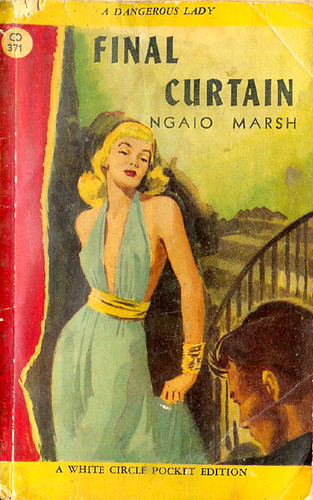
Friday Forgotten Book: FINAL CURTAIN (1947) by Ngaio Marsh


I'm not posting forgotten books regularly anymore - I simply have run out of steam, possibly because I've forgotten any forgotten books I've read in the past. But occasionally, when I do stumble across one, accidentally or otherwise, I'll be writing about it - kind of on an irregular basis. In the meantime, don't forget to keep checking in at Patti Abbott's blog to see what forgotten (or overlooked) books other readers are talking about - most of them show up every Friday.

I know I read Ngaio Marsh's FINAL CURTAIN a while back but damn if I hadn't forgotten who the killer was, not that that really matters much. Remembering would not have stopped me re-reading - it's all about the writing and the re-visiting for me. This is a particularly leisurely mystery as the first murder doesn't happen until well into the book and the second murder happens just a few pages before the end.

As for the ending, it is a bit abrupt and not very satisfying, after everything that has gone before. But this is one of those books that you want to read regardless because Ngaio Marsh's gift for characterization and dialogue are absolutely topnotch and the setting is perfection, mystery-writing-wise.

Here again we have murder at a large, foreboding, ungainly estate in the English countryside - something I am very fond of reading about. Ancreton is the 'family home' of  the Ancreds - a very theatrical and fractious family at whose head sits Sir Henry, a famous and oh-so-egotistical Shakespearean actor now past his prime. 'Drama' is the Ancreds' middle name - they thrive on it, can't manage to get through the day without six or seven exhausting emotional scenes. Everything is a production. Everything has to be hashed over and over until there's nothing left but a morsel of the original idea.

They are a wearisome bunch. And now that they are all gathering at Ancreton for Sir Henry's birthday, unpleasant things are bound to happen. Especially since Sir Henry has a habit of changing his will at the drop of a hat, depending on who in his family is momentarily in disfavor.

Agatha Troy (known as 'Troy' to her hubby), the famous painter and wife of Scotland Yard Superintendent Roderick Alleyn is commissioned to paint a birthday portrait of Sir Henry in costume as MacBeth. She has been nervously awaiting the return of her husband who has been on overseas duty for MI5 (or its equivalent) during the war. They haven't seen each other in three years, so she's on pins and needles. Judging correctly that working will help pass the time that much quicker (Alleyn is due home in a couple of weeks), Troy arrives at Ancreton ready to paint.

What she is not ready for are the constant battle royals and dramatic scenes involving Sir Henry and assorted members of his family, all of whom have arrived at the house to spend a few days. She finds Sir Henry a wonderful subject - though elderly, he is tall, handsome and dignified with a sweeping head of white hair - and the painting goes along relatively smoothly. The first third of the book is taken up with family drama and the feeling of impending doom, yes, but also with the how-to of portrait painting which I found fascinating. I'm very fond of painting minutia.

But things can't help but go from bad to worse at Ancreton. Sir Henry has installed a young chippy of a gold-digging actress, the beautiful Sonia Orrincourt, and is making plans to marry her. Needless to say, this does not go down well with the relatives several of whom are in various stages of hysteria at the mere thought.

When the very unfunny practical jokes begin early on, Troy realizes that something is seriously amiss.

"A lamp, out of sight beyond the first spiral, brought the curved wall rather stealthily to life.

Troy mounted briskly, hoping there would still be a fire in her white room. As she turned the spiral, she gathered up her long dress in her right hand and her left reached out for the narrow rail.

The rail was sticky.

She snatched her hand away with some violence and looked at it. The palm and the under surface was dark. Troy stood in the shadow of the inner wall but she now moved up into light. By the single lamp she saw that the stain on her hand was red.

Five seconds must have gone by before she realized that the stuff on her hand was paint."

By the time of the expected first murder, we know more than enough about the Ancreds' eccentricities and antagonisms to fill a volume. For me, the fun of this book lies in the family's day to day dramatics and the interaction between parties involved. Ngaio Marsh creates two very memorable characters: the achingly swishy Cedric Ancred (the expected heir) who is persistently hard up for money - adored by his mother but abhorred by the rest of the family - and Thomas Ancred who is incapable of expressing himself without his mind wandering afield. Conversation with Thomas is fatiguing, to say the least. But oh, he makes you smile.

It's fun to see how Troy and eventually, Roderick Alleyn (arriving home from the Antipodes to a murder involving his wife) deal with this frenetic and oh-so-very-British bunch. An excellent whodunit although in the end, you won't care that much about the 'why' of it.

I will say though that if, like me, you love reading about voluble theatrical families given to grand gestures, this is the book for you. A book, by the way, which would make for a terrific play.

Friday, October 19, 2012

Forgotten Book Friday: ETHAN FROME by Edith Wharton


Today is Forgotten (or Overlooked) Book day over at Patti Abbott's blog, Pattinsase  Don't forget to check out all the other book mavens talking about forgotten books today. Lots of good recommendations.

I know that ETHAN FROME is not the first book you think of when you think of Edith Wharton's work - the woman wrote several classics of early 20th century literature - but it's the only one I remember reading in high school - thanks to Miss Eisenberg, my wonderful English teacher. I've since re-read it many times, it remains one of those books hard to define but intriguing as hell. It's a kind of grim romantic tragedy that is also, because of its ending, a horror story. At least in my view.

I have a feeling it was one of Miss Eisenberg's favorites as well since she was/is a big fan of allegory and symbolism. And let me tell you, ETHAN FROME is a symbolist's dream.

Part of our lesson plan was to highlight and interpret the various symbols Wharton used in the book, for instance, 'the sled'.  Let me tell you we had some great discussions in class.

The story is set (mostly in winter) in a bleak New England village, imaginatively enough called Starkville, by the author. Frome is a tall, silent, physical 'ruin of a man' when we first meet him. He is an enigma to the narrator who, an outsider, is in Starkville on some sort of company business never much elaborated on because it isn't important.

"I had the story, bit by bit, from various people, and, as generally happens in such cases, each time it was a different story.

If you know Starkfield, Massachusetts, you know the post-office. If you know the post-office you must have seen Ethan Frome drive up to it, drop the reins on his hollow-backed bay and drag himself across the brick pavement to the white colonnade: and you must have asked who he was."

Note the specific use of the word, 'drag' in describing Frome's approach to the post office door. The narrator then goes on to describe him in detail, making a powerful picture in our minds before we're much into the story.

Many people are put off by the idea that the story is not told from the point of view of any of the protagonists but from that of a sophisticated humanist, someone who has no stake in the outcome except assuaging his curiosity.

But we enter the story twenty four years after the main events and as Wharton herself puts it in an Author's Introduction, she gave the mechanics of story-telling a great deal of thought:

"The problem before me, as I saw in the first flash, was this: I had to deal with a subject of which the dramatic climax, or rather the anti-climax, occurs a generation later than the first acts of the tragedy. This enforced lapse of time would seem to anyone persuaded - as I have always been - that every subject (in the novelist's sense of the term) implicitly contains its own form and dimensions - to mark Ethan Frome as the subject for a novel. But I never thought this for a moment, for I had felt, at the same time, that the theme of my tale was not one on which many variations could be played. It must be treated as starkly and summarily as life had always presented itself to my protagonists; any attempt to elaborate and complicate their sentiments would necessarily have falsified the whole. They were, in truth, these figures, my granite outcroppings; but half-emerged from the soil, and scarcely more articulate."

The plot:

In his late twenties, From is married to a needy and unpleasant woman, a bitter hypochondriac who's joy in life is to complain. His character dictates that he make the best of the situation; he is silent and stoic and accepting of life's harsh vicissitudes.

Until his wife's young, vivacious and impoverished cousin comes to stay on the farm.

The inevitable ending - inevitable because of the time and place and who these people are - has a garish horror to it which transcends even the general bleakness of the story.

Everytime I re-read ETHAN FROME, I get caught up and hope for a different outcome. It never happens.

The book was turned into a movie a few years ago starring Liam Neesom as Ethan Frome (he was wonderful in the part) and Patricia Arquette. It wasn't bad. But read the book first.

Friday, September 14, 2012

Friday's Forgotten Books: DISTEMPER (2000) by Beth Saulnier


If it's Friday, it's usually Forgotten Books Day at Patti Abbott's blog, Pattinase. So don't forget to go take a look and check out the links. We're a fun bunch.

DISTEMPER by Beth Saulnier is one of those books I never get tired of telling people to read (though people may get tired of hearing me going on and on about it). Set in an upstate New York college town full of the sorts of people you'd meet everyday if you were a wily reporter for the town paper named Alex Bernier and you were slightly famous for making headlines in a previous murder case which struck a little too close to home.

Alex is a complicated but thoroughly engaging character, a young woman who lives a kind of casual yet intense lifestyle (the author's figured out a way to put those two seemingly opposite ideas together) which involves various housemates, several dogs, an unpleasable, foul-mouthed boss down at the paper and an awkward knack for stumbling over dead bodies. Or maybe not so awkward, considering she's a reporter. Plus the current case allows her to interact with a big, attractive, red-haired Irish cop:

"Good guard dogs you've got there. Yours?"

I shook my head. "That lump on the couch is mine. Her name is Shakespeare. She's part German Shepherd, part Beagle. She'd play fetch with a rapist. The big black poodle is Tipsy. He belongs to my roommate Emma. The shepherd is C.A.'s. He's a purebred, real champion stock. Her mom's family's really into the dog-show thing. Name's Nanki-Poo."

"That's humiliating."

But as usual, I'm getting ahead of myself again. Let's back up to the utter 'wow' of a beginning to give you a better idea of what goes on in frozen wastes of upstate New York - land of the hearty and the eccentric - in case you didn't know.

"They found the first body in April, which is when things tend to turn up around here. The sun came out for the first time in six months, the top crust started to melt, and some poor bastard cross-country skiing in his shirt-sleeves saw her foot sticking up out of the snow."

Pretty terrific, so far.

So here we have a serial killer stalking and killing young women and of course, Alex gets caught up in the middle of it all. Especially since the killer isn't averse to keeping her in the loop - so to speak.

But as Alex links two and two together and discovers a four legged denominator common to the crimes, she puts herself in danger, yet again. Reporters lead such interesting lives.

The main reason for liking this book (other than the tricky plot and the likable main characters) is the dialogue. For me, the kiss of death with most books is the generally clumsy dialogue which makes the characters 'sound' as if they KNOW their words are being read. This is a book in which the characters speak exactly as you think they would. And that's good enough for me.

"Hey, you know, you got really big tits."

I looked up to find two college guys, each just slightly smaller than the new Volkswagen Beetle. They were bleary-eyed and standing close together, like they were holding each other up.

"Didn't ya hear me?" said lout number one. "I said, 'Man, you got really nice tits.' We saw ya through the window here." He gestured with his beer mug and I felt a splash go down my neck.

"Yeah," said his companion. "He said, like, 'Look at that girl with that great rack,' and I said, like, 'Dude, it's your duty to go in there and tell her how you feel.' And he said, 'Dude, you are so right.' And...here we are." He said it like he was Lindbergh describing his trip across the Atlantic. I didn't know whether to laugh at them or reach for my Mace. Oh, hell. If you live in a college town, sometimes you have to suffer for all the good coffee and reasonably priced drugs.

"So whaddaya say?" said the first guy.

"Yeah," said the other. "Whaddaya say?"

"Is there a question? Because if there is, I believe I may have missed it."

They looked at each other. "Huh?" said lout number two. "My friend here just wanted to express himself, that's all."

Where do these guys come from? Failed government experiments?

Alex is someone you want to meet. And not just because she has a nice rack.

Friday, July 27, 2012

Friday's Forgotten Books: SMALL VICES (1997) by Robert B. Parker


Today is Forgotten Book Friday (as usual) - my choice this week is SMALL VICES by Robert B. Parker. (Don't forget to head on over to PATINASE, Patti Abbott's blog to see what other forgotten books other bloggers are buzzing about.)

Boston private eye and general all-purpose tough-guy, Spenser (That's Spenser with an S - like the English poet) is drawn into an investigation at the request of old friend, Rita Fiore - once a lowly public defender now a hotshot at a prestigious private firm. Rita has qualms about a four year old case in which she did her inexperienced best but her client, a low-life named Ellis Alves, was convicted of the murder of Melissa Henderson, a college coed found strangled on campus.

Even though the thoroughly reprehensible Ellis Alves is/was the sort who deserves to be in prison for other crimes committed, Rita suspects he was not guilty of murder. She wants Spenser to relieve her guilt and possibly help right a miscarriage of justice.

When Spenser begins poking around asking questions, it becomes apparent to him that the two main witnesses to the crime are hiding something (or at the very least are behaving strangely), not only that but the cop involved in the original investigation is acting as if he, too, has something to hide - though maybe that's just incompetence, prejudice and shoddy detective work.

The thing is, Ellis Alves is a black man with a record and Melissa Henderson was a white girl with well-to-do parents, so everyone assumes Alves was guilty as hell and why doesn't Spenser just go away and let them all get on with their lives.

It also turns out that Melissa Henderson had a yuppy boyfriend who was never interviewed in the original case - a young man with an attitude and very, very rich parents. (That the boyfriend is a light-skinned African American adopted by white parents adds a unique twist to the mix.)

Spenser is the sort who, once he gets his teeth into something, just doesn't let go - kind of like a pit bull. It is what makes him such a relentless investigator. Eventually, he comes to believe that Ellis Alves was framed though there isn't any proof, just a working theory.

Within days the word is out that someone has hired an out-of-town hit man to take Spenser out. Obviously, Spenser has stepped on some sensitive toes.

This is the book in which we first meet the so-called 'gray man', a professional killer with no emotion, no remorse and no redeeming social qualities. He will turn up again in one of Parker's last books, ROUGH WEATHER, one of his best.

I can't say much more without giving away a couple of major plot points which help make SMALL VICES a stand-out in the long-running Spenser series. This is my second (or maybe third) time reading it and it still holds up as well as the first.

Though I'm not a fan of Susan Silverman, Spenser's girl-friend (boy is she hard to take), she isn't as obnoxious as usual in this book. Hawk (Spenser's close and very dangerous friend) is on the spot as back-up as well as Vinnie (a bad guy who works for the local crime boss - both men who happen to respect Spenser) and a couple of Spenser's cop friends who rally round when he and Susan are threatened. Last but certainly not least are the many quips and Spenser-isms we've all come to love and expect.

This is top-notch Spenser, the late Mr. Parker writing at his very best.

Friday, July 13, 2012

Friday's Forgotten Books: THE WINDS OF CHANGE (2004) by Martha Grimes


Friday's Forgotten Books is a weekly meme hosted by Patti Abbott at her blog, PATTINASE. Drop in later and check the links for today's books. It's bound to be varied and intriguing.

My entry today, THE WINDS OF CHANGE is a slightly edited version of a review I did a few years ago for the now defunct website, MYSTERYINK.

Martha Grimes is an American who thinks and writes like a Brit. She's created her own version of England and peopled it with an imaginatively inventive set of characters. This nineteenth installment in the long-running series featuring her elegiac Scotland Yard Superintendent Richard Jury, The Winds of Change -- the books are all titled after British pubs -- begins with the worst of crimes: the murder of a child on a London city street.

The sad death of this abused and unidentified, little girl is seemingly unrelated to the previous disappearance, several years before, of four year old Flora Scott, who was snatched from a public garden in Cornwall, right under the nose of her frantic mother, Mary. The loss of his step-daughter (a crime never solved) followed by the death from illness of his beloved wife, has left wealthy Declan Scott a recluse, a man consumed by grief.

Flora's biological father, London businessman, coin collector and suspected pedophile Viktor Baumann (whom the vice unit has been keeping an eye on) is linked to a notorious house in North London which happens to sit just a couple of blocks from the street where the current victim has been found.
Since there are few coincidences in crime, this is more than enough to raise an eyebrow as far as the local police are concerned.

When Richard Jury is alerted by Brian Macalvie, his old friend and divisional commander with the Devon and Cornwall police, that an unknown woman has been found murdered on the very estate where Flora Scott lived -- coincidentally shot with the same caliber gun as the little girl in London - Jury's investigation necessarily deepens. Soon he and the germ fighting, herb-tea-swilling, hypochondriac associate, Sergeant Wiggins are on their way to the southern coast of England.

For Jury this is also a personally trying time, he's just had news that his cousin Sarah, a difficult woman he was never especially fond of, has died. Since she was the only one left who shared Jury's hazy recollections of his youth, guilt forces him to reconsider their relationship and his memories as he takes time out to attend her funeral in Newcastle-Upon-Tyne. We know little, even after eighteen books, about Jury's life before he became a policeman, so it's interesting to see him interact with his few remaining relatives. Grimes is not often willing to share much about Jury's past. In some strange way, it's almost as if she guards him from our prying eyes.

Martha Grimes' books generally swoon with layer upon layer of melancholy. Her style is unique and no other thriller writer working today has her eloquent technique or her gift for staging. Dark forebodings plague her characters and often play part in establishing links between catastrophic events. The moors, the windswept coasts of the new angst-ridden England, even the London side streets reek of gloom and perished dreams. Even her animals share the human's penchant for melancholy, a unique "Grime-ism" which only she seems able to get away with. Grimes never just concocts a simple tale of murder, her stories always include that "something else," something indefinable; a sinister presence, unnamed, unexplained, unseen but always felt. Hers is a darkly gothic England which hasn't quite shaken loose its mythical demons and where secrets always rise up out of the past to snarl and bite.

But the unseen creature stirring in the woodshed in a Grimes tale is more ambiguous than a mere monster of fantasy. The monsters Grimes invents are human ones, well hidden beneath the deceptive guise of normalcy. No one is spared in a Grimes tale, not even children. Especially children. Grimes can be ruthless when it comes to the more innocent among us. She has a way of writing children, recognizably different from others in the genre. The Grimes child is always enigmatic, uniquely precocious, capricious and very much given to other-worldliness. The author obviously enjoys creating them and it shows.

And when one of them comes to harm, it seems a doubly hurtful occurrence.

The most melancholy of all characters in this series, is of course, her enigmatic creation Richard Jury. A Scotland Yard detective superintendent; Jury is a sensitive, introspective man given to reading poetry and ruminating about the exquisite darkness of life, and with just cause. He believes (like many things in a Grimes book, we're not entirely sure where the actual truth lies) he saw his mother die in a London wartime bombing which destroyed their home when he was about 4 or so. Lately though, he's begun to doubt this.

The reader gets the sense that Jury has spent his entire life in a fruitless search for the unnamed thing that his mother's death robbed him of -- but maybe not. One thing for sure, he can't seem to find and keep the right woman. A kind-hearted, attractive and intriguing man, he seems complacent in his aloneness. And can sometimes appear obstinate and obtuse. One wonders, for instance, if he will ever notice the suitability of Carole-Ann, an equally enigmatic young woman living and preening her bright plumage in London, right under Jury's nose. It's enough to make this reader occasionally shake her head in exasperation.

If Grimes' books were exclusively about Jury, the time might come when enough would be enough. As a character, he is, after all, overburdened with a gift for rumination bordering on the excessive. Upon occasion I have been heard to mutter "ENOUGH!" quite loudly in the recesses of my room. Jury can, occasionally, get on a reader's nerves.

But Grimes is astute enough to include a revolving cast of characters which serve to poke and prod the Detective Superintendent out of his self imposed inclinations and into the cold, cruel world to do battle with evil; a job at which he is superbly talented.

Grimes has a relish for quirky character names, ergo, the cast: Trevor Sly, Ada Crisp, Marshall Trueblood, Polly Praed, Vivian Rivington, Diane Demorney and the odious Theo Wrenn Browne, bookstore proprietor. We also get an assorted variety of oddly named cats and dogs (a feline named Desperado, for one) all denizens of the village of Long Piddleton - they seem to have wandered in from a P.G. Wodehouse novel. Yet somehow this disconcerting mixture works.

The Winds of Change is a darkly moody tale of murder, mixed identities and sleight of hand deception, and Richard Jury is once again on call to solve a case where the past casts a long shadow over the present.

Jury's good friend, the oh-so-upper-class Melrose Plant -- an Earl who has abandoned the title for reasons which remain unclear although in The Lamorna Wink, the sixteenth book in the series, hints are given -- arrives at Declan Scott's estate in Cornwall - incognito - masquerading as a gardener with an arcane specialty: the laying on and re-establishment of turf. Though given to cynicism, Melrose is almost impossible to dislike.
"The following day dawned clear and cold. Not that Melrose was up in it. He wondered sometimes what an up-at-dawn experience would be like, but he never wondered enough to try it."
Exceedingly rich, naturally charming (though seemingly unaware of it) and a lifelong bachelor, he is usually ensconced at his estate Ardry End, with his butler Ruthven, a fussy retainer of the old school. Both men are constantly on guard against visits from Plant's truly awful Aunt Agatha who delights in tormenting Melrose with the social niceties, and making trouble for the hapless citizens of their little village, Long Piddleton. But since Melrose is friends with Jury, he does routinely get involved in cases when Jury feels like including him.

Also on hand in this book, is the perpetually brooding police inspector Brian Macalvie. Burdened with his own private demons and dark nature, he and Jury make for an interesting, if somewhat somber, crime fighting duo. And as usual, Chief Superintendent Racer and his nemesis, the office cat Cyril, are on hand to make malicious mischief down at New Scotland Yard.

Martha Grimes works her compelling magic on the various skeins of this thorny, ultimately heartbreaking problem she's set before Jury and though all, of course, is never completely right in the end -- how could it be? -- most of the answers are revealed and life continues for the melancholy  Superintendent Jury of Scotland Yard.