Showing posts with label Wilkie Collins. Show all posts

Monday, November 19, 2012

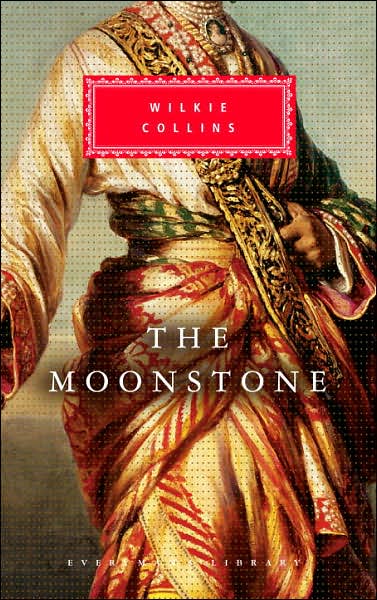
Review: THE MOONSTONE by Wilkie Collins


Hold on to your hats, here we go.

This is a large read, a luxurious read to snuggle down with on a cold winter's day (if we're ever going to get another of those here in the northeast), a great thumping Victorian melodrama mystery - my great big second helping of Wilkie Collins in two years.

THE MOONSTONE (1868) is the story of a missing jewel (the moonstone is a diamond not...uh, a moonstone - it's just called The Moonstone) and the two thwarted and very misguided lovers who spend the entire book misdirecting everyone and generally making a nuisance of themselves. But that's Victorian melodrama for you. We kind of expect that going in.

I suppose that Wilkie Collins - a contemporary of Charles Dickens - sort of, kind of, invented the mystery story as we've come to know it today, at least in Great Britain. (Edgar Allan Poe is credited with the American side of the invention.) Having not been very familiar with Collins' work (except for a brief forgotten fling while I was in high school), I was pleasantly surprised by how much I enjoyed reading THE MOONSTONE, not to mention last year's WOMEN IN WHITE, which I also loved and recommend highly and heartily. You have to be in the mood, though, I will say that.

In THE MOONSTONE, Collins practically invents the know-it-all detective with eccentric quirks though having done so, he forces him offstage about halfway through the story (we kind of miss him) only to have him  reappear near the end (thank goodness since he kind of grows on you) in time for the grand denouement.  Sergeant Cuff is a pragmatic, hyperactive fellow whose only love (besides crime solving) is roses and gardening. He almost immediately appears to know more about what has happened than anyone else on the scene - ah, genius. 

The scene being a large English country house and a fine cast of suspects all gathered for a young woman's birthday celebration. Among the celebrants, two young men with hopes, an argumentative doctor, and assorted others.

Anyway, Cuff is eventually hired (in those days, oddly enough, you could hire a cop as you do a private detective nowadays) to find a missing jewel; the diamond known as The Moonstone. The jewel (cursed apparently since it's theft from the forehead of an Indian idol way back when) has been left to Miss Rachel Verinder (our heroine) by a spiteful uncle with nefarious purposes. She inherits the diamond on her birthday much to her chagrin and secret delight, but on that very night the jewel disappears from the not-too-hard-to- find hiding place in the heroine's boudoir.

The next day Rachel and her stalwart and frankly rather callow beau, Franklin Blake, have a huge fight but nobody knows the reason why. Actually, not even the two young things know the reason why since neither will tell the other what in hell is going on and besides even if they did....well, you have to keep reading. But from that moment on Rachel becomes as intransigent as a young woman of her class was allowed to be and still keep her place in society. She refuses to see Sergeant Cuff when he arrives on the scene at her mother's request, refuses even to make any sense, refuses to cooperate with the investigation of the theft of her jewel. Cuff, naturally enough, is suspicious.

Franklin Blake, also naturally enough, leaves the premises much confused by his girlfriend's behavior - which borders on hysteria - afraid to make things worse by staying. You can't blame the guy for shaking his head and wondering what on earth - besides the theft of the diamond - has happened. One minute everything's fine, the next minute his intended has turned into a termagant. Maybe he's had a lucky escape, I'd say. But no, Mr. Franklin is in love. He flees the scene to recoup and figure out what, if anything, is to be done next.

In the meantime, Sgt. Cuff has his eye on a servant girl as a possible culprit. Rosanna Spearman is one of those tragic book characters you know will come to a bad end. She is an ex-con (not what they called them then, but there's no getting around it), who works below stairs at the Verinder house. Rosanna is trying to make a new life for herself though it's rather obvious she hates the work.

In character Rosanna reminds me a little of the moody Sarah Woodruff of THE FRENCH LIEUTENANT'S WOMAN fame (the novel written by John Fowles set in Victorian England). Rosanna, who, besides being plain and insignificant also has a hunched shoulder (I mean, could she be any more pathetic?) and an aura of tragedy worn almost like a mantle. You see, Rosanna aspires. In those days, servants were not allowed to aspire. And to make matters so much worse, the sad girl has fallen in love at first sight with Mr. Franklin Blake. Uh oh.

In truth, Rosanna is the third protagonist in the story, a character whose involvement in the outcome of the mystery remains unknown to Mr. Franklin and Miss Verinder (and to us) until nearly the end. But a character whose suspicious behavior immediately catches the eye of Sgt. Cuff.

I might also mention that the Verinder country house is set on an ocean shore where, nearby, the gurgling of quicksand can be heard and if you're not careful, seen. Uh oh. I can say no more.

Oh wait - there's one more thing I forgot to mention: the assorted group of sinister Indians in garb skulking about the outside of the Verinder house and in the nearby town pretending to be a harmless group of traveling jugglers.

Okay, so there you have it. The gist of a story which, on the surface, doesn't seem to require the four hundred and some odd pages Wilkie Collins used to tell it all. But there you'd be wrong.

THE MOONSTONE saga is revealed in separate chapters made up of journals and letters from several of the characters involved, all pertinent to some aspect of the story - so we get to view certain events from the viewpoint of Mr. Gabriel Betteredge, House-Steward in the service of Julia, Lady Verinder (Rachel's mother), Miss Clack, niece of the late Sir John Verinder (from whose malevolent beneficence the missing diamond sprang), Matthew Bruff, Solicitor of Gray's Inn Square, a narrative contributed by Mr. Franklin Blake the aforementioned confused young swain, the journal of Ezra Jennings, a narrative by Sgt. Cuff, a statement by Sgt. Cuff's man, a statement by a sea captain and finally a statement by a Mr. Murthwaite in a letter to Mr. Bruff. We also get a letter from Rosanna Spearman near the end which explains her part in the mysterious doings at the Verinder house early on.

All of this makes it easy enough for the reader to form his or her own opinion of the sagacity, the honesty and/or the moral rectitude of those involved. The story takes place over a long stretch of time, about a year or so and the missing diamond leads, eventually to a dastardly murder and all other sorts of chicanery which, I suppose, leads us to the inevitable moral: when you spot a diamond (no matter how huge) on the forehead of an Indian idol, for goodness' sake leave it there.

P.S. The Indian idol part of the narrative taken from Verinder family papers reminded me very much of the Arthur Conan Doyle, Sherlock Holmes story, THE SIGN OF FOUR written in 1888. See if you agree.

P.S. P.S. Charles Dickens apparently didn't like the form Wilkie Collins used to tell the story of THE MOONSTONE, but I think it works splendidly. You just have to pay attention.


Monday, June 20, 2011

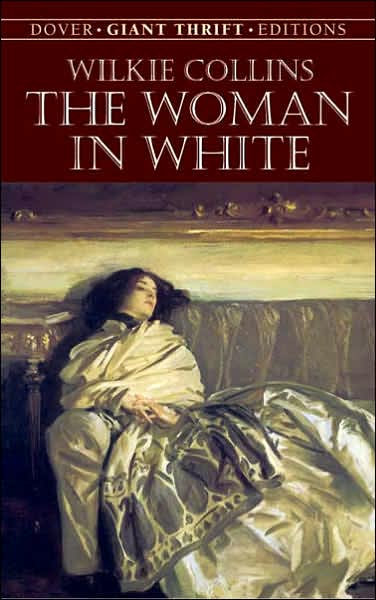
Monday Book Review: As THE WOMAN IN WHITE Turns: Part Two.


I reviewed the first half of Wilkie Collins' classic THE WOMAN IN WHITE some days ago - at this link. So now I've returned with the second half of my review of a book I never expected to love as much as I do. My experience with Wilkie Collins is/was limited. I'd only read THE MOONSTONE eons ago and didn't remember much about it. (I'm going to be re-reading that in a few weeks simply because I would be a fool not to.) But I joined in The Victorian Reading Challenge (on a whim) a couple of months ago and hadn't done much since - been too busy reading other stuff. Wilkie Collins is my first Victorian author (in years) and he definitely won't be the last.

The Victorian Reading Challenge is hosted by Bethany at SUBTLE MELODRAMA.

Before I go any further, I thought I'd add a sentence which, to me, exemplifies much of what I like about Victorian Literature:

June18th - The misery of self-reproach which I suffered yesterday evening, on hearing what Laura told me in the boat-house, returned in the loneliness of the night, and kept me waking and wretched for hours.

Isn't this excessively marvelous? It's from the pages written by Vincent Gilmore of Chancery Lane, Solicitor - to further the plot of THE WOMAN IN WHITE. Although from its tone you might think it was was an excerpt from a woman's journal. Evidently men and women were prone to overwrought thoughts and actions during Victoria's reign.

I like it.

One of the reasons why I like it is that, despite the flourishes it is exactly what it purports to be. There's no getting around the meaning of these words. The man was obviously overwrought and this is evident. I love the use of fairly specific language to describe EXACTLY what a character means - the English language is a beautiful thing if used well and I love it used in this dramatic fashion.

When last we left the story, poor but honest and honorable drawing master Mr. Walter Hartright (our hero) was gone from the scene. He'd left for Central America to get away from the very idea that the love of his life, Laura Fairlie - a rich and beautiful, but not especially brilliant, young woman - had been forced, by societal and other obligations to marry Sir Percival Glyde, an unprincipled cad and desperate fortune-hunter. Just how desperate we were yet to find out. Indeed, at this point in the reading, we were left to wonder if Walter would ever return to the increasingly gloomy narrative.

The story continues to be told from different points of view, journals, letters and 'testimony' of witnesses as the story evolves.

Laura - Lady Glyde - has moved into Sir Percival's large but run-down estate (Sir Percival not having had the necessary wherewithal to maintain the property) after a month-long honeymoon in Italy. She is joined at Glyde's house by her half-sister and confidant, Marian Halcomb - a young woman denied a husband in Victorian Society because of her ugliness and possibly, her forthright manner. But what Marian lacks in outer beauty she makes up for in inner strength, imagination and daring. I can't help but wish that  Walter had fallen in love with her instead. (I'm sure I'm not the only reader who has ever thought that. I often wonder if it occurred to Wilkie Collins at all.)

Making up the rest of the cast is another couple whom Sir Percival appears to have picked up in Italy - the rotund and smarmy Count Fosco, of supposed Italian nobility - and his oddly complaisant wife, the Countess who happens to be a cousin of the Fairlies and as such, in line for a 10,000 pound inheritance should anything happen to Laura. Uh-oh.

It doesn't take a genius to figure out that something is not quite right in this strange household. Sure enough, Glyde begins almost immediately to show his true colors by attempting to force Laura to sign some official looking papers which he won't allow her to read. (!!??) But even Laura has her limits and she refuses to sign without reading the content. Good for her. I don't think I could have kept on reading if she'd meekly signed without protest. Though there is some 'hemming and hawing' but thank goodness, Marian is there to provide ballast.

I did wonder though, why Percival didn't simply forge Laura's signature. But perhaps there are some things even an unprincipled cad will not do. In truth, forgery would have been the least of his villainy especially since we learn later that he had, indeed, forged a line or two in a wedding registry. But I can say no more for fear of giving away a main plot point.

Soon enough it becomes evident that Glyde will stick at nothing (except forgery), not even physical intimidation, to get his hands on Laura's money AND that the oily Count Fosco is meant to act as the 'good cop' in their 'bad cop/good cop' routine. What I find most interesting about these pages is that with Walter off in the wilds of Central America and Laura's lawyer unable to do much because of the austere marriage settlement (Victorian pre-nup), Laura and Marian are pretty much on their own. In Victorian society there wasn't much a woman could do once she married and became basically her husband's chattel, most especially if she had no father or older brother to step in on her account. So Laura must resort to lots of hand-wringing and 'what shall we do? what shall we do? That sort of thing.

It is touching (and frustrating) to think how helpless she and Marian truly are under the strictures of the law of the land AND in society's narrow view.

I know that Wilkie Collins didn't hold much with marriage, his own unconventional living arrangements are proof enough of that. Obviously he didn't think much of what marriage did to women. This view comes across clearly in THE WOMAN IN WHITE. Laura Fairlie was pretty much doomed from the start if not for the machinations of Marian and later, Walter Hartright who comes back into the plot in the veritable nick of time.

As does Anne Cartherick - remember her? She is 'the woman in white' of the title and she is still lurking in the shadows, on the run from the men in white who want nothing more than to find her and take her back to the lunatic asylum.

We soon find out that Anne Catherick might be in possession of a deep, dark secret which could destroy Sir Percival Glyde. When Anne tries again to see Laura and warn her (remember she sent Laura the anonymous letter warning her - to no avail - not to marry Percival Glyde), she is sealing her own doom once the nefarious Count Fosco with his cockatoo, canaries and white mice (??!!) picks up the scent. His modus vivendi is making sure that nothing happens to Glyde who has promised him [Fosco] a cut of Laura's money. Greed and self-importance guides Fosco who is one of the sleaziest, slimiest villains in literary history. Yet the man can't be all bad, he does fall head over heels for Marian Halcomb. He calls her 'magnificent' and you know, in truth, she is.

But oh, is Fosco odious. He is the kind of cunning, operatic villain you hiss at. A man who thinks he knows himself but is hardly aware of his own villainy. He has an excuse and a reason for everything he does and expects you (as we learn later in his self-explaining, self-excusing treatise) to overlook his methods because his motives surely can't be seen as anything but noble.

Okay, long story short: Earlier, it had been made clear to us that Anne Catherick and Laura Fairlie have a very strong physical resemblance to each other. (When all is revealed in the end, you will learn why this should be so.) With that in mind, a hideous plot is hatched - based on this resemblance - by Fosco and Glyde and is carried out with a willful proficiency and malice. Your heart will be in your mouth as you read of the length and breadth that Fosco and Glyde will go to get their hands on Laura's money. Poor Anne Catherick. Poor Laura.

I can say no more without giving away too much more of the plot. But I will say this: Walter Hartright comes back on the scene just in the nick of time. Literally.

From then on it's sheer hard sleuthing grunt work on Walter's part that will help save the day and it is a happy day indeed when we read that Glyde and later, Fosco, both come to a very bad end. Two more unprincipled villains more deseerving of their bad endings you will never meet.

Also near the end, in full circle mode, we welcome back the delightfully exuberant - tiny in stature but enormous in heart - Professor Pesca who had, in the first few pages of the book, been responsible for Walter's getting the job as drawing master to Laura and Marian. Though this time around it is a Pesca who harbors deep and deadly secrets which belie his cheerful countenance. Still, he is a great help in bringing about a satisfactory ending to this harrowing Victorian tale of greed and malevolence in the undaunted face of true love.

I do hope that if you're not familiar with Wilkie Collins THE WOMAN IN WHITE, you will rectify that oversight immediately. But make sure you have the time to set aside. This is definitely a book that will keep you turning the pages to see what happens next until the wee hours of the morning. I loved it.


Thanks to Kathy for the idea to use 'As THE WOMAN IN WHITE Turns' for a title.

Monday, June 6, 2011

A Work In Progress Book Review - Part One: THE WOMAN IN WHITE by Wilkie Collins


Progress report: I haven't finished THE WOMAN IN WHITE yet (I'm more than halfway there, though AND loving it) but the thought of reviewing the WHOLE thing in one lump is very intimidating to me. I've yet to review an actual literary classic on my blog. Don't know that I'm ready to. Very daunting. Though I admit I've been staying up half the last few nights speeding right along with Collins to see what happens next! At this rate, I may have to re-read THE MOONSTONE, which I know I read while in high school. (Other than the fact that the book is about a fabulous stolen jewel, I remember very little about it.)

Thinking grandiosely, I signed up for the Victorian Reading Challenge hosted by Bethany at SUBTLE MELODRAMA six months ago and haven't done anything since to endear myself to the Challenge host. (Sorry I haven't been more productive, Bethany!) But once I finish THE WOMAN IN WHITE  I'm thinking - can Trollope be far behind? Yegads!  

At any rate, here's what's happened so far: 
THE WOMAN IN WHITE is told from several varying viewpoints by several different characters. Each section of the book is picked up by the next character involved, once the previous character signs off - sort of like a round robin type thing. Collins himself (in a preface) declares this a new way of telling a story, though today it is quite common place. So far, I must admit, it is done very well even if Collins writing from a woman's point of view is slightly less successful than Collins writing as a male.But I suppose that's not really unexpected.

Anyway,  it all begins with Walter Hartright ( a character I like immensely), a poor but honest drawing master and gentleman, who, through the machinations of a family friend, the delightful Professor Pesca, has been hired to give drawing lessons to two young ladies of quality. He is also to oversee the art collection (mostly from what I could gather, of drawings and etchings, Rembrandt and the like), of their excessively eccentric, hypochondriac guardian: Frederick Fairlie Esq. of Limmeridge House in Cumberland. The guardian, by the way is a hilarious creation though I'm not at all sure he's meant to be

To have one's future entrapped in the feeble hands of such a man, is to know frustration and chagrin and the overwhelming urge to commit bloody murder upon the person of the effette Mr. Fairlie. How his servants haven't risen up en masse and struck him down and buried him in the garden in the middle of the night is beyond me.

Back to the story:
As one might expect, Mr. Hartright falls in love - inappropriately though honorably, as is made very clear - with one of his charges, Laura Fairlie - a wimp of a girl, but given her upbringing and the nature of Victorian society, an understandable sort of wimp. But, really, even though you want to take her in hand and occasionally shake the stuffing out of her, Wilkie Collins somehow manages to make her likeable.You feel for her and her plight from the very beginning.

Luckily for Laura, she has her half-sister living with her - the poor but gutsy,  intelligent and well-meaning, Miss Halcomb. Both young women are to receive the drawing lessons.

One evening, on his way - walking to Cumberland to begin his new duties - Mr. Harwright comes across a woman in white (or rather, she sneaks up on him), slinking along the dark road - lingeirng in a place she has no business being. They have a strange conversation in which she asks him, among other things, if he knows any baronets in the area. She makes it clear that she is in deep fear of a titled man who has, perhaps, done her some harm. Hartright, a gentleman, helps the mysterious woman on her way. Anne Catherick, he later learns, is an escapee from an asylum.


Something I'd never thought about before:
In the 19th century, people appeared to spend a great deal of time walking to and from their destinations even if those destinations were miles off. It was just something that was done, especially if you had no carriage or money to engage one. At first it seemed odd to me that Hartright would simply leave late in the day to walk to Cumberland (after a fond farewell to his sisters), but obviously this was not an extraordinary thing.

Back to the story once Hartright reaches Limmeridge House:
It was interesting to me to read Mr. Hartright's description of Miss Halcomb whom he first sees in dim light. He is quite taken with her splendid figure, her beautiful hair and her grace, but once he sees her face which he describes as ugly - she is done for as the possible object of desire for any man worth is manly salt. The fact that she has all the attributes mentioned PLUS is clever, kind, sensible and capable of great love carries little weight with Victorian men - obviously. Ah, the plight of the poor and plain relation.

But when Hartright first sees Laura, he is enchanted by her quiet beauty and then, I suppose, by her wimpy airs. Wait, wait, I mustn't carry on. She IS likeable. I assure you. We see, right off the bat that poor Hartright is doomed to suffer heartbreak - as is Laura. In those days a drawing master could not hope to marry or even give voice to feelings of love for an upper class girl of fortune - yes, Laura will inherit a fortune when she reaches a certain age. She is so above Hartright in station that words and/or feelings of an affectionate nature cannot, must not be spoken or acknowledged. Wilkie Collins handles the exposition of these emotions and the burgeoning love between both characters in a wonderfully understated way. It's all wretchedness and heartbreak beneath the surface. Very well done. Though of course, as a modern day woman, I was appalled by the unhappiness these two and society were foisting on each other, I understood it.

After three halcyon months at Limmeridge House which has slowly become a hotbed of unspoken, unexpressed emotions, Miss Halcomb warns off Mr. Hartright and tells him he must leave or risk bringing disaster on Laura and himself.  She is engaged to be married and has been for two years, to a Sir Percival Glyde- an older man whom Laura's father had great affection and respect for. On his deathbed, Laura's father had extracted a promise from her that she would marry Sir Percival. Uh-oh, you say and you'd be right. Laura was/is a malleable daughter who wants to do right by her father's wishes and cause no one even a moment's unhappiness. She wants everyone to be happy. Well, you know, people who want everyone to be happy usually wind up making no one happy, least of all themselves.


See, here's the problem right off the bat: Laura and to a certain extent, Miss Halcomb and even the family lawyer, the elderly Mr. Gilmore - who relates part of the story in his own words - all make the mistake of thinking that Sir Percival is worthy of the title 'gentleman' and that he is the sort to not want to cause anyone any unhappiness either. In a word or two: they get taken in by a veneer of manners and breeding.

But in the meantime, Laura receives an anonymous letter warning her not to marry Sir Percival - dire consequences will ensue if she does, for he is a vile villain - or words to that effect. It is obvious as Miss Halcomb and Hartright, rightly surmise, that Anne Catherick (he had earlier told the tale of his odd meeting in the night with a woman in white) is in the vicinity of Cumberland herself. Putting two and two together, they also surmise that Sir Percival must be the baronet Anne Catherick spoke of so mysteriously. But surely, these are the ravings of a mad woman. Still, Miss Halcomb promises to keep an eye out for Laura's safety and to learn what she can of Anne Catherick's whereabouts.

Once Hartright, convinced he is doing the right thing for Laura, leaves Limmeridge House for parts unknown. Well, not so unknown, he goes back to London and later signs on to an expedition to some dangerous jungley place in Central America - the expedition needing someone to draw what they discover along the way. Hartright had pleaded with Miss Halcomb to help him find just such a job away from England and the heartbreak he could hardly endure. He is the very essence of wretchedness when he leaves the country. Your heart bleeds for him. Oh, if only things could be different.

Well, it seems fairly obvious, they can't.

Despite misgivings, Laura marries Sir Percival and off they go to Italy for their honeymoon.  When, several months later, they return to take up residence at the baronet's crumbling country seat, Miss Halcomb comes to live with them at Laura's insistence.

Earlier, the story had been picked up by Miss Halcomb after Gilmore the lawyer had signed off, so we see everything from her point of view - at least as far as I've currently gone, halfway through the book.

Almost immediately, Miss Halcomb intuits that something is not quite right. Laura has changed and so has Sir Percy.(No big surprise, I'd say.) Adding to the uncomfortable mix, another couple has come to stay with them - friends of Sir Percy - the corpulent and utterly creepy (at least to me) Count Fosco - of Italian nobility - and his eerily docile though stiff-necked wife, the Countess. What a strange brew!

What happens from then on is only to be expected as dark doings are hinted at when it becomes fairly obvious, fairly early, that Laura has been married strictly for her fortune - actually, the marraige settlement earlier tells us that but Mr. Gilmore had been powerless to prevent the settlement contract since Laura's guardian, the weedy Mr. Fairlie,  was most insistent that it be carried out as arranged.

To read about the oddly eccentric and entirely creepy doings - I keep using that word but really, there's no other way to describe what is going on in that house most especially when Count Fosco  is on the scene. He has brought with him from Italy,  a pet cockatoo, two canaries and a little cage in the shape of a castle filled with white mice which he allows to run all over him when he gets the urge -  the mice, not the cage.. Picture it. Canaries singing, mice climbing in and out of his clothing and the cockatoo screeching. Eccentric is too mild a word for dear Count Fosco of the piercing gray eyes and seemingly inflexible will. A will which he masquerades in the guise of obsequious continental manners. But it is obvious to anyone with eyes and a bit of brain that Fosco and Sir Percy are in some sort of nefarious cahoots.

A charming household.

I'm at the point in the story when things look very bleak for Laura and Miss Halcomb. Sir Percival is an unprinicpled cad whose main concern is getting his hands on Laura's money - to that end he has trouble even pretending to good manners and concern for Laura of any sort. In short, he is NO gentleman.

I hope to find out within the next day or two when Hartright will come back on the scene - IF he ever comes back (I suspect he will) and also, when will Anne Catherick - the woman in white - will be discovered and flushed from her hiding place, perhaps to her death. I worry for Laura and the indefatigable Miss Halcomb - what can two 19th century ladies do with no male protector on the scene? No father or brother to whom they can appeal for help and guidance?

Stay tuned, dear ladies and gentlemen, stay tuned.

(I have to say, I am loving this book much more than I thought I would. It is no chore to read this melodramatic 19th century tale of evil doings and ladies in distress, not to mention a stalwart hero. This Wilkie Collins experience has turned out better than I would have ever expected.)


To read more about Collins and his work, please use this link.