Showing posts with label Cary Grant. Show all posts

Tuesday, October 29, 2013

Tuesday's Forgotten (or Overlooked) Film: ARSENIC AND OLD LACE (1944) starring Cary Grant, Priscilla Lane, Raymond Massey and Peter Lorre.


I've saved the best for last on this my final October Forgotten Film Post:

(This is a repeat of a review originally posted (by me) on 2011, newly edited (by me) and re-posted since, really, this is my favorite Halloween movie and it's kind of a ritual around these parts. Far as I'm concerned, you can't say too much about ARSENIC AND OLD LACE or for that matter, say it often enough. 

ARSENIC AND OLD LACE directed by Frank Capra, screenplay adapted by Julius and Peter Epstein from the stage play by Joseph Kesserling, and with an utterly delightful musical score by Max Steiner (arranged by Hugo Friedhofer), is, to my own mind at least, one of the greatest screwball comedies ever conceived in any mind, man or woman. There, I said it and I'm glad. I LOVE THIS MOVIE!

Cary Grant was not, I understand, the first choice to play Mortimer Brewster but really, I can't imagine anyone else in the part. Grant himself thought he was not the best choice. (I've read he said that Jimmy Stewart would have been better.) He was wrong. Grant is superb as the crazed (and reluctant) newlywed who suddenly finds his whole life upended by hilarious madness and murder. Well, hilarious to us, at any rate.


Grant's facial expressions and over-the-top physicality alone are worth the price of admission. He threw himself into the part and steals the picture away from a whole host of seasoned scene stealers. He is simply magnificent. I have to say that ARSENIC AND OLD LACE and BRINGING UP BABY are my two very favorite Cary Grant movies of all time. (In my book, two Oscar worthy performances, if the vaunted Academy had valued comedy as much as drama.)

Yeah, I liked Grant's serious stuff too, but I just fell in love with Mortimer Brewster as I did earlier, with Dr. David Huxley. I love when an actor plays against type so successfully. Despite (or maybe because of) his physical beauty, Grant was not afraid to mix it up, to play a nerdy, hapless anthropologist or a hysterical, anti-marriage newspaper columnist on the eve of his honeymoon: a man who has suddenly discovered that his doddering, adorable aunts have been busy poisoning lonely old men who happen to drop by their house in Brooklyn. (No spoilers here, this is made evident very early in the movie.)


So, grab a bag of popcorn, sit back and get ready for the screwiest Halloween movie of all.

  *****************************


Here's the complete cast, just so you get an idea of the wonderfulness of it all:

Cary Grant as Mortimer Brewster, a newspaper columnist and author of a best selling book quaintly termed, The Bachelor's Bible: "Marriage, A Fraud and A Failure."

Priscilla Lane as the adorable Elaine Harper who has managed to rope in Mortimer, to his chagrin. Not to mention, his readers.

Raymond Massey as Jonathan Brewster, Mortimer's sinister brother and Boris Karloff look-alike (Karloff, who played the part on Broadway, was unavailable).

Peter Lorre as Dr. Einstein, Jonathan's ultra creepy plastic surgeon and cohort in crime.

Josephine Hull as Abby Brewster one half of the murderous duo of sweet doting aunts. She's the plump one.

Jean Adair as Martha Brewster, the other half. She's the skinnier one.


John Alexander as 'Teddy Roosevelt' Brewster, the loony-toony brother who lives with the aunts and thinks he's President Theodore Roosevelt.

Edward Everett Horton as Mr. Witherspoon, head of the local lunatic asylum: Happydale Sanatorium.

Jack Carson as O'Hara, the local cop on duty, a simpleton who can't spot a crime happening under his very nose. Literally.

James Gleason as Lieutenant Rooney, the local detective and O'Hara's exasperated boss.

...and to top it all off, our favorite character actor of them all, the ubiquitous and long-lived Charles Lane (1905 - 2007) who would outlive most everyone in this film, shows up at the beginning playing a news reporter.

See what I mean? Scene stealers all. But this time out, Grant does the stealing.


********************************
...and, finally, here's the story:

Opening scene at Ebbits Field: the Brooklyn Dodgers, a baseball game which ends in bedlam. Bliss. Brooklyn. The Bums. Already I'm happy.


Then we see the bridge and we switch to Manhattan, the marriage license bureau at city hall where Mortimer and Elaine are getting a license to wed. They're standing on line while Mortimer tries to hide his face from the other couples and two nosy reporters looking for a story, any story.


And this being Frank Capra's show, we get a room full of mixed ethnicities which is very nice for a 1944 flick.

Then we switch back to Brooklyn. To a cemetery, wind blowing leaves among the headstones. It's Fall, it's chilly, in fact it's Halloween and here come Mortimer and Elaine, freshly married. She lives next door to Mortimer's aunts' house, right next door to the cemetery. All very cozy and comfy in the shadow of the Brooklyn Bridge.


Mortimer has the cab driver wait for them. (The bemused cab driver spends the entire movie waiting outside the house.) Elaine goes next door to get her luggage and Mortimer drops in on his aunts to tell them the happy news.

Uh-oh.

The delightfully roly-poly Aunt Abby and the thinner, more spinsterish Aunt Martha are thrilled with the news. Mortimer is their favorite nephew and they've been match-making for a while. Grant plays his scenes with them so sweetly. It is just a pleasure to watch.


So, while Elaine is off gathering her trousseau Mortimer spends happy time with his aunts. But a few minutes later, he (very) inadvertently discovers the sweet old ladies' secret. And what a hideous secret it is, too.


While his aunts are in the kitchen getting refreshments, Mortimer decides to search for the notes to his new book, "Mind Over Matrimony". He lifts the cover on the window seat and - though he can hardly believe his eyes - discovers a dead body.


When he reacts as anyone would under those circumstances, he is utterly hilarious. Then when he tries to tell his Aunt Abby, she doesn't react as anyone would under those circumstances. She is perfectly calm and tells Mortimer to forget about it. Turns out that the body belongs to an itinerant old man who had come by earlier in the day and been given a glass of the aunts'  'special' wine.


Aunt Abby hid the body in the window seat because sister Martha hadn't been there to give her a hand lugging it down to the basement and brother Teddy hadn't had a chance yet to dig another lock for the canal, (to inter this latest body). Oh yes, there are many more in the basement. Teddy thinks they're all yellow fever victims.


Never one to think slowly on his feet, Mortimer realizes that his aunts have no clue they're doing anything wrong. According to them, they're saving these old men from their lonely lives. They're doing a good deed.

Mortimer decides that he can't/won't call the cops, instead he will call Happydale Sanatorium where Teddy (alias President Roosevelt) was scheduled to go anyway, in future, once the elderly aunts passed on. A most obliging coincidence.

Mortimer wants a rush job. He must have Teddy AND his aunts put away for their own good and the public safety - immediately, if not sooner. The way he sees it, he has no choice. What else is a sane man to do?


Meanwhile, newly-wed Elaine returns wondering what's keeping the new hubby. Mortimer pleads with her to go back to her house on some pretense or other and wait for him. Actually, he carries her out of his aunts' house and locks the door. She is befuddled. They were all set to go to Niagara Falls.

With Elaine temporarily disposed of, Mortimer rushes back inside his house and tries to get through on the phone to Mr. Witherspoon (Edward Everett Horton), the head of Happydale Sanatorium.
Then - his hysteria mounting - he runs out to see a judge to get an order for his relatives' incarceration. Let's face it, very few can do sympathetic hysteria like Cary Grant.

Later that same night, once the aunts are upstairs and the house dark and quiet, the front door opens and in creep two very strange men. Jonathan Brewster (Raymond Massey who looks remarkably like the Frankenstein monster as played by Karloff in the films) and his henchman and plastic surgeon, Dr. Einstein (Peter Lorre).

A scary duo.

They've escaped from a hospital for the criminally insane and have come home to Jonathan's aunts to hide out. Oh, and they're carting their own dead body, a Mr. Spinoza. A dead body that needs to be hidden. They too discover the old man in the window seat.


The aunts come downstairs but are frightened by Jonathan into going back to their rooms where they've been preparing for funeral services. They worry that their particular body won't have a proper burial down the basement, what with scary Jonathan in the house.


When Mortimer returns, he is not happy to be reunited with his brother. But when he tries to get Jonathan and Einstein to leave, they tie him up and gag him.


For what happens next, you'll have to see the film. It's all fast-paced screwball madness, nonsense, black humor and tons of physical comedy.


Since this was based on a stage play, there's people coming and going, plenty of opening and closing of doors, plenty of interruptions to Jonathan's plans, not to mention Mortimer's.

The cops eventually show up.


The scenes with Mr. Witherspoon (who thinks perhaps Mortimer too should be included in the sanatorium family package) are especially funny.


In the end, Mortimer works it all out after fearing that he too will go nutso since he is, after all, a Brewster. But the aunts have a further surprise in store for him.


See the movie, and if you've already seen it - see it again.

Link here to see the original trailer at TCM.

I didn't remove the original comments when I had the chance (didn't know I had to), so please remember that this is a re-do and I'm not the sharpest blade in the tool shed. Just pretend they're not there. Or add to your original comments if you feel like it. It's all good.

Tuesday, September 18, 2012

Forgotten (or Overlooked) Film Tuesday: MR. LUCKY starring Cary Grant and Laraine Day


If it's Tuesday, it's you-know-what: Forgotten (or Overlooked) Film or other Audio/Visuals Day. Try saying that quickly three times in a row. So here's my entry for this week. Also, don't forget to check in at Todd Mason's blog, Sweet Freedom, to get the full list of participating bloggers and appropriate links.

***********************

'MR. LUCKY' is a 1943 tilm starring Cary Grant and Laraine Day, directed by H. C. Potter and written by Milton Holmes.

I'm operating from memory again today (with prompts from Wikipedia and IMdB) simply because I haven't seen the film in many MANY years and it isn't, currently, available for viewing anywhere. There is a DVD for purchase online, but I didn't.

MR. LUCKY used to be a staple on local TV channels in the old days and features one of my favorite Cary Grant performances. Here Grant plays Joe 'the Greek' Adams, a gambler/con-man with a heart full of larceny. Really, in the first third of the film he is quite reprehensible and you do worry about him. He's such a bad guy but you know there has to be a saving grace - right? He's Cary Grant, for goodness' sake.


Well, our erstwhile hero is in cahoots with a really bad guy played by gravel-voiced Paul Stewart (yeah the actor who nearly lived forever and was in almost as many pictures as our beloved Charles Lane) who has no heart, period.

The film opens on a scene at a dark pier where a young woman is walking anxiously back and forth, obviously waiting for something or someone. A sailor relates a story to a night watchman and we watch the movie unfold in flashback.


Joe 'the Greek' Adams (Cary Grant), a conniving gambler, meets a nice, rich, society girl named Dorothy Bryant (Laraine Day) who works for a war relief organization looking to raise some decent money for their cause. (It is 1943 - remember.)

Laraine Day was never my favorite actress, but she is just perfect in this part - she and Cary have real sparks together and you can actually see her falling for him despite her initial reservations. The 'sugary goodness' she often radiated on film works for her here. She is really wonderful. (Hey, I give credit where credit is due.)


Joe schmoozes Dorothy and her society lady-friends (Gladys Cooper plays the head of the charity) into setting up a gambling ship with all the money collected (save for expenses) to be donated to their war relief organization. Society loves nothing better than throwing money at a charity while having a good time. It all works beautifully and war relief scores lots of dough.


Except that Joe and his nasty partner mean to keep all the money for themselves and to heck with the charity. They will skim most of the profits and only allow a pittance for war relief as camouflage.

What did I tell you? Reprehensible.


But all is not lost, while all the behind the scenes double-dealing has been going on, Joe and Dorothy have been making googly-eyes at each other. He is hard-boiled and cynical, just ripe for the picking by a good and decent girl trying to do her bit for war-torn refugees.

 Joe doesn't believe that Dorothy's on the level - nobody can be that good. She, on the other hand, falls hard for Joe's line after he assuages her initial suspicions. I love their scenes together. It's always fun to watch a man fall in love against his will and inclinations.


Well, after several knitting lessons (you hadda' be there), many dramatic twists and turns including a killing, a hasty escape through a window, a punch on the jaw for Dorothy, an unpleasant confrontation with the truth and the correction of a very mistaken identity (oh, and the return of the money), somehow it all works out.

In the end we return to the dark pier and watch as Dorothy rushes into the arms of a tall, handsome Merchant Marine on shore leave. Joe has seen the error of his ways and done the honorable thing - thinking Dorothy believes him to be dead. He has no clue she's been waiting for him on the pier.

A great ending.


The MR. LUCKY film was also loosely adapted for a short-lived television series starring a very smooth guy named John Vivyan in the lead. It only ran for a few episodes 1959-60 but I can still remember   how much I liked it and the music by Henry Mancini, the opening credits and the general ambiance. Blake Edwards was one of the directors.

John Vivyan

Tuesday, November 1, 2011

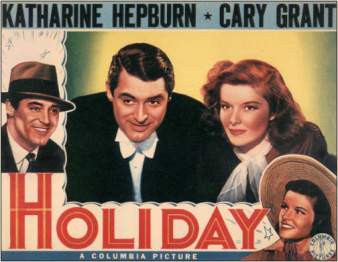
Tuesday's Overlooked (or Forgotten) Movies: HOLIDAY (1938) starring Cary Grant and Katherine Hepburn.


Tuesday means Overlooked Films Day, a weekly meme hosted by Todd Mason at his blog, SWEET FREEDOM. Don't forget to check in and see what other overlooked films other bloggers are posting about today.

I am here to confess that, strangely, I've never seen HOLIDAY, although I was sure I had. Possibly I saw bits of it over the years, just never all the way through. I'm so glad I finally decided it was time to change that. I most especially loved Katherine Hepburn in this. She is superb. Grant's good too, as always, but it's Hepburn who steals the show. She is radiant as the sister (the black sheep in the family) supposed to be 'less than' her steely and 'more' beautiful ice blond sister.


But as Lew Ayres (playing her sad, weak-willed brother, Ned) tells her late in the film: "You're twice as beautiful, ten times the person she is." Or words to that effect, I'm paraphrasing. Of course, he's perfectly right. But these are words that Hepburn's character, Linda Seton, has never heard from anyone in her family. It is a wonderful moment.


By the way, the story takes place over the Christmas to New Year's Holiday so it's a perfect film for this time of year, give or take a few weeks from now.

HOLIDAY, as directed by George Cukor, is  not really a comedy though it has its moments. For me, it's more of a romantic drama with touches of comedy and wit. But at its heart, it is anything but light-hearted.  Cary Grant's character (in a manic sort of way) is trying to dodge the bullet. But that particular bullet is never really defined. It's not enough to say that possessions and money are the root of all evil. Besides, Johnny seems a bit too old not to have decided what he wants to do in life. I had a suspicion while watching his antics that a prescription for Zoloft would have done Johnny a world of good.

I also am leery of men who are still called Johnny though they've obviously at an age when John would be more appropriate. Jeez, I'm sounding like the stiff-necked, icy blond dame when I would much rather be Katherine Hepburn. I mean, who wouldn't?

Here's the plot:

Johnny Case (Cary Grant) is a man newly in love. He thinks he's found the perfect woman in Julia Seton (Doris Nolan), an heiress to millions (though he's unaware of it at the time). They both appear to be impulsive love-at-first-sight types. Ah, but appearances can be so deceiving.


Almost from the first we can see that Julia is all wrong for Johnny, just as he is wrong for her. (He wears a bow tie, for goodness' sake!) But he is besotted. He wants a quick marriage so he and Julia can go off on their own and make their happy life.

Of course, WE know that's not going to happen. Julia is too much daddy's little girl, too much under his restrictive thumb, too much like him - a Wall Street mogul who worships money. As the story develops it's easy enough to see that what Julia wants is someone to manipulate and make into the image of her father. She doesn't realize that Johnny is NOTHING like her father, though he is capable of making a great deal of money. (That part isn't made very clear except that it has something to do with stocks and bonds.)

BUT - Johnny has a plan: once he reaches a certain amount in the bank, he wants to quit work and go on holiday to find himself. Yeah, it's a bit naive and kind of infantile, really, especially in the late 1930's with war on the horizon. But, hey, it's Cary Grant, we'll allow him anything. But still, there's an uneasiness.

When Johnny calls on Julia at home for the first time, he assumes she's a secretary working at this huge mansion in Manhattan - so wrongly has he misread her. But he is soon disabused of this notion. Julia is Miss Ritzy Ritz - she'd simply forgotten to tell him.


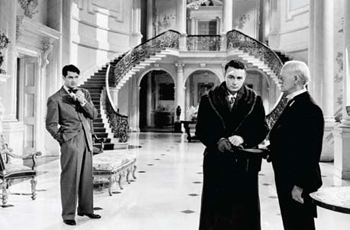
The interior of the Seton house looks like an opulent marble mausoleum. It has all the warmth of the Roman Coliseum. Nobody really 'lives' in this house. It's all for show. The only breath of life in that marble cavern is Katherine Hepburn - though she thinks Johnny's the fresh breath of air - once she meets him.

Linda is a poor little rich girl who can't find her place in life. She's older than her sister and still struggling to break free from a domineering father. She's apparently gone about it the wrong way for years. Julia is the apple of her daddy's eye, Linda just the annoying cinder.


But Linda loves her sister and wants her to be happy. She can probably sense that Johnny is the wrong man for Julia, but doesn't really understand it completely until late in the film.


But she almost immediately realizes that Johnny is the happy-go-lucky sort with his own very definite view of the world. He isn't ready to buckle under the strictures of wealth and position.


When, out of her devotion to Julia, Linda decides she wants to give the happy couple a small, private party for their engagement, she begs Linda not to allow the party to be taken over by all the usual hoopla. She wants to plan and carry out the whole thing herself, up in the play room where it's comfy and cozy. "Let me do this for you," pleads Linda.


The playroom, with its fireplace and comfortable chintz sofas looks like something transported from a New England cottage - yet its on the fourth floor of the mansion. The room served as a 'retreat' for Julia's late mother - someone who, like Linda, needed as escape from the cold marble downstairs. It's the room where Linda feels most at home.

But Julia and her father ignore Linda's wishes (as usual) and we get a quick cut from Julia and Linda hugging on the stairs, to a gilded invitation inviting all of  New York society (it seems) to the Seton engagement soiree. It also happens to be New Year's Eve.


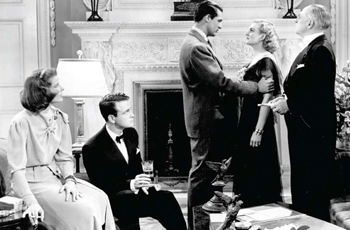
Julia refuses to come downstairs and of course, much is made of her absence by the society snoots cavorting among the marble. But soon, the playroom is filled with laughter when Johnny's friends, Professor Potter and his wife - the wonderful Edward Everett Horton and Jean Dixon (who appear to have the kind of easy-going, affectionate marriage all of us dream of) show up and find their way upstairs. Then Ned joins them, drunk as usual.


Johnny proceeds to have a grand time with Linda. They do some sort of acrobatic routine and roll around on the floor laughing. Much to her father's and Julia's dismay when they come upstairs looking for Johnny. This dame has forgotten what it is to have fun. Fun that doesn't have anything to with money, that is.


I think, really, that all this silly physical stuff (Johnny can do a backward flip and a somersault at the drop of a hat and does so when he feels pressured) is meant by the director as as easy way to show up the differences between the sisters - Linda joins in the fun - Julia is indulgent, though increasingly annoyed. It's obvious she wonders when Johnny will grow up. It's also a very visual way to show the differences between up tight society  types and the easy going Johnny and his friends who feel free to indulge their eccentricities.


Julia has no idea what Johnny is. He doesn't care much about making money, he wants to be happy, he wants to enjoy life. Money is just a means to that end. But, Julia says, in a very chilling moment: "There's nothing like the thrill of making money."

My feeling is that Julia has taken the place of the son in her father's eyes. Ned is a weakling who shows up at work at the family firm only because his father insists. He just isn't strong enough to break free. He has talent as a musician, which was (as is made obvious) his true calling, but, Linda explains, "Father soon put a stop to that."

If Seton women worked, Julia would be down at the firm making money for her daddy.


On New Year's Eve, before Johnny gives voice to his doubts, Linda and he dance up in the playroom - just the two of them - and you realize that Linda is in love with him and what's worse, she hates herself for it. When he makes a motion to deepen a friendly kiss, she backs off and sends him downstairs to Julia.


That night Johnny leaves the mansion and disappears for a few days - "...to think things over."

Later there is a quietly powerful scene as Linda finds out how her sister really feels about her. Julia has resented Linda - gone around her ideas or blocked them, whichever was easiest for her and father.

Hepburn is superb as she reels from the news that the love she'd envisioned between herself and her sister simply doesn't exist. She backs into a corner as she'd been physically struck.

But Linda wants what's best for Johnny and if Julia is what he wants, then it's Julia he shall have.

Johnny comes back from a few days away, full of purpose. He's decided to give Julia an ultimatum. He's sailing for Europe with his friends the Potters and wants Julia to run off with him. She says no and Johnny shows up at the mansion to speak to her and her father.

SPOILERS coming up...


When Johnny (capitulating) says, that as a compromise he's decided to work for Seton's firm for two years and then he'll re-evaluate - something Julia had proposed - all seems settled. Then, because he can't help himself, Seton, senior, offers the couple their own townhouse and a staff of servants as a wedding present. Then he maps out their entire European honeymoon down to their sailing schedule. Johnny stands numbly by while Julia is delighted.

But he's had enough. Johnny can see that compromise is impossible. He breaks it off with Julia (FINALLY!) and walks out..


Linda immediately confronts Julia. She (FINALLY!) realizes that Julia doesn't love Johnny - she is incapable of the sort of unencumbered love Johnny was offering. Linda says, "Why, you never loved him. Look at you, you're relieved it's over."  Julia responds, "Of course I'm relieved."


It's another chilling moment really and we breathe a sigh of our own relief at Johnny's fortuitous escape.

Linda decides to go after Johnny on board ship. She tries to get Ned to go with her, sail with them. But Ned simply hasn't the courage.

So Linda rushes down to the boat and she and Johnny sail off together into their happy future.

Yup, Johnny's head over heels.

I think, possibly, this movie isn't as popular as many other Cary Grant films for a very good reason. The film isn't sure what it wants to be. It's not a comedy, it's not totally a drama. It also has some very unpleasant characters. Henry Daniells for one. Hisss....!


Henry Daniell...hisss...!

The director, or maybe it's the script, doesn't quite make Johnny's mania for somersaults and yearning to discover what he was meant to do in life, all that appealing or even, charming.

It's not enough to be against something, you have to have a good reason for it. The Setons, father, daughter and son, are the status quo, that is evident. Julia and her father would have smothered Johnny. No one can blame him for wanting out. But it's not enough to be anti-stuffed shirt or anti-society, or anti-whatever, you have to be FOR something else. What exactly is Johnny for?

In my view, that's the weakness in the film. What exactly is Johnny for?

But, if you don't think about it too much, it's possible to enjoy this film for the wonderful performances, most especially that of Katherine Hepburn, Lew Ayres, Edward Everett Horton and Jean Dixon. Cary Grant is good with a very difficult part.