Showing posts with label Basil Rathbone. Show all posts

Tuesday, July 8, 2014

Tuesday Forgotten (or Overlooked) Film: SIN TAKES A HOLIDAY (1930) starring Constance Bennett, Kennth MacKenna and Basil Rathbone


It's difficult to take a movie seriously in which the two male leads are named Gaylord and Reggie. But, it was 1930 and these were thought to be the kinds of 'sophisticated' names which appealed to women in the audience I suppose. Hard to believe, I know.

SIN TAKES A HOLIDAY (1930) is a film directed by Paul L. Stein, starring Constance Bennett, Kenneth MacKenna and the utterly suave as suave can be, Basil Rathbone, in his non-Sherlock days. This is a pre-code release so the actors are free to talk about 'affairs' and 'having lovers' and that sort of thing. Although the leading lady never actually takes the plunge, she just pretends to.

So even pre-code, the bride must be pure and true on her wedding night even if that wedding night doesn't come until the very end of the movie many months after a spur of the moment marriage of convenience and a trip (the bride sails alone) to Paris and other assorted whatnot.

But let's back up a bit:

Constance Bennett - 'plain jane' secretary. I'm surprised she didn't have glasses.

The impromptu marriage was set up by Gaylord Stanton (Kenneth MacKenna), a New York divorce lawyer with a steady stream of female clients and friends who think of marriage as a game of revolving beds. Stanton is unmarried and having a fine time cynically squiring divorcees and about-to-be-divorcees around town. But lately he appears caught in a snare set up by a female dragon-lady hell-bent on marrying him just as soon as she's divorced from her fourth husband - naming Gaylord as correspondent, of course. Ah, the good old days of divorce by correspondent.

Constance Bennett and Kenneth MacKenna apres wedding. The bride doesn't look very thrilled.

At any rate, Gaylord, you see, doesn't want to marry the vampish man-eater, he just enjoys going to bed with her (implied airily of course). So he comes up with a devious plan: he asks his secretary Sylvia (who, unbeknownst to Gaylord, is secretly in love with him) to marry him - in name only. At first she resists, but then what the heck, it's better than 75 bucks a week and sharing a tiny apartment with two other girls. (One of the girls is played by a very young ZaSu Pitts.)

Now Sylvia is supposed to be 'plain' because she's a mere 'secretary' and not as glamorous as the women who flitter in and out of Stanton's life. But since she's played by Constance Bennett, how plain could she be? Answer: not plain at all. Especially once she's changed into expensive French frocks and begins living it up in Paris in the company of Reggie Durant (Basil Rathbone) whom she meets  on board the ship sailing to France.

Coincidentally, Reggie is a friend of Gaylord's and an equally cynical unmarried man about town who at first glance doesn't recognize Stanton's once plain-jane secretary - got it? (He has to ask the steward who the lady is.)

Basil Rathbone wooing Constance Bennett in Paris

Long story short, after several months in Paris, with everyone assuming she and Reggie are lovers sharing a gorgeous villa, Sylvia gets a surprising proposal - from Reggie. You guessed it, he's fallen in love with her and wants to marry her - for real. But first of course she must divorce her hubby who is back in New York still carrying on with the same femme for whom the marriage to Sylvia was contrived in the first place.

In the end, Sylvia and the patient Reggie return to the states so she can make her final decision. Gaylord, now jealous of Reggie, decides he's in love with Sylvia after all and somehow or other (not very convincingly to my eyes) convinces her to take a chance and stay married to him.


Reggie gets to act very sophisticated and has the last say. To my mind Basil has rarely looked so attractive. Sigh.

Personally, I would have stayed with Basil...uh, Reggie.

This is the sort of not-very-daring, light-weight, light-hearted (despite the cynical talk) film Hollywood was known for back in the day. A romantic bit of entertaining fluff made palatable by the three leads in the cast.

I'm kind of surprised it wasn't re-made later, this would have been right up Carole Lombard's alley.

Since it's Tuesday once again, don't forget to check in at Todd's blog, Sweet Freedom, to see what other films, television or whatnot, other bloggers are talking about today. We're a gregarious bunch.

Tuesday, October 22, 2013

Tuesday's Forgotten (or Overlooked) Film: THE SCARLET CLAW (1944) starring Basil Rathbone and Nigel Bruce


Of all the Sherlock Holmes films starring Basil Rathbone and Nigel Bruce, I think this is the one with the most creepy-scary moments - so I am hereby qualifying it as a tip-top Halloween offering.

THE SCARLET CLAW (1944) is a film directed by Roy William Neill (as were most of the Holmes/Watson movies released by Universal) and it is based, far as I know, on nothing Conan Doyle ever wrote (except for the characters), especially since the action takes place in Canada.

The story:

Holmes (Basil Rathbone) and Watson (Nigel Bruce) are, for no apparent reason that I can make heads or tails of, traveling in Canada to attend some sort of conference on the occult. Here's why it makes no sense: Holmes doesn't believe in spooks and spirits so why would he travel halfway around the world just to tell people who do, that he doesn't. See what I mean?


At any rate, here we are in Quebec at a posh hotel.

Just as Lord Penrose (the always good for a 'sneer' Paul Cavanaugh) is addressing the conference on his belief in things supernatural - coming up against Holmes' disbelief - he receives news that his wife has been found dead back home. Without much hint of emotion, he stiffly informs the conference members that Lady Penrose's body has been discovered by the village priest in the local church - her throat torn out. I mean, jeez.

Though mortally wounded, she had dragged herself to the church where she clutched at the bell pull in a last desperate attempt to bring help. (The manor house has no phone.) Unfortunately for her, the village people in the charmingly named village of La Mort Rouge are not inclined to go out in the night just to answer the odd bell ringing or two.

Eventually, the priest did set out for the church and discovered the body. Now I don't know about you, but I'd imagine a cut throat would be rather a bloody thing, but nary a hint of blood or wound are we shown even when the priest looks down at the unfortunate lady's body. I'm the last person in the world - heaven knows - to call for blood and guts, but really, the whole thing looks a little too antiseptic even to me.

Minor quibble, I know.

Lord Penrose declines Holmes' immediate offer of help in investigating his wife's death. He is convinced that Lady Penrose has been done in by some supernatural evil lurking in his aptly named home town.

But Holmes is surprised the next morning as he and Watson are preparing to return to London, to discover a letter asking for his help. The letter was written by none other than Lady Penrose herself just days before her tragic death.

As Holmes' says, "Imagine the irony, Watson. For the first time we have been retained by a corpse." (Or words to that effect.)


Despite Lord Penrose's standoff-ishness, Holmes and Watson travel to the gloomy (not to mention, foggy and shadowy) village of La Mort Rouge to investigate the murder of Lady Penrose.


To that end, the villagers they meet up with, including a rather garrulous post man and a surly publican with a sweetly innocent daughter, are a nervous and suspicious lot full of superstitious nonsense stemming from the fact that some sheep have recently been found nearby with their throats cut. Yeah, that would be enough to make me nervous and suspicious, I admit it.

La Mort Rouge is one of those grim places with a tedious history where everything happens at night and daylight is a rare commodity.


Of course Holmes, the most rational of men, is not convinced that the evil they're dealing with is of the supernatural variety, not even after coming across a ghostly figure prancing about the fields in the dark.


Unable to prevent a couple more murders, Holmes comes to realize that the victims (except one) all share a common - if improbable - link and that a brutal killer, adept at disguise, is actually lurking among the villagers, hiding in plain sight.

In this as in so many Holmes' movies made at Universal, we have a familiar cast of character actors who appear over and over again in various and sundry parts: Gerald Hamer, Paul Cavanaugh, Arthur Hohl, Miles Mander, David Clyde and the always wonderfully creepy Ian Wolfe among others.


It's almost like little theater where the same actors take different parts, sometimes as villains, sometimes as heroes, sometimes bit parts, sometimes more. It's always fun to distinguish among them and realize where and when you've seen them before. The only constants are Holmes and Watson and occasionally Inspector Lestrade of Scotland Yard (Dennis Hoey,who does not appear in this film).

If THE SCARLET CLAW is successful, believe me it is not because of the rather hackneyed, illogical script. (Which is basically a version of The Hound of the Baskervilles, minus the hound.) What works for me best are the creepy atmospherics (and you know how important I think those are).


As I mentioned, everything happens in the dark of night - all is doom and gloom, and the murder weapon, a five pronged garden weeder, is as nasty as it sounds.


So, throw logic out the window, fix a batch of popcorn and prepare to enjoy another moody Halloween flick which will get you in the mood but will not gross you out.

Preview the original trailer here.

Friday, October 26, 2012

Foreign Film Poster Friday

Son of Frankenstein in French. Now this I would pay money to see. 

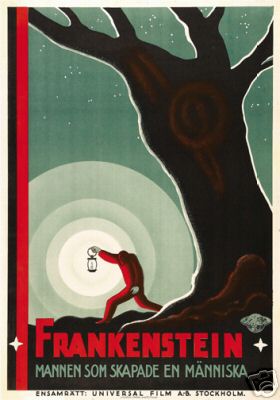
The poster below is, I believe for the first film in the series, just plain: Frankenstein. I'm posting it because of its wonderful design. Don't know the language. But I see Stockholm at the very bottom. So, Swedish? I thought the Swedes spoke French. Or am I mixing them up with the Swiss? Probably. Someone correct me.


Tuesday, July 10, 2012

Best Hitchcock Films Hitchcock NEVER Made Blogathon


The Best Hitchcock Films Hitchcock Never Made Blogathon. Now, that's a mouthful. Say it fast three times in a row. Ha! This blogathon was the clever idea of movie belle-dames, Dorian of TALES OF THE EASILY DISTRACTED and Becky of CLASSIC BECKY BRAIN FOOD, they are doing the hosting duties which began on the 7th and will run through Friday the13th.

Lots of movie mavens signed up (including yours truly) so be sure and check out the links and see what films are being talked about this week especially if you're a Hitchcock fan or even if you're not. What the heck, take a look, you'll probably find several films that will pique your interest.

We're supposed to talk about films which had some sort of Hitchcock flare and Hitchcock might, perhaps, have made if...

Figuring out a code messages, typical honeymoon activities for Joan and Fred.

ABOVE SUSPICION is a 1943 film directed by Richard Thorpe, starring Fred MacMurray and Joan Crawford. It is based on the book by famed suspense writer, Helen MacInnes. Though the book is superior, I have still enjoyed the film over the years primarily because of its terrific cast.

The film also stars Basil Rathbone as an evil Nazi and Conrad Veidt as quite the opposite which was a nice change of pace for him. Oh, spoilers, spoilers, you'd have figured it out really quickly anyway. Especially since Basil Rathbone's character, Sig von Aschenhausen comes equipped with a steely-eyed, dragon-mama - sort of like Claude Rains's mother in NOTORIOUS, only perhaps, not as awful.

(A man who shows up at a rousing Liszt concert with his mother can't help but be up to no good.)

It's 1939, the setting (at least for the first few minutes of the film) is Oxford. Frances (Joan Crawford) and Richard (Fred MacMurray) Myles are a newlywed couple off on their honeymoon. He's a professor at Oxford even though he's an American - probably a 'visiting' professorship. This is before war was delcared so Germany was still not out of travel bounds.
But before their wedding night can get down to business, an old friend from the foreign office shows up and offers the disconcerted couple a chance to do a bit of spying in the south of Germany. It's nothing much really, just track down an agent who has gone silent, get a secret bomb formula (Hitchcock's maguffin) and a list of secret German agents who can still be trusted. Oh, is THAT all? Jeez.

The formula will help the Brits deal with a new magnetic bomb the Nazis have developed. Hardly the sort of thing you'd send amateurs into, but that's the story.

Richard and Frances are supposedly above suspicion because of their innocent countenance + their trip really is a honeymoon + who would suspect two rather bland Americans. Well, Fred MacMurray certainly is bland enough, but maybe not Joan Crawford. She can't help looking a bit too sophisticated for him and for the the film (her face really does grab the screen), but I guess I'm being picayune. Though I wish Fred would learn to wipe the smirk off his face. That's really my only objection to his playing a Nazi fighting hero. You know who would have been great in this part? Robert Donat.

Anyway, the couple is given a fixed set of passwords to use, since it appears that everyone in Germany is understandably on their guard, afraid to speak for fear of being over-heard by the Gestapo which has tentacles everywhere. Frances is instructed to wear a hat with a red rose as a sort of recognition signal and the song, 'My Love is Like A Red, Red Rose' plays part in the hijinks. Luckily for all, Frances knows how to play the piano and both she and Richard can sing in a pinch. I especially like Richard's rendition of 'Where is Sylvia?'


Fred MacMurray, Conrad Veidt and Joan Crawford. In the film, she's just stepped on Veidt's toe.

Once in Germany - Salzburg - Richard and Frances play the part of tourists (though it's not a part, they really are tourists, just tourists with an agenda) and make their contacts with members of the resistance using their appropriate code-words and signals. The only problem is that the Nazis are apparently on to them almost from the very beginning. (This is not explained.)

At a Liszt concert one evening, they meet up with old Sig von Aschenhausen (Basil Rathbone looking dashing in a tux) and his mom - both Sig and Richard had been Rhodes Scholars at Oxford. During the concert, the kommandant of a concentration camp (in the audience) is shot dead during a particularly loud explosion of cymbals and drums.

Sig manages to get Richard and Frances excused (since they're Americans and who could possibly suspect them?) from interrogation. Richard also asks for Sig to excuse his nervous friend, Thornley, a fellow Oxford...uh, fellow. Richard claims that Thornley (Bruce Lester) is a long time friend of his. In truth, they'd only just met that afternoon at the hotel and somehow Richard suspects that Thornley is responsible for the dead Nazi. HOW he suspects this is not made clear. (At least it's not shown in the version of the film I watched.)

That's the mom in the fur.

But almost immediately, Sig suspects his old 'friend' from Oxford as well as Thornley who can't stop sweating. One must assume that Sig is particularly sharp though he doesn't actually seem to be later in the film.

At any rate, the dragon-mom invites Frances, Richard and Thornley to dinner at her Schloss.  The three can hardly refuse after Sig has cleared the way for them to leave the concert hall. After dinner, Sig reconstructs the killing at the concert with appropriate music played by Frances (she can play Liszt), putting everyone on edge.


Poor stiff Thornley on the far left - sweating.

Later back at the hotel, after deciphering a couple of secret messages, Frances and Richard must then make a connection with a certain Doctor Mespelbrunn who will more than likely have the info they seek. (Remember the macguffin?) Once they have it, they'll be home free to leave Germany and continue on their honeymoon.

BUT, not so fast.

When they arrive at their destination, a hunting lodge, who should turn up but old Sig pretending he is the mysterious Doctor Mespelbrunn (a code name, I guess) and what's more, he knows that 'My Love Is Like A Red, Red Rose' is the secret musical password. (He comes into the room whistling it in a very jaunty way.)

But again, not so fast. He gives himself away to Richard and Frances by not revealing a particular habit of the real Dr. Mespelbrunn. (The couple had been told this in secret by another contact.)


I won't reveal much more except to say that Conrad Veidt (whom I adore as much as I do Basil Rathbone) turns up out of the blue just in time to save the day at one point. He'd met the couple early in the film and behaved suspiciously enough to fool us into believing he was something other than he appeared to be. What he was was a particularly good spy.

The one and only Conrad Veidt who, with his family, actually fled the real Nazis in the nick of time.

At one point in the film, Richard and Frances are called upon to pretend to be simple-minded country peasants in typical lederhosen type costumes - Joan gets to wear a babushka and looks very fetching.


Happy peasants in Nazi Germany.

Before long, Frances (disguised this time, as an old woman) is picked up on the street by Sig and his Nazis cohorts and taken to a secluded Schloss on a mountain for questioning. It's then up to the intrepid heroes, joined by Thornley - who also shows up out of the blue - to save Frances and get away with the bomb formula and the names. (Oh, they got the info from the real Professor Mespelbrunn - Reginald Owen - whom they found tied up in an upstairs room at the lodge.)

Production values on the film are not all that great, it's mostly back-lot MGM/faux Germany and lots of rear-projection, something Hitchcock also used in his early films. But I usually make allowances for that if the story and cast are good enough. And I admit that though the plot has holes in it big enough to drive a whole Panzer division through, it still has many exciting moments. The cast (except for MacMurray's smirk) is terrific and I am always up for a film in which Nazis are outwitted. Basil Rathbone at his fiendish best is always a treat. Plus I love Conrad Veidt and Reginald Owen too.

My favorite scene in the movie? The one in a nightclub where Conrad Veidt's character (Hassert Seidel) dances a lively tango with a plump middle-aged lady. They are both light on their feet and quite wonderful.

(This was Conrad Veidt's last film. He died suddenly of a heart attact in 1943 at the age of 50. But he is remembered today with a great deal of affection by many movie mavens such as myself.)

To my mind, the most Hitchcockian character in the film is Conrad Veidt's. It's all in the hints of hidden depths which Veidt creates with little more than facial expression and an angled fedora. In a way he is a caricature and in a way he most definitely  is not. The dance sequence I mentioned has lots of Hitchcockian humor in it, though there is not a hint of making fun of the overweight woman - don't know that Hitchcock would have put up with an overweight woman without making her a joke. But I could be wrong. I am not a Hitchcock scholar.

If Hitch had made this film, I hope he would have tightened the plot, made the camera-work a bit more interesting AND the humor a bit less juvenile. Example of ABOVE SUSPICION humor: The last line, once the happy couple is safely across the border in Italy: "C'mon, let's get some spaghetti." Not the sort of thing Hitchcock would have condoned. I don't think. This kind of flippancy only works if the actor saying it is playing against type, i.e. if Cary Grant said it, THEN it would work.

The killing at the crowded concert though, was right up Hitch's alley. Especially the cutting back and forth from the orchestra to the white gloved hand holding a gun hidden behind a program.

But except for two or three brief scenes, the one thing missing from ABOVE SUSPICION, the main thing I think Hitchcock would have brought to the table, is intensity. This film is more escapade than real suspense, but to tell you the truth, despite my quibbles, I love it anyway.

Currently, you can only either buy the DVD, watch the movie when it turns up occasionally on Turner or pay Amazon 3.99 and watch it as a rental on your computer.

(That's what I did.)


Wednesday, June 13, 2012

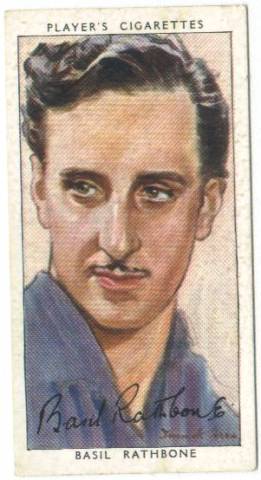
Happy Birthday, Basil Rathbone!


Basil Rathbone (1892 - 1967) One of my favorite actors of all time! Gosh, I love this man. Not only as Sherlock Holmes, but even as the scurrilous villain in ABOVE SUSPICION and the odious Sir Guy of Gisbourne in ADVENTURES OF ROBIN HOOD and the snarling, sneering French pirate in CAPTAIN BLOOD and so on and so on...The man was such a strong screen presence. As I said, I love him. Always will. He can do no wrong.

Happy Birthday, Basil, you lovely man.