Showing posts with label Dodsworth. Show all posts

Tuesday, May 7, 2013

Mary Astor Blogathon and Overlooked (or Forgotten) Film Tuesday: DODSWORTH (1936) starring Walter Huston, Ruth Chatterton and Mary Astor


My post today does double-duty. I'm taking part in the Mary Astor Blogathon hosted by Dorian at Tales of the Easily Distracted and Silver Screenings, running through May 3rd and May 10th, 2013 - as well as fulfilling my Tuesday's Overlooked (or Forgotten) Film commitment at Todd's Sweet Freedom blog. How's that for multi-tasking?


DODSWORTH (1936) is a film directed by William Wyler (Oscar nominated), adapted for the screen by Sidney Howard and starring Walter Huston (in an Oscar nominated role), Ruth Chatterton and Mary Astor, co-starring Paul Lukas and David Niven.

It is the engrossing story of the 'happy' marriage of Sam and Fran Dodsworth and maybe in an odd way, it's also a cautionary tale against retirement.


I loved the book by Sinclair Lewis (if you like, you can read my book review here), but I adore the movie so pardon me if I gush. The film is actually a pretty true interpretation of Lewis's novel, so whichever you do first, you won't be disappointed. This is that rare combo of film and book working fabulously alone or together.

The gorgeous Mary Astor as she looked in the 1930's.

Since this is a Mary Astor Blogathon post, I'll begin by saying that Mary Astor never looked better than she does in this movie. She is absolutely spectacular. From the first moment she shows up on camera wrapped in a dark fur, Astor puts the film's star, Ruth Chatterton, in the shade. In this instance, it's the wife who fancies herself an eternally young deb and 'the other woman' who represents a more classic elegance.
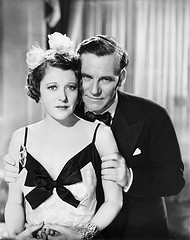
Stop encouraging her, Sam.


Astor is all calm, cool and collected sophistication. She plays Edith Cortright, a divorced ex-pat living by herself (with a servant or two and a wonderful and very large dog) in a small, sunny Italian seaside villa.

Sam Dodsworth (Walter Huston) and Mrs. Cortright (Mary Astor) chatting aboard ship.

Mrs. Cortright (as she's known in the film rather formally) first meets Sam Dodsworth (Walter Huston), retired automobile titan, on the Queen Mary. Dodsworth is traveling with his wife on a sort of second honeymoon - at her insistence - sailing to Europe in search of relaxation and something new and - in his wife's case - exciting.

Sam says goodbye to his kingdom.

In truth, Sam (a self-made man) is plenty satisfied with their life back in the good old comfortably familiar Midwest where he'd built an automobile company from scratch. While that 'scratching' was going on, his wife Fran had busied herself with the sort of typical small town duties which (unknown to Sam) bored her to death. She is the sort of woman who feels much put upon by a comfortable life - she wants Excitement. What's more, she feels entitled to that excitement - small town life can be oh-so-stifling, especially for a would-be woman of the world.


Fran sees Sam's retirement (he's sold the company to a large conglomerate for big bucks) as her opportunity to 'begin to live' the kind of life to which she would like to become accustomed. Desperate to hang on to her youth, she pretends to be thirty five again (though she has a married daughter), fooling no one but herself. She never seems to tire of reminding Sam how he robbed the cradle when he married her.

From the very beginning we see Fran's restlessness, her impatience with Sam's 'homey' values, his happy complacency. He adores her, but that's not enough for Fran, she considers Sam's devotion her due.

Ruth Chatterton is excellent playing a woman who craves a second chance at romance and excitement, as if life can be made to order. She fancies herself a sophisticate while wrongly viewing her husband as a 'rustic' bumpkin - a part he is not embarrassed to play. He is who he is and makes no pretense. The fact that he is simply charming in his Midwestern rusticity escapes Fran.


I am happy that they did not cast a Hollywood-handsome icon in the role of Sam Dodsworth. Huston is tall, lanky and raw-boned, completely believable as an unsophisticated Midwesterner willing to oblige his wife's silly attempts at rejuvenation. He delights in her 'girlishness'.

When he meets Mrs. Cortright (Mary Astor) on board ship, Sam is no more looking for a 'dalliance' than she is. She throws out no lures. Both become shipboard friends (Sam seems immune to her casual glamor) since his attention is focused on his wife and on sharing the sights with her. (Something she is quite willing not to do.)

Fran and dashing shipboard beau (David Niven) dancing the night away.

On board ship, Fran has already indulged in a flirtation with a young and rather callow David Niven who remarks, impertinently, that she is not as sophisticated as she would like to believe. See what a fuss she makes when he attempts to kiss her. He raises an eyebrow and puts Fran in her place. It's only a kiss, my dear - grow up.

Chagrined and humiliated, Fran decides to indulge a more dangerous infatuation with experienced roue Arnold Iselin (Paul Lukas) whom she meets while lunching one day in Paris with an acquaintance. (The acquaintance fosters the introduction.) Iselin is a smarmy predator who has no qualms about making Fran his latest conquest. A 'real' sophisticate would see through him in ten seconds, but poor Fran, alas, makes the mistake of thinking herself irresistible.


Through glances and body language, we are meant to understand that Fran is indulging in much more than mere flirtation with Iselin. Sam realizes the truth but believes Fran will return to him once she's outgrown her infatuation. In his eyes, she is still the same spoiled, charming girl he married twenty years before even if occasionally she tries his patience.

A triangle. Perhaps not so eternal.

But Fran (apres Iselin) is not ready to return home. She has more fish to fry. When she fancies herself in love ('real' love this time) with a younger man (she has apparently pulled the wool over his eyes about her age) she asks an astonished Sam for a divorce. She has marriage plans. Don't be difficult Sam, be happy for me.

"Could you let yourself enjoy life for awhile?"

On his own in Europe (still hoping Fran will change her mind), Sam re-connects with Mrs. Cortright when they run into each other in Italy at an American Express office. Impulsively she invites him to her home. Once Sam sees the comfortable way of life Mrs. Outright has established (she has a dog!), he is intrigued. She makes him believe that he too can rest, relax and perhaps let go of the past. She wisely makes a quiet, carefree haven for him.


Mrs. Cortright is the antithesis of Sam's wife. She embodies the kind of life that Fran, in all her sophisticated pretense, would never know how to deal with. She is a grown woman capable of grown-up love.

In the meantime, Fran plans her marriage to a certain Baron Von Obersdorf (think of it, a 'girl' of 35 from the Midwest, landing a Baron), a rather vapid young man dominated by his formidable mother (or maybe grandmother). The Baroness Von Obersdorf is played by the one and only Maria Ouspenskaya (in an Oscar nominated role). Remember her as the old gypsy woman in Lon Chaney Jr.'s THE WOLF MAN? She was a remarkable screen presence.


Once the Baroness meets Fran, the knowing old lady puts the kibosh on the nuptials. My dear, it would never do. The Baron must have children.

Thinking herself heartbroken, Fran decides to head home. In truth I don't think she's learned anything at all. She imperiously recalls Sam from his seaside tryst and he, like a lamb to the slaughter, says goodbye to Mrs. Cortright and prepares to follow his unhappy wife home.


Mary Astor's natural 'coolness' works well for her here, because it is obviously masking hidden depths. She is 'settled' in her life alone, perhaps wary of men, but Sam has somehow won her over. He can be himself with her, not having to mind his ways or be afraid he might embarrass her. He is delightful. You can see why she would fall for this lanky guy whose manners border on the gauche. But she knows that Sam hasn't completely broken free from the hold his ex-wife exerts over him.

The end I leave to your imagination in case you haven't seen the film yet.


And if you haven't, what the heck are you waiting for? I urge you to see DODSWORTH, it is simply, memorably wonderful.

Unfortunately Netflix doesn't have the film in any form yet. You have to go on the 'save' queue. And it's only available on youtube in parts. Check with your library or else you may have to buy the DVD. It's well worth the money.

Thursday, January 20, 2011

A Favorite Read: DODSWORTH by Sinclair Lewis (1885 - 1951)

Until DODSWORTH I hadn't read a Sinclair Lewis book since high school. So, I've read a total of two books by Lewis in my lifetime. Loved one, disliked the other. Yes, I am going to read more Lewis at some point. In high school we read his Pulitzer Prize winning novel, ARROWSMITH, and I wasn't so taken with it probably because I was too young to get what Lewis was doing (and who cared about a Midwestern doctor anyway). I'd originally thought the book was about cowboys and Indians and boy was I victim of disappointment.

I'd seen the film version of DODSWORTH with Walter Huston, Ruth Chatterton and Mary Astor (as well as David Niven in a very small early role) and loved it. It remains one of my favorite films. Mary Astor is actually sympathetic and likable in her role as 'the other woman'. The screenwriters did a great job adapting the book to film.

Anyway, once I'd seen the movie I decided to read the book but kept putting it off until a couple of years ago when finally I picked up a paperback and began reading. Between you and me I thought I'd find the book boring or hard to get into. But the truth is, I had no problem. 

I know that Sinclair Lewis isn't much appreciated today but that doesn't apply to me. The man won two Pulitzer Prizes and the Nobel Prize for Literature in his lifetime, so how bad could he be? Times change. Fashions in reading change. I have a suspicion that the Lewis ennui is due to the fact that the world he wrote about has mostly disappeared. And let's face it, he was not the most razzle-dazzle of writers. Yet, I am more inclined to read Lewis than, say, one of Hemingway's manly little tales.

Back to the book:

Sam Dodsworth is a victim of his own early retirement. He's a millionaire, an automobile magnate, who, at 50 years of age finds himself willing to grow old gracefully, happy with who he is and what he's become. His wife Fran, however, is fighting age tooth and nail. She is a difficult character who really, borders on the satirical. She is much younger than Sam (she stresses the much whenever and wherever she goes) and now that Sam is retired, she want to LIVE life to the fullest, she want to travel and see the world. In a way, you can't blame her. But it's her motivation that's suspect. The woman is so childishly self-centered that you wonder almost immediately what Sam ever saw in her, why he married her. She totally disregards Sam's cheerful acceptance of a life he likes; his dignity and elegance of spirit escape her understanding. (In the film, Walter Huston plays this beautifully.) In fact, she goes out of her way to belittle Sam's quiet good nature in private and in company.

Their two children grown, their daughter Emily married, Sam and Fran finally sail to Europe, despite Sam's misgivings. Yes, he is a bit of a stick-in-the mud, but he is willing to acquiesce to Fran's desires, to make her happy. Despite her obvious faults, he loves her.

As you read further, you begin to realize how desperate Fran is and you slowly realize that Sam feels sorry for her. Aboard ship he indulges her need to be the center of every male attention because he understands she is terrified of growing old. He looks the other way when Fran encourages the attentions of the unattached younger males aboard the ship. He's convinced himself that these are harmless shipboard flirtations. When Fran appears to go too far with one of the young men, Sam reins her in, despite her denials and protestations.

When reading about this marriage, I found it most interesting that I was forever in Sam's camp. I understood Fran's terror at the passing years, but not her complete selfishness and self-absorption. It's obvious that Sam's devotion merely bores her.

Once they arrive in London, Sam tags along after Fran as she spins from one flirtation to another. In Europe she pretends a sophistication she does not possess embarrassing herself as well as Sam as she tries to run away from her middle-class upbringing, her Americanism. In this part of the novel author Lewis makes much of the many differences between the American way of doing things versus the European: two differing outlooks easily misunderstood.

Later, when they arrive in Paris, Sam and Fran grab a cab to their hotel.

He had been accustomed to 'sizing up' American towns;he could look from a Pullman window at Kalamazoo or Titus Center and guess the population within ten per cent. He could, and with frequency he did; he was fascinated by figures of any sort, and for twenty years he had been trying to persuade Fran that there was nothing essentially ignoble in remembering populations and areas and grade-percentages and the average life of tires. He had been able to guess not too badly at the size of British towns; he had not been too greatly bewildered by anything in England, once he was over the shock of seeing postmen in funny hats, and taxicabs with no apparent speed above neutral. But in Paris, as they bumped and slid and darted from the Gare du Nord to their hotel, he could not be certain just what it was that he was seeing.

Fran was articulate enough about it. She half stood up in the taxi, crying, "Oh look, Sam, look! Isn't it adorable! Isn't it too exciting! Oh, the darling funny little zincs! And the Cointreau ads, instead of chewing gum! These bald-faced high white houses! Everybody so noisy, and yet so gay! Oh, I adore it!"

But for Sam it was a motion picture produced by an insane asylum; it was an earthquake with a volcano erupting and a telephone bell ringing just after he'd gone to sleep; it was lightning flashes and steam whistles and newspaper extras and war.

Yes, you grow impatient with Sam's reluctance to enjoy himself, but he is who he is. He is slow to change. Fran's constant impatience with him, her zeal for their surroundings, her forced gaiety is fatiguing - both for Sam and the reader.

When Fran gives in to the attentions of another young man, a minor aristocrat, it is the last straw. A heartbroken Sam has no choice but to give her her an ultimatum. She either comes back home with him or he's leaving without her.

Fran stays in Europe, convinced she's found true love. Sam heads home, disconsolate and alone.

But Fran still hasn't quite released him. She sends letters detailing her new life in Europe. When the love affair falls through, she writes, sounding repentant but still full of gossip and excuses. This is a woman sure of her power, still needing attention, still pretending she's done nothing wrong, apparently not having learned a thing from her mistakes.

Sam decides to head back to Europe and, despite her behavior, to try and bring Fran back with him.

When he had finished her letter from Deauville, he had suddenly grasped something which he had never completely formulated in their twenty-three years of marriage: that she was not in the least a mature and responsible woman, mother and wife and administrator, but simply a clever child, with a child's confused self-dramatizations. The discovery dismayed him. Then it had made him the more tender. His other children, Brent and Emily, did not need him, his child Fran did need him! He thought of her, awaiting him there in Paris as he had thought of her in the uncomplicated days of their courtship.

In Paris, Fran again refuses to give up her friends and her frivolous existence. Clearly Sam's devotion and love are not enough of a lure for her. Finally, they separate once again.

In Italy, Sam hangs around, at loose ends, lonesome for his wife, willing to wait around for her if he must even though they've signed divorce papers. Then at the American Express office in Venice, he meets up with Edith Cortright an attractive woman (played in the film by Mary Astor) who had sailed across from New York on their first trip to Europe and whom he remembers vaguely. They begin talking and, as a fellow American, she invites him to dinner at her small villa.

It is through this friendship that Sam begins to see the possibility of a life without Fran. As they grow closer, he sees that Edith possesses the unique ability to enjoy life as it happens. She is more European than American and her point of view delights Sam. He throws caution to the winds and moves into the villa with her, finally the story seems headed for a happy ending.

But Sam's wife isn't through with him. She poo-poos his involvement with Edith and sends Sam a letter begging his forgiveness and letting him know she's finally going home and will he come with her.

This is a totally engrossing tale of a disintegrating marriage, proving once again that unhappy people are unhappy each in their own fashion. I think Sinclair Lewis also means to say that we each carry within ourselves the capacity for a fairly specific sort of happiness. The last line in the book is both touching and exasperating but very human.