Thursday, January 26, 2012

The Fab Four

Christopher Lee, Vincent Price, John Carradine and the rather gloomy Peter Cushing.

In my google travels, I happened upon this amazing photo of four of the best villains ever to grace the silver screen. (Of course they also made for wonderful good guys too, when they played against type.) In their later years, they were still capable of delivering a chill or two.

Christoper Lee is the only one still with us, but the other three live on in film and vivid memory.

I love this pix. So apropos of nothing, here it is for your movie maven enjoyment.

Wednesday, January 25, 2012

10 More Characters Actors We've Always Loved


****************************


Henry Daniell (1894 - 1963) could do no wrong as far as I'm concerned. He and Zucco (see next) were two of my very favorite bad guys par excellence. There was nothing on Daniell's face but smarmy, supercilious insolence. That glorious face of his was incapable of 'not sneering.' He really did look wonderfully like a codfish. I adore him. Even if whenever I write about him, I have to hisssss.....!

He was cool, calm and oh-so-sinister as Professor Moriarity to Basil Rathbone's Sherlock Holmes.

To learn more about Henry Daniell - hssssss....! - please use this link.


George Zucco (1886 - 1960) is every one's idea of malevolence in the grand tradition. The only thing he lacked was the twirling mustache. I loved the guy. When  Zucco came on screen you immediately said, 'uh oh' and waited for the worst to happen.

He was perfection too as Professor Moriarity to Basil Rathbone's Sherlock Holmes.

In fact, the few times Zucco played a benign character, I still kept waiting for the other shoe to drop.

To learn more about George Zucco, please use this link.


Paul Cavanaugh (1888 - 1964) Since we're talking basic smarmy. Here's the guy who epitomized the word. Cavanaugh is the universal face of weak charactered second leads. He could be charming in a perfectly surface way - just enough unctuousness to imply his true nature was anything but.

In TARZAN FINDS A MATE, he not only appears naked but actually makes a play for Jane. No wonder Tarzan didn't look upon him with a happy face.

To learn more about Paul Cavanaugh, please use this link.


Walter Connolly (1887 - 1940) has always been my idea of the pompous, high-blood-pressured, society father of the bride. He could also play a great newspaper editor-in-chief and any corporate head of any conglomerate you might imagine.

I guess his role as Claudette Colbert's millionaire papa in IT HAPPENED ONE NIGHT implanted itself in my subconscious. He was wonderful.

To learn more about Walter Connolly, please use this link.


Elsa Lanchester (1902 - 1986) is most famous for her screech and her hairdo in THE BRIDE OF FRANKENSTEIN though she could also be wonderfully gentle and self-effacing in her screen roles.


She was married to famed British actor, Charles Laughton (1899 - 1962) and occasionally worked with him, as in WITNESS FOR THE PROSECUTION. Not a woman of conventional good looks, she could appear quite glamorous in one role, then show up as a plain-jane housefrau in the next.

To learn more about Elsa Lanchester, please use this link.


Barton MacLane (1902 - 1969) was the gruff bad guy in almost every western I saw as a kid. His gravel voice and sinister, snarly look made him the perfect choice to play the menacing saloon owner or the leader of a gang of cattle rustlers or bank robbers. Any general purpose bunch of loutish cowboy varmints would probably have MacLane as its head. He could also, occasionally, play a cop.

To learn more about Barton MacLane, please use this link.


Woody Strode (1914 - 1994) was the essential, quietly looming, physical presence. He was implacable, stalwart and occasionally deadly.  He was not a man to be trifled with. That look of his made you immediately understand that he meant business.

My favorite of his many roles was always the honorable SERGEANT RUTLEDGE. He stole the movie from Jeffrey Hunter and the rest of John Ford's familiar cast.

To learn more about Woody Strode, please use this link.


Ward Bond (1903 - 1960) was an actor who, early on, worked mostly for John Ford in his epic westerns and often beside John Wayne. He played many sleazy bad guys, but could also play the good-hearted sidekick. He achieved a level of stardom in later years as the star of the TV series, WAGON TRAIN.


Another actor with a wonderfully gravelly speaking voice, he was the personification of the 'the big lug' in many of his roles.

To learn more about Ward Bond, please use this link.


Jeanette Nolan (1911 - 1998) was a hard working, versatile actress who began her long career playing a variety of parts, but mostly personified the doting grandma as she got older.

But she could also play nasty and underhanded despite her harmless appearance.

She was married to fellow character actor, John McIntire for 56 years, until his death.

To learn more about Jeanette Nolan, please use this link.


Lee Van Cleef (1925 - 1989) was the ultimate, steely-eyed, chiseled cheekbones, bad guy in tons of 50's and 60's westerns. He also achieved some level of stardom (unusual for a villainous character actor) in the occasional spaghetti western in the 1960's.

He had the slinky appearance, usually dressed in black, of the hard-living, sinister gun fighter who relished his role as arbiter of death.. I would have loved to have seen him playing against type sometime, but I don't think I ever did.

To learn more about Lee Van Cleef, please use this link.


If you don't see your favorites, then please check my previous two posts before you begin lamenting. I might have included them there. But fear not, if I didn't, they might be coming up in a future post.

This is my third entry in a series about My Favorite Character Actors, that I've begun to do monthly.

To read the previous two posts, please use this link and secondly, this link.

Tuesday, January 24, 2012

Tuesday's Overlooked (or Forgotten) Films: I WANNA HOLD YOUR HAND (1978) Starring Wendie Jo Sperber, Nancy Allen and Theresa Saldana.


Tuesday is Overlooked (or Forgotten) Film Day, a weekly meme hosted by Todd Mason over at his blog, SWEET FREEDOM. As usual, don't forget to take a look at the mighty list of Overlooked (or Forgotten) Films, other movie mavens are talking about today.

**************

It's 1964 and the Beatles have arrived on our shores - Beatlemania reigns supreme.

I WANNA HOLD YOUR HAND is a funny, exuberant, glad-to-be-a-teenager movie. It defies logic and common sense, but that's exactly what we like about it.

Though not brilliant or classic, it is still worth a second look because of its great cast and because for those of us of a certain age, it brings the 60's back again - with a vengeance.

The film is first time directed by Robert Zemeckis (Stephen Spielberg in his first producer role). They capture the hysteria which grasped New York once upon a rock m' roll time. I was there, believe me, it was real.

In 1964, the Beatles made their official American debut on The Ed Sullivan Show which aired live every Sunday night, showcasing a variety of acts.

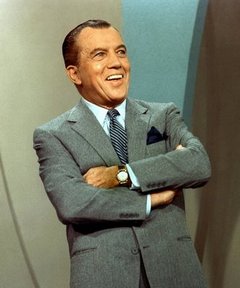
The popular show was hosted by Ed Sullivan, a stiff, awkward, kind of gangly guy with an odd way of speaking I always got the impression that he was mostly clueless about the 'talent' which appeared on his stage. But the formula worked for him and his show was watched by millions every Sunday night at 8.

The real Ed Sullivan.

This is such a sweetheart of a movie. An homage to The Beatles whom we never actually see except  on tape during part of a televised performance and from afar, as figures on a TV stage. It's all very well done. We also get a view of booted feet, pants cuffs, hands and backs here or there and hear a few words spoken in their inimitable Liverpool accents.

Of course it's mostly an homage to the adoring zeal of their fans who, for one moment in time, seemed to take over the city.


The film stars a cast of unknowns (the stand-out is Wendi Jo Sperber as Rosie Petrofsky) playing a bunch of kids who jump at the chance to get a glimpse of the Fab Four upon the group's first trip to New York. To that end they (and everyone else anywhere near the Plaza Hotel on that day) run amok in their eagerness to sneak past the cops and hotel guards.


That's really the basic plot. It's what happens when these kids get caught up in the frenzy of it all that makes for such an entertaining movie.


I worked in the area in the early 60's and of course, during lunch I walked over to the Plaza to see what I could see. Other than cops and droves of dreamy-eyed girls hanging around the hotel, nothing much. But there was an electricity in the air. I was still young enough to feel it - fun time in the city.

Wendy Jo as she appeared on the TV show, BUSOM BUDDIES which starred Tom Hanks.

The stand-out in the cast is Wendie Jo Sperber as an adorably plump teenager (with a bow in her hair) whose zeal for the Beatles is hilarious to watch. She's given to screaming and running for the nearest phone in a frenzied attempt to win tickets to see her idols. A local radio station is running a Beatles quiz leading right up to the 8 P.M. showtime. Wendie Jo as Rosie Petrofsky steals the movie, far as I'm concerned. She is delightful.

Nancy Allen is Pam Mitchell who, at first, is resistant to driving into the city in a borrowed limousine driven by a sweet looking kid with a learner's permit. She, at least, has a modicum of common sense. But that doesn't stop her going along with the insane plan - though she is supposed to get married the next day. "I hope Eddie doesn't find out..." is her mantra.

It takes the kids seven hours to drive to Manhattan from Maplewood, New Jersey - they take a detour to Philadelphia when Larry Dubois, the driver, a hapless Mark McLure (Jimmy Olsen in SUPERMAN The Movie, which of course, eclipsed this little gem in 1978) mis-reads a highway sign.

It is future journalist, Grace Corrigan's idea (she is played by Theresa Saldana) to drive up  to the hotel in a limo since the cops will not allow taxis full of kids near the Plaza entrance. Her plan is to take a few pictures of the Fab Four and sell them to Life Magazine.

Eventually the limo packed with kids gets past the harried cops and the girls are deposited at the Plaza, separated by circumstance and set loose to find their way to the 12th floor where the Beatles have a suite.

Pam Mitchell has the experience of a lifetime when, hiding in a food cart (covered by hotel linen), she is delivered to the empty suite (the Beatles have left for the studio but then return) and is forced to hide under a bed - just your typical teenage hijinks.


Earlier, alone in the room, Pam has a great time getting up close and personal with the Beatles' guitars, wineglasses, plates, handkerchiefs, not to mention a hair brush with hairs from one of the Fab Four's fabulous mops. She even gets to roll around on one of the beds AND touch the Beatles's clothing. Nancy Allen is very good in these scenes as an adoring fan who hadn't realized she was quite so adoring.


Another stand-out is Eddie Deezen, who is terrific as a geeky, screech-voiced, hopeless nerd (name-changed to Ringo Klaus in honor of his idol) whom Rosie latches onto. He's grabbed an empty room at the hotel and filled it with Beatle-related paraphernalia. Part of his horde is a mound of grass the Beatles stepped on in the park. It is his most treasured possession. This kid is scary.

As showtime approaches, the kids are all over the Plaza, the streets and the TV studio in hopes of outwitting hotel personnel, guards and cops. Rosie Petrofsky is particularly physical in her relentless quest for a glimpse of Paul, John, George or Ringo. At one point, she commandeers a Plaza elevator after first kicking out the operator who lands on an indignant hotel patron.

Ah, kids. They really know how to have fun.

In the end, through various and nefarious ways and means, the girls (and 'Ringo' Klaus) get to attend the Ed Sullivan Show where Rosie promptly faints dead away as the Beatles begin their song.


There is a heck of a funny ending involving the borrowed limo and finally, all's well that ends well for a bunch of kids from Maplewood, New Jersey.

Monday, January 23, 2012

Window Shopping


How wonderful is this Emma Bridgewater cup? Very wonderful, I'm thinking.

I've loved the British potter Emma Bridgewater's work, since I first beheld it years ago in the pages of Victoria Magazine. Could never afford any actual Bridgewater pieces but over the years I've bought an imitation or  two. I'm a sucker for kitchenware with writing on it - though Emma does many other designs as well and all are handmade in England.

I first saw this particular mug on Susan Branch's cozy blog where she actually has a shopping page (which I didn't know about until recently). If you'd like to see more Emma Bridgwater patterns and find out about Bridgewater Potters, here's your chance. Link.


Emma Bridgewater pottery can easily be found online at various sites.

Review: DEATH IN KASHMIR (1953) by M.M. Kaye


DEATH IN KASHMIR is the first in the wonderful M.M. Kaye's series of 'young woman in danger' books and one of my favorites. I can't remember ever reading this one so it came as a very pleasant surprise to me and not only that, it qualifies as an entry in the VINTAGE READING MYSTERY CHALLENGE hosted by Bev at her blog, MY READER'S BLOCK. (Notice how smoothly I slipped that in.)

Mary Margaret Kaye (1908 - 2004) lived a long and amazing life. She wrote historical novels, mysteries, children's books and non-fiction set in the various countries she and her husband (in the British government service) were posted to.

This year I plan on reading her three volume autobiography which I've been told is quite extraordinary.

DEATH IN KASHMIR is set in colonial India as the rule of the British Raj is coming to an end. Everything in that part of the world is in flux and an incredible plot hatched by nefarious forces behind the scenes is at the heart of the danger our heroine, Sarah Parrish, unexpectedly finds herself in.

Sarah is on a skiing vacation in Gulmarg, a resort in the snowy mountains above the romantically named Vale of Kashmir. It is 1947 and Sarah and a group of other skiers are attending what will probably be the last holiday jaunt of the Ski Club of India.

Beautiful mountain-locked Kashmir was one of India's many semi-independent princely states which, by treaty, were in effect 'protectorates' of the Government of India, ruled over by hereditary Maharajahs, Nawabs, Rajas or Ranas who were 'advised' by a British Resident. And though access to this particular state was not easy, since it was walled in on every side by high mountains, it has been regarded for centuries as an ideal hot-weather retreat from the burning plains - the great Moguls in their day, making the journey on elephants, horses or in palanquins.

The British had followed where the Moguls led, and made it one of their favourite playgrounds.

(Don't worry, there is a handy map enclosed to give you an idea of the depth and breadth of the area.)

While up in the mountains, one of the older women skiers in Sarah's club has been killed in an 'accident'. Shortly thereafter, Janet Rushton, a young friend of the dead woman, confides in Sarah (in a late night whispered meeting in Janet's room) that the death was no accident. She - Rushton - is in the same danger that swept up her friend. At first Sarah doesn't believe the fantastic tale, but the woman is obviously frightened and desperate. Sarah tries to make sense of her story.

The ski group is rather isolated by weather and terrain at the moment, and Janet Rushton needs someone to confide in, instinctively she trusts Sarah. As Janet says, there's no one else to tell and the truth of what she and her friend discovered cannot be allowed to die with her. And who knows, she may survive yet and all this impromptu hugger-mugger may be moot.

What truth? Well, turns out, Janet Rushton is a British spy. One half of an espionage duo headed by her dead colleague. They'd been on the trail of an outrageous rumor which had turned out to be quite true. But their contacts had so far been unable to reach them or relieve them of the info up in the mountains. Janet is desperate to pass on her information to her superiors, she knows she is  likely next on the murderer's list. Hard as it may be to believe, someone in that harmless seeming group of assorted skiers is an enemy agent.

Janet's fear and desperation conveys itself to Sarah. Especially since Sarah knows that someone had been trying to break into Janet's room (that's what had awakened her in the night) AND she spots the footprints in the snow.

Janet must find a way to pass on the important information she and her colleague have stumbled upon. She's recorded the details of the deadly plot and pleads with Sarah -  if worst  should come to worst - to travel down to Janet's houseboat in Peshawar where the message is hidden. But she doesn't tell Sarah what the information actually is (or where on the houseboat it's hidden), of course, since she, Janet, may still pull off the impossible and come out of this whole adventure alive and well.

Well, long story short, Janet is wrong. She is killed just when she thinks she's gone to meet her contact. Sarah doesn't reveal Janet's story to anyone and once back down from the mountains, she plans on traveling to Ceylon and continuing her holiday since really, who can she tell? What can she do? She has no idea who in the British community can be trusted. Besides, it isn't really her business.

Several of the same people who were skiing up in the mountains have now transferred their holiday to Peshawar, along with a new entry in the group, Charles Mallory, a tall, dark and enigmatic man of mystery, the type to cause palpitations in the breast of any young woman.

Mallory catches Sarah's eye, but she is not sure if he be enemy or friend.

The main attraction of DEATH IN KASHMIR is the incredibly romantic and exotic setting. M.M. Kaye's talent as a writer, her gift for making this lost colonial world of the Raj (a world she knew well, having been born in India) come alive is what kept me reading late into the night. She fashions a wonderful tale of espionage and murder in the sort of exotic locale where anything is possible. I couldn't turn the pages fast enough to learn what happens next to Sarah and Charles - oh yes, Sarah changes her mind and cancels the Ceylon part of her trip.

With death and suspicion all around her, can Sarah ferret out the truth and stay alive long enough to decide if Charles is the man for her?

I am a big fan of M.M. Kaye (if you haven't read THE FAR PAVILLIONS, drop everything and do so immediately) and I must say I loved DEATH IN KASHMIR. I can hardly believe it was the first of M.M. Kaye's wonderful stories.

To see the complete list of M.M. Kaye's books, please use this link.

Luckily, there are plenty of copies of Kaye's books still available.

Saturday, January 21, 2012

Saturday Salon: A Favorite Painting or Two.....or Three!

Repose

The Spanish Dancer

The Children of Asher Wertheimer

A Dinner Table At Night

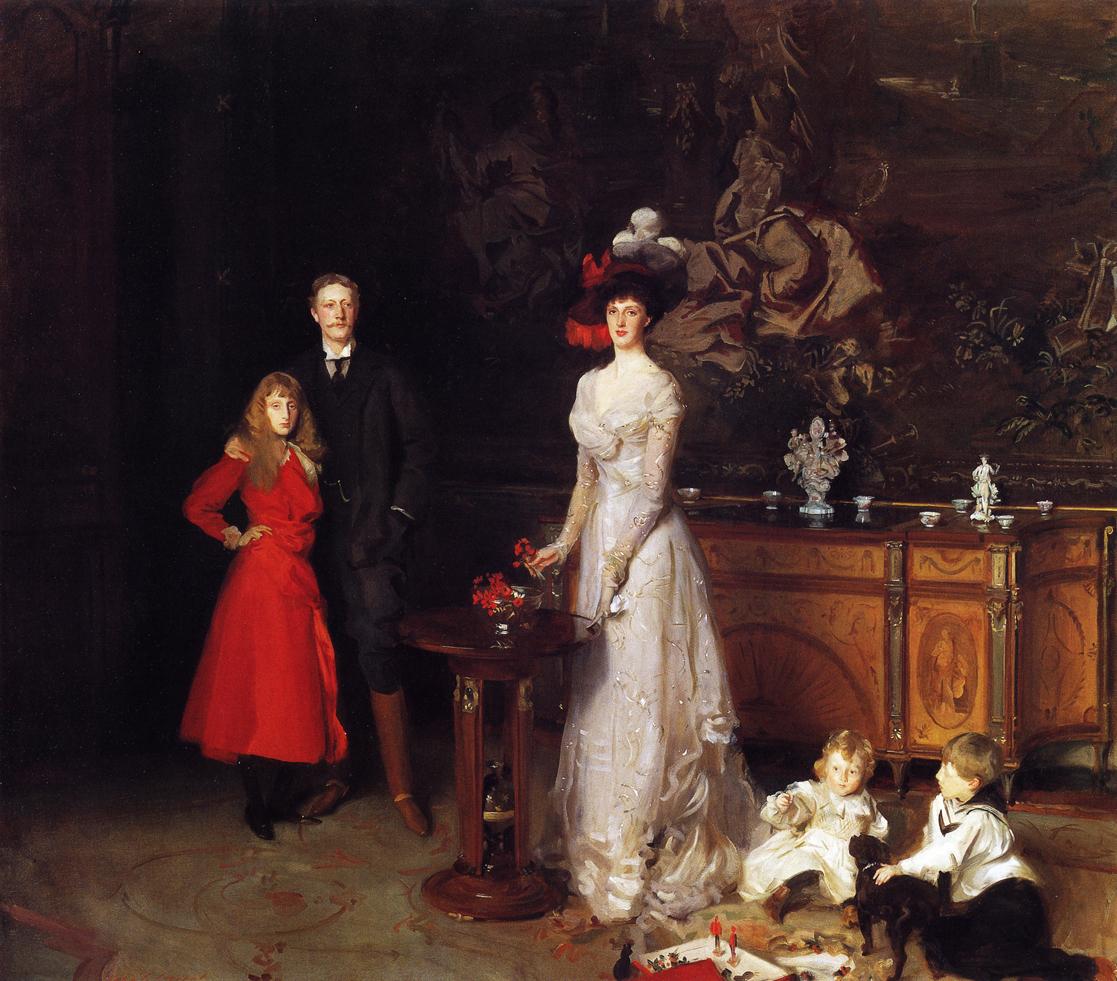
The Sitwell Family

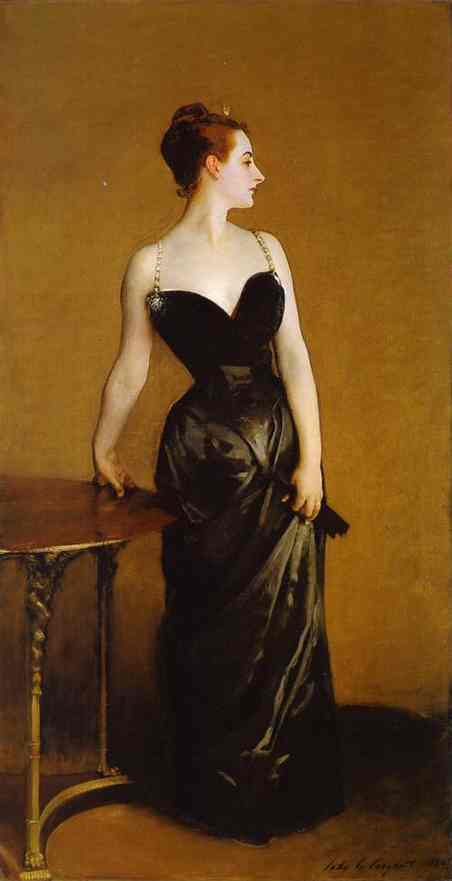
Madame X, the scandalous painting that drove Sargent's move to London from Paris. The over-sized portrait hung in Sargent's studio until he sold it to the Metropolitan Museum of Art a few years before his death.

Sargent in his studio with the infamous portrait.

Lady Agnew of Lohnaw

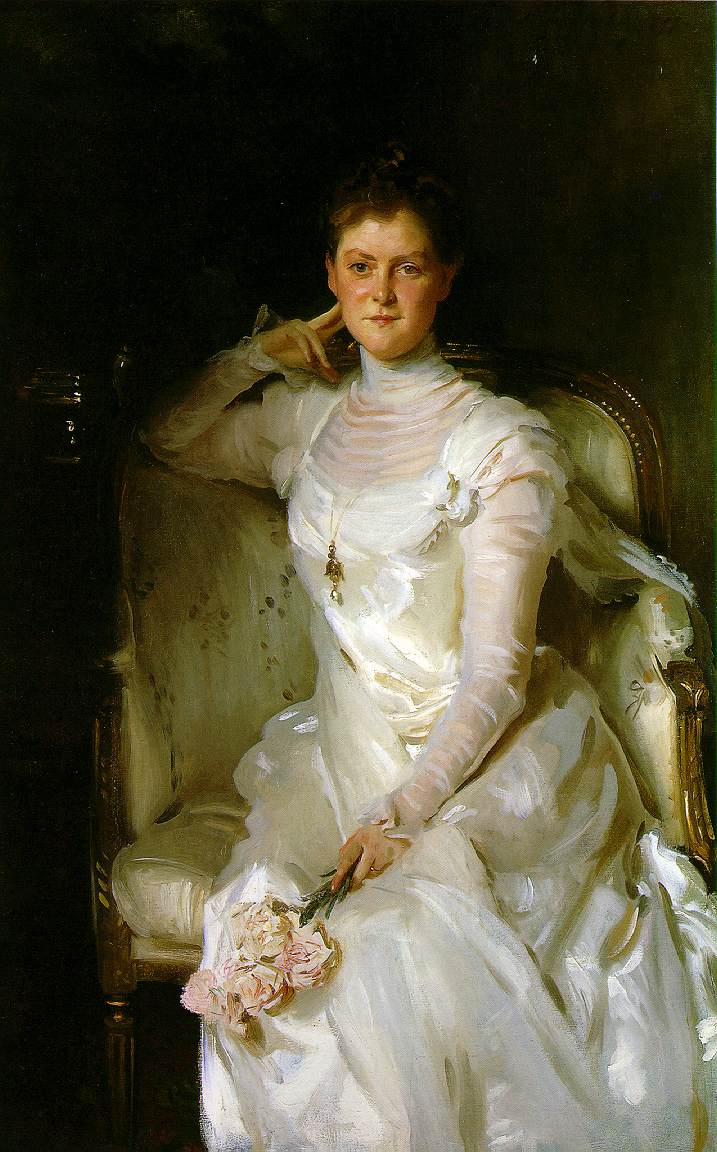
Mrs. Joshua Montgomery Sears


Portait of famed actress Ellen Terry in her Lady MacBeth costume. In her Jack the Ripper mystery, author Marantz Cohen sets a conversation between James and Sargent in the studio, at the time of Terry's sitting.

Portrait of Isabella Stewart Gardner, art patron.

Portrait of Louise Pomeroy.

An artist in his studio - might be a self-portrait.

Portrait of Robert Louis Stevenson.

Portrait of Coventry Patmore.

Smoke of Ambergris

Two Women Asleep in A Punt Under the Willows
 
 
Paul-Cesar Helleu Sketching With His Wife. That pinky!


American John Singer Sargent (1856 - 1925) , "...the greatest society portrait painter of his time." is one of my very favorite artists. His elegant, often larger than life portrait work remains unequaled, far as I'm concerned. One sees majesty in Sargent's paintings and even now, when majesty appears to have gone by the wayside, it is thrilling to find it in Sargent's work.


Sketch of his friend, author Henry James, by Sargent.

We've spoken about Sargent before, but my feeling is that you can never have too much of a good thing. Having recently read the wonderful book, WHAT ALICE KNEW A Most Curious Tale of Henry James and Jack the Ripper by Paula Marantz Cohen, a mystery in which John Singer Sargent plays a small role, I realized that another, more comprehensive, showing of Sargent's work was overdue.

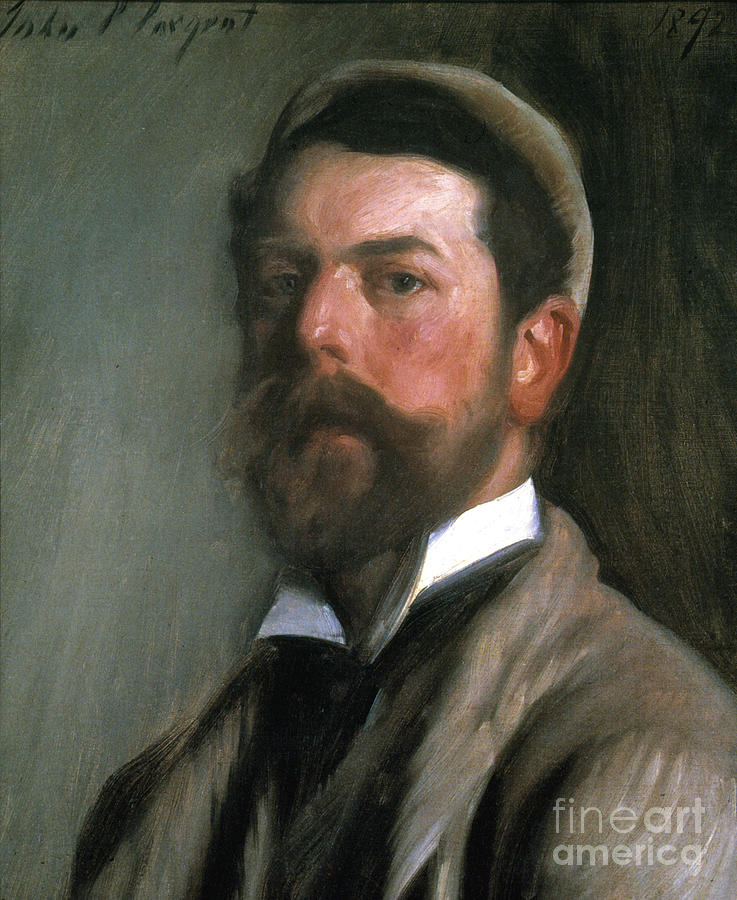
Self-portrait.

John Singer Sargent was an American born to ex-pat parents in Florence, Italy in 1856. His parents continued to live and travel abroad after Sargent's mother suffered a breakdown upon the death, in America, of  his sister.


Sargent's facility for drawing with a loaded brush - derived from Diego Velazquez - and avoiding the well established rule of sketching and under-painting, made him the object of criticism from some quarters, but on the whole he was a well established and admired painter who glamorized the age he lived in.. Later in life he tired of the portrait business and began concentrating on landscapes and watercolor. Though the high prices he asked for and received for his portrait work had made him a wealthy man.


A life long bachelor, Sargent's sexuality is debated even to this day.  He lived long enough to see his style of painting go out of fashion. How galling for an artist of his genius to realize he'd outlived his welcome. 

Today Sargent's prodigous talent is once again revered.

To read more about Sargent and his work, please use this link.


Friday, January 20, 2012

Foreign Film Poster Friday

ALL THROUGH THE NIGHT starring Bogart, Veidt and Lorre.

Friday's Forgotten Books: THE CASE OF THE CONSTANT SUICIDES (1941) by John Dickson Carr


Friday means Forgotten Books, a weekly meme hosted by Patti Abbott at her blog, PATTINASE.  Don't forget to check in to see what other Forgotten Books other bloggers are talking about today.

Since my book was written in 1941, it also qualifies as an entry in Bev's VINTAGE MYSTERY READING CHALLENGE.  As I said last week: two birds with one stone.

In the Highlands of Scotland, near Inveraray, sits the Castle of Shira, the ancestral home of the Campbells - or at least what's left of them. It is a gloomy picturesque pile - the perfect spot for a murder or two. THE CASE OF THE CONSTANT SUICIDES by John Dickson Carr, famed for his locked room expertise, provides a fiendishly fun antidote to the winter blues.

Invited to attend a family counsel after the death of Angus Campbell who tumbled from a tower window and was dashed on the ground below - a likely suicide - are two professors who begin their relationship by bickering over the historical details pertaining to the persona of the Duchess of Cleveland.

The professors are Kathryn Campbell who teaches at a woman's college and Alan Campbell who teaches at a male. Forced to share one compartment because of a name mix-up - the professors have just met for the first time - they are, unfortunately, overheard in the heat of their all night argument by a newspaper reporter in the next compartment. An incident which will have repercussions later in the story.

The London reporter is named Charles Swan. He has been summoned to Shira by Aunt Elspat, an ancient crone who rules the roost. She had been the mistress of the now dead Angus.

Once this troupe of travelers arrive at the castle, they are met by the elderly Colin Campbell, Angus's gregarious, whiskey loving brother as well as the family law agent (Scotlands's term for lawyers) who has come visiting. In the mix that same evening is Walter Chapman, an insurance agent who argues that his company won't pay the premium on a suicide.

So it behooves the family Campbell to prove that Angus was murdered. Angus had one enemy, Alec Forbes, his ex-partner in several preposterous get-rich-quick schemes. Forbes has immediately fallen under suspicion.

When the cranky Aunt Elspat joins the company downstairs she furiously denies having sent for Swan the reporter and has him thrown out. This will not be the first indignity suffered by the hapless, though intrepid Swan. Aunt Elspat is not to be trifled with.

Later, Doctor Gideon Fell joins the group, summoned by Duncan the law agent to try and decide if Angus's death was suicide or murder. The matter is further complicated by the near death of Colin Campbell who falls from the same window as Angus after insisting he will spend the night up in the turret no matter that a ghost with no face was seen at the open window.

Are you with me so far?

The scene of the crime is thus: Angus Campbell fell to his death from a window in his locked bedroom. A locked dog carrier minus a dog is found under his bed. The dog carrier has metal grating at one end to allow for any occupant's breathing. What did Angus OR the killer carry into the room inside a dog carrier?

The family Campbell is in dire straits, financially. If Angus was murdered, then the insurance - a tidy sum - will be enough to keep Colin and Elspat for the rest of their days. But if Angus died by suicide - the family gets zip.

When Colin almost meets the same end as his brother, it most definitely is not an attempted suicide. But who could possibly want to kill Colin?

Join the confusion as master of the locked room mystery, John Dickson Carr pulls the wool over our eyes yet again. Though this time I did catch on to one of the tricks before Doctor Fell. Ta-DA!

But for the rest of the crime solving duties I defer to the rotund lexicographer whose genius cannot be denied. He dashes about, pipe smoking, wild hair flopping and loud voice exclaiming and before you know it, all is made right again.

Even if now and again Fell manages to cheat the law, he catches the culprit, saves the day after yet another suicide(?) occurs and reveals the nasty convoluted truth, thus assuring that Colin and Elspat will spend the rest of their remaining days in comfort.

What more could you want?

Oh, there's also a satisfactory love story with a happy ending.